 NL·0121
Herbarium of the Nature Library
- Name
- Pinus longaeva
- Family
- Pinaceae
- Native to
- High mountains of eastern California, Nevada and Utah, mostly 2,600–3,500 m
- Habitat
- Subalpine woodland, Cold desert mountains
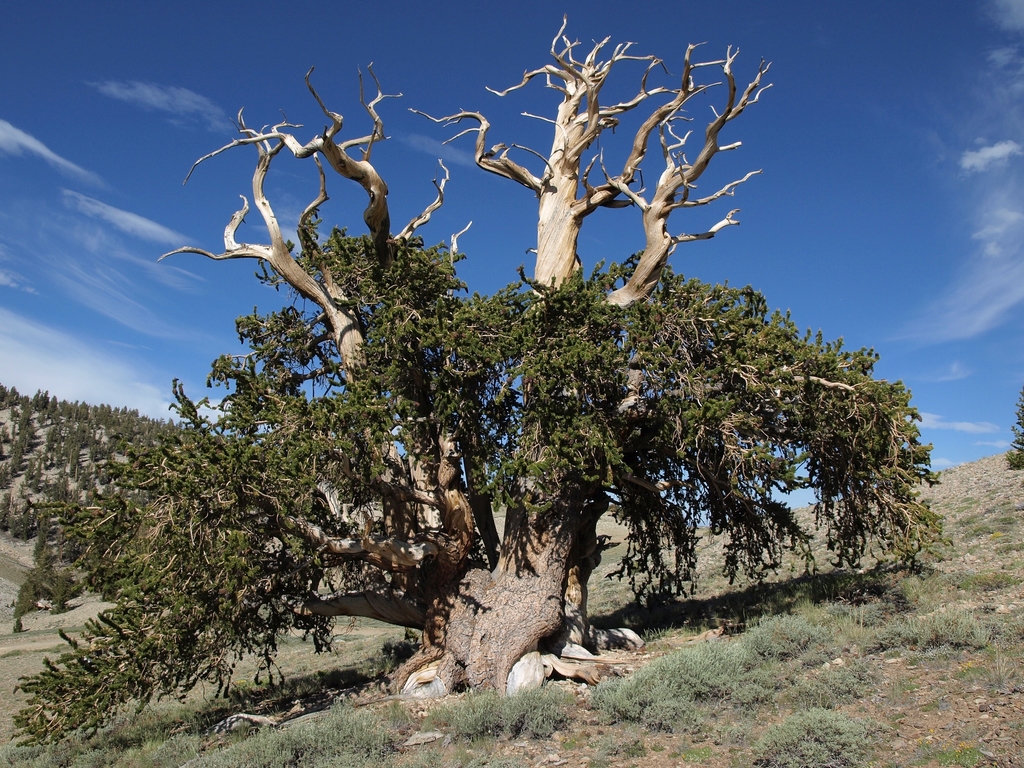
Great Basin bristlecone pine
Pinus longaeva
Also calledBristlecone (English) · Pino longevo (Spanish) · Langlebige Kiefer (German) · 狐尾松 húwěisōng (Chinese)
Among the oldest individual non-clonal organisms on Earth. The tree called Methuselah, in California's White Mountains, germinated more than 4,800 years ago, before the Great Pyramid was finished. Bristlecones survive by growing incredibly slowly and letting most of their bark die back.
Pinus longaeva is a long-living species of bristlecone pine tree found in the higher mountains of California, Nevada, and Utah. In 1987, the bristlecone pine was designated one of Nevada's state trees. Wikipedia
What it can do
- iLives more than 4,800 years on dry, alkaline dolomite where few competitors grow
- iiPractises 'sectored architecture': when roots die, only the matching strip of bark dies, so the tree survives on a narrow living ribbon
- iiiProduces dense, resinous wood that resists rot, insects and fungi, so dead wood can lie on the ground for thousands of years
- ivKeeps needles for up to 40 years or more, saving energy on dry ground
At the table
Pine seeds are small and not a traditional food; not considered toxic.
Fruit & seed
Fruit
Woody seed cone
Ripens: Matures in the second autumn
Dark purple cones 6–10 cm long with a fragile bristle on each scale.
Seed
~5 mm (wing ~12 mm)
Small seeds with a detachable wing
- Dispersal
- Wind, and caching by Clark's nutcrackers
- Germination
- Cold-stratify ~60 days; sow in gritty mineral mix
How to grow it
Hardiness (USDA zones)
USDA 4–7. Survives winters down to about -34 °C.
- Light
- Full sun
- Water
- Low
- Soil
- Lean, gravelly, sharply drained
- Propagation
- Seed
- To harvest
- Ornamental; extremely slow
- Climates
- Montane, Continental, Arid
- 1Cold-stratify seed for about two months
- 2Sow in a gritty, low-nutrient mix
- 3Grow on in full sun with minimal fertilizer
- 4Plant in poor, well-drained ground; rich soil and wet roots kill it
Can it grow where you are?
Where it lives
Recorded sightings
—
geo-referenced records in GBIF, from museums, herbaria and field observers.
Native range
High mountains of eastern California, Nevada and Utah, mostly 2,600–3,500 m
Drag the globe to turn it. Dots are where records exist, not a range map; darker means more records.
In the old herbals & bestiaries
No plate in the Source Library names this exact species, so these show its closest relatives as the old naturalists drew them: same genus, or the same kind of plant. Click a plate to read the page it came from, with translation.

Commentaries on the Six Books of Dioscorides
Relative · Pietro Andrea Mattioli · 1560 · p.180

Commentaries on the Six Books of Pedanius Dioscorides on Medical Matter
Relative · Pietro Andrea Mattioli · 1565 · p.272

Ortus sanitatis
Relative · 1491 · p.335

Commentaries on the Six Books of Dioscorides
Relative · Pietro Andrea Mattioli · 1560 · p.179

Commentaries on the Six Books of Pedanius Dioscorides on Medical Matter
Relative · Pietro Andrea Mattioli · 1565 · p.277

Discourses on the Six Books of Dioscorides
Relative · Dioscorides; Pietro Andrea Mattioli (comm.) · 1568 · p.295

Discourses on the Six Books of Dioscorides
Relative · Dioscorides; Pietro Andrea Mattioli (comm.) · 1568 · p.296

Stirpium adversaria nova
Relative · Matthias de Lobel · 1571 · p.474

Six Groups of the History of Plants
Relative · Rembert Dodoens · 1583 · p.870

Six Groups of the History of Plants
Relative · Rembert Dodoens · 1583 · p.868
In the stacks
Searching the stacks…
Every page naming Pinus longaeva in the Biodiversity Heritage Library →
Marginalia
Edmund Schulman's ring-counts in the 1950s revealed the trees' age, and bristlecone chronologies stretching back more than 8,000 years were used to calibrate radiocarbon dating. In 1964 a researcher cut down the tree later named Prometheus, at about 4,900 years old, with Forest Service permission.
Curiosity
Because bristlecone ring-widths record past climate, the trees helped show that early radiocarbon dates were off by centuries.
Kinship


Photographs: iNaturalist contributors under the licences shown. Records: GBIF.org. Historical plates: Source Library (CC BY-SA 4.0; originals public domain). Summary text: Nature Library editors and Wikipedia (CC BY-SA). Medicinal and edibility notes are historical and educational, not advice. iNaturalist taxon 48414.