- Plants
- ›Vascular Plants
- ›flowering plants
- ›monocots
- ›Agaves, Orchids, Irises, and Allies
- ›Orchids
- ›Higher Epidendroid Orchids
- ›Cymbidieae
- ›Cymbidium Alliance Orchids
- ›Cymbidium
- ›Cyperorchis
- ›Iridorchis
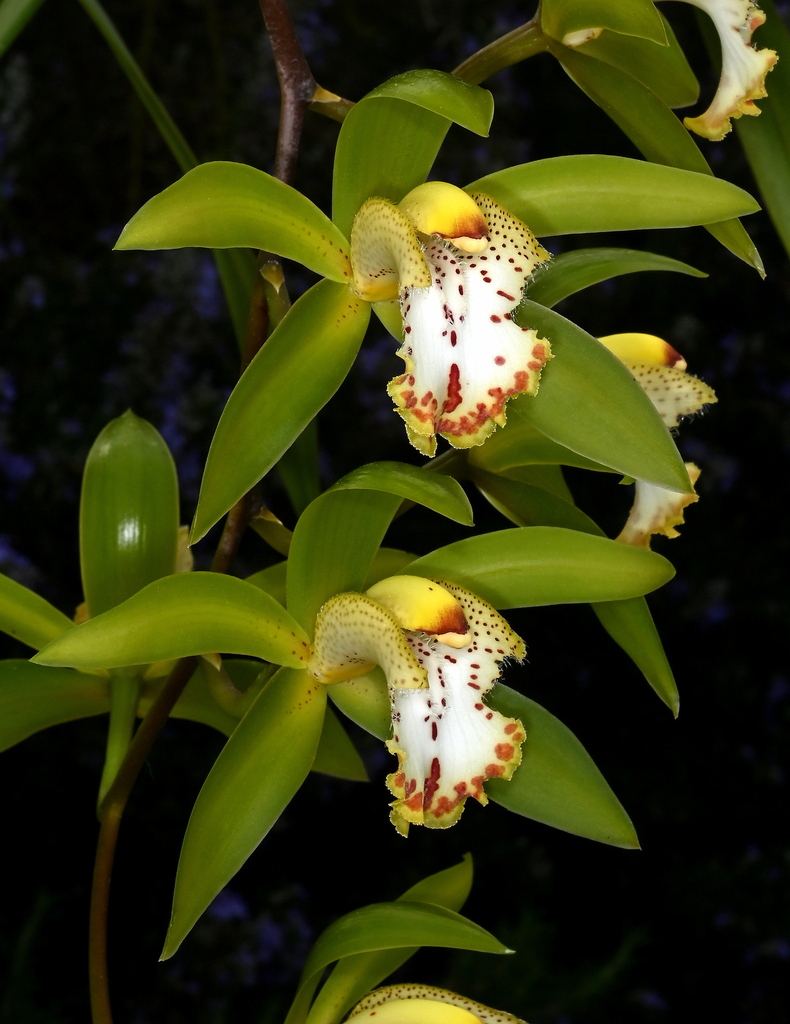
Cymbidium hookerianum
Cymbidium hookerianum (common name Hooker's Cymbidium) is a species of orchid found in India, China, and Vietnam. It is distributed widely in Bhutan, especially in the cool temperate forests.
From the article Cymbidium hookerianum on Wikipedia (CC BY-SA), quoted section by section
Description
Cymbidium hookerianum is a species of medium to large size orchid, which prefers cold weather. It is epiphytic with an ovoid pseudobulb, elongated with ligulate, acuminate, and articulated leaves. It blooms in a solid inflorescence, sheathed at the base, hanging and arched, 75 cm long, apical with triangular floral bracts and bearing 6 to 15 flowers, 14 cm long. It has a very fragrant and long-lasting odor. Flowering occurs in late winter and spring.
Range & habitat
It is distributed throughout Nepal, Bhutan, and Sikkim on steep river banks in dense and humid forests or oak forests, always at heights of 1600 to 2400 meters.
Wikipedia: “Distribution and habitat”
In human culture
Cymbidium: The name derives from the Greek word kumbos, which means "hole, cavity". This refers to the shape of the base of the lip. According to other scholars it derives from the Greek kimbe, which means boat, for the shape of the ship that the lip assumes. The species name hookerianum was chosen in honor of botanist Joseph Dalton Hooker, "an excellent name too, given with the writer's best wishes as a gratulation for the first new year's day of his Kew directorship, to Dr. Hooker."
Wikipedia: “Etymology”
Where it lives
Recorded sightings
—
geo-referenced records in GBIF, from museums, herbaria and field observers.
Drag the globe to turn it. Dots are where records exist, not a range map; darker means more records.
In the stacks
Searching the stacks…
Every page naming Cymbidium hookerianum in the Biodiversity Heritage Library →
This page is assembled live from iNaturalist, GBIF, Wikipedia, the Source Library and the Internet Archive. It is not yet part of the hand-edited codex. iNaturalist taxon 484261.