- Plants
- ›Vascular Plants
- ›flowering plants
- ›Dicots
- ›pinks, cactuses, and allies
- ›cacti
- ›globular cacti, moonlight cacti, torch cacti, and allies
- ›Cereeae
- ›Melocactus
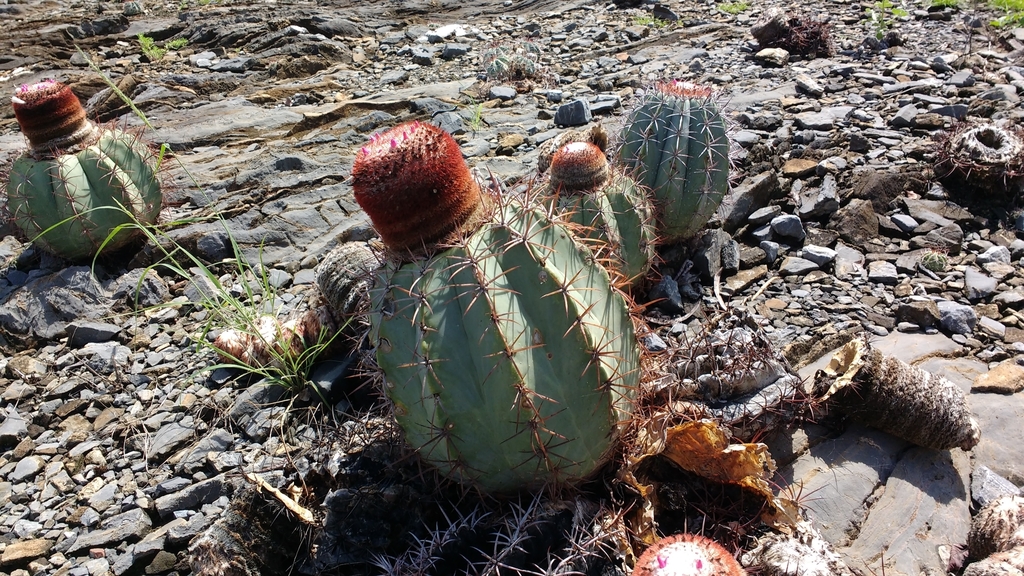
Turk's Cap Cactus
Melocactus azureus
Melocactus azureus is a species of cactus. It is endemic to Brazil, where it is known only from Bahia. It is locally abundant but the populations are fragmented and vulnerable to habitat degradation.
From the article Melocactus azureus on Wikipedia (CC BY-SA), quoted section by section
Description
Melocactus azureus has a striking frosty blue epidermis. Its cylindrical stem is(9-)14-30(-45cm) tall and 14-20 centimeters in diameter, green, grey-green, but never glaucous like subspecies Melocactus azureus ferreophilus with mucilage present in the cortical tissues. It has 9-10 ribs and the spines are black to reddish, overlaid with gray, and some are hooked in seedlings while the central spines are slightly curved to straight and the radial spines are very stout. The flowers are small, 15-23mm long and 4-11 mm in diameter, and pink to magenta, it flowers in spring to late autumn. The fruits are small, white to able pink and seeds are smooth. It has the chromosome number 2n = 44.
Range & habitat
Melocactus azureus is endemic to central, northern, and eastern Brazil at altitudes of 450-800 metres above sea level. This species has a small range and is only in low-lying outcrops of limestone, tt occurs in fragmented populations from a few hundred to millions. A major threat to the species is habitat loss for agriculture, vegetation is destroyed when the surrounding caatinga forest is cleared causing a decline of wild populations. The change has an impact on the outcrops were the species grows as well, making them prone to invasive species.
Wikipedia: “Habitat”
How it is grown
Melocactus azureus has a relatively rapid growth rate given the best conditions. These tropical cacti are not recommended for beginners as they are not easy to grow. It grows well in very porous standard cactus mix soil, this cactus preferes very bright light however not as much as most arid growing cacti.
Wikipedia: “Cultivation”
Where it lives
Recorded sightings
—
geo-referenced records in GBIF, from museums, herbaria and field observers.
Drag the globe to turn it. Dots are where records exist, not a range map; darker means more records.
In the stacks
Searching the stacks…
Every page naming Melocactus azureus in the Biodiversity Heritage Library →
This page is assembled live from iNaturalist, GBIF, Wikipedia, the Source Library and the Internet Archive. It is not yet part of the hand-edited codex. iNaturalist taxon 49183.