- Plants
- ›Vascular Plants
- ›flowering plants
- ›monocots
- ›Agaves, Orchids, Irises, and Allies
- ›Orchids
- ›Higher Epidendroid Orchids
- ›Cymbidieae
- ›Cymbidium Alliance Orchids
- ›Cymbidium
- ›Cymbidium
- ›Austrocymbidium
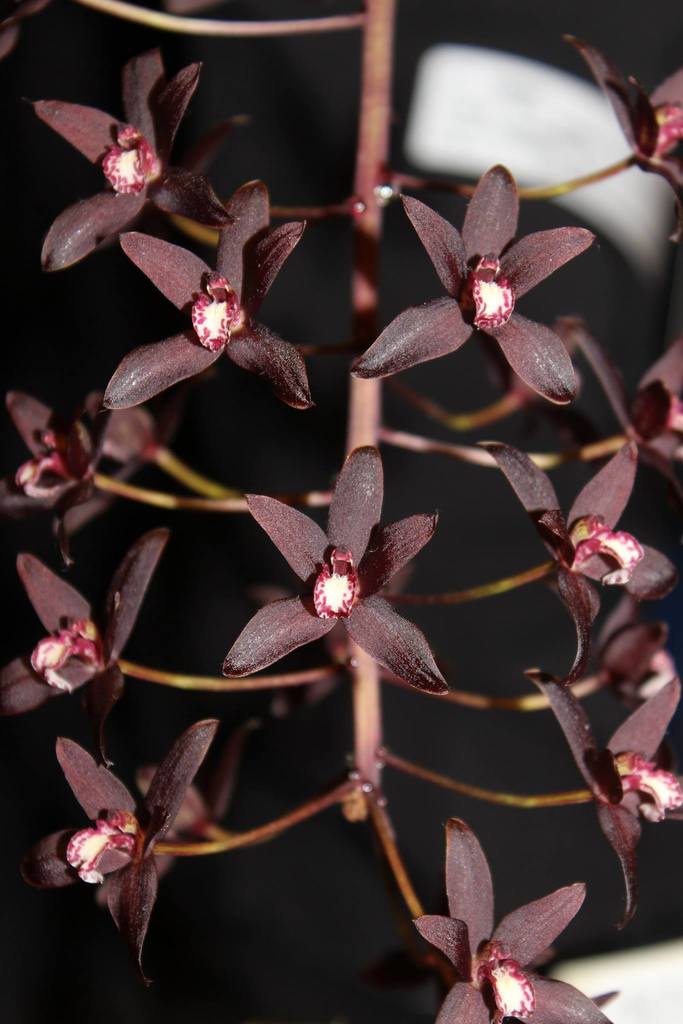
Channelled boat-lip orchid
Cymbidium canaliculatum
Cymbidium canaliculatum, commonly known as the channelled boat-lip orchid, tiger boat-lip orchid, native cymbidium or tiger orchid is a plant in the orchid family and is endemic to Australia. It is a clump-forming epiphyte with large, greyish green pseudobulbs, each with up to six curved, deeply channelled leaves and up to sixty fragrant, variably coloured flowers that often have spots and blotches and a white to cream-coloured labellum with red markings. This orchid usually grows in the forks or hollows of trees and is found from New South Wales to the northern parts of Western Australia.
From the article Cymbidium canaliculatum on Wikipedia (CC BY-SA), quoted section by section
Description
Cymbidium canaliculatum is an epiphytic, clump-forming herb with greyish green pseudobulbs 80–120 mm (3.1–4.7 in) long and 30–40 mm (1–2 in) wide. Each pseudobulb has between two and six rigid, fleshy, curved, deeply channelled leaves 300–500 mm (12–20 in) and 30–40 mm (1–2 in) wide. Between five and sixty flowers, 25–45 mm (0.98–1.8 in) long and 20–40 mm (0.79–1.6 in) wide are borne on a flowering stem 200–400 mm (7.9–16 in) long. The flowers are olive green, yellow, brown or purple often with spots, blotches or both. The sepals are 15–25 mm (0.59–0.98 in) long and 7–10 mm (0.3–0.4 in) wide and the petals are 13–22 mm (0.51–0.87 in) long and 5–9 mm (0.2–0.4 in) wide. The labellum is usually white with red or purple markings, 15–20 mm (0.59–0.79 in) long and 8–10 mm (0.31–0.39 in) wide with three lobes. The side lobes are erect and the middle lobe curves downwards with a warty or hairy upper surface and two ridges along its midline. Flowering occurs between September and October.
Range & habitat
The channelled boat-lip orchid grows in the forks or hollows of trees in woodlands and drier forests in the Kimberley region of Western Australia, the northern parts of the Northern Territory, (including Melville Island) and from Cape York Peninsula in Queensland south to the Hunter River in New South Wales.
Wikipedia: “Distribution and habitat”
Where it lives
Recorded sightings
—
geo-referenced records in GBIF, from museums, herbaria and field observers.
Drag the globe to turn it. Dots are where records exist, not a range map; darker means more records.
In the stacks
Searching the stacks…
Every page naming Cymbidium canaliculatum in the Biodiversity Heritage Library →
This page is assembled live from iNaturalist, GBIF, Wikipedia, the Source Library and the Internet Archive. It is not yet part of the hand-edited codex. iNaturalist taxon 493680.