- Animals
- ›Arthropods
- ›Hexapods
- ›Insects
- ›Winged and Once-winged Insects
- ›Butterflies and Moths
- ›Butterflies
- ›Whites, Yellows, and Sulphurs
- ›Whites
- ›Pierini
- ›Pierina
- ›Ascia
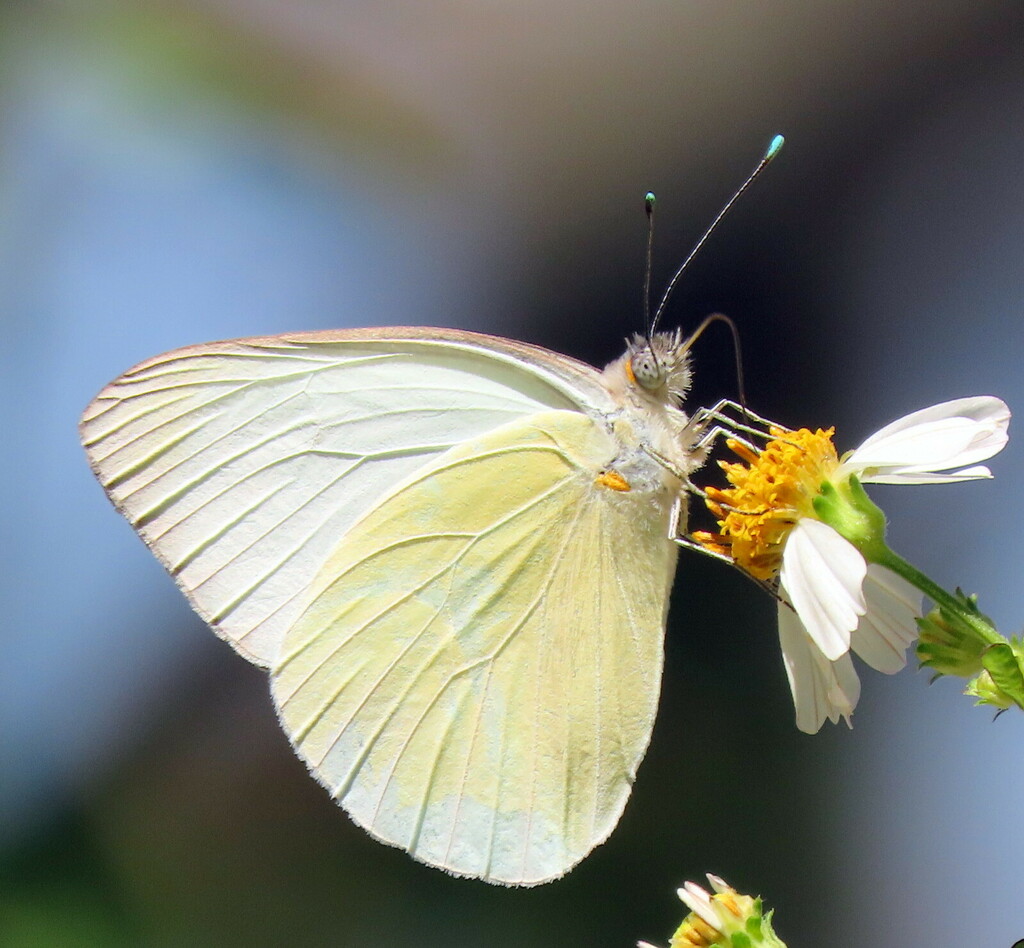
Great Southern White
Ascia monuste
Ascia is a genus of butterflies in the family Pieridae. It is monotypic, being represented by the single species Ascia monuste, commonly known as the great southern white, In this species the sexes may differ with the female being either light or dark colored. It is found from the Atlantic and Gulf coasts of the United States, and south to Argentina. It is migratory along the south-eastern coast of the United States, with strays to Maryland, Kansas, and Colorado.
Larvae have distinct body segments within which there appears to be four to six subsegments. They are purplish-green with two longitudinal, greenish-yellow stripes on each side and the dorsal side. When full-grown, they are approximately one and a quarter inches long. The wingspan in adults is 63–86 mm (2.5–3.4 in). Adults are on wing all year round in southern Texas, peninsular Florida and along the Gulf Coast.
From the article Ascia on Wikipedia (CC BY-SA), quoted section by section
In human culture
This species seeks out appropriate plant hosts for oviposition by detection of compounds called glucosinolates present in the family Brassicaceae. Adults appear to prefer to lay their eggs on certain areas of the plant. On kale leaves, for example, the preferred regions are the apical, medium and basal parts of the leaves. The average number of eggs laid is about 43 with as many as 245, being laid singly or in clusters. A. m. monuste has been observed feeding on the chorion soon after hatching as their first food, as well as larvae feeding on eggs. It has been suggested that this behavior provides them with extra protein. If a female oviposits on a plant already supporting conspecifics, cannibalism is more likely. Since they have a high growth rate and a non-regulated body temperature, herbivorous insects require a higher quantity of protein. It is questionable that A. monuste is strictly herbivorous as they often consume conspecific eggs. Larvae have been seen consuming whole eggs from the same clutch or others nearby on the same leaf. This behavior appears to be advantageous from an evolutionary stand point as this is an opportunistic behavior and can increase fitness. In general, the development time for eggs ranges from 4–5 days in field conditions and 3.4 days in laboratory conditions. …
Wikipedia: “Life history”
Listen
Looking for field recordings…
Where it lives
Recorded sightings
—
geo-referenced records in GBIF, from museums, herbaria and field observers.
Drag the globe to turn it. Dots are where records exist, not a range map; darker means more records.
In the stacks
Searching the stacks…
Every page naming Ascia monuste in the Biodiversity Heritage Library →
This page is assembled live from iNaturalist, GBIF, Wikipedia, the Source Library and the Internet Archive. It is not yet part of the hand-edited codex. iNaturalist taxon 51536.