 NL·0052
Herbarium of the Nature Library
- Name
- Drosera rotundifolia
- Family
- Droseraceae
- Native to
- Circumboreal: Europe, northern Asia, North America, Greenland
- Habitat
- Peat bog, Fen, Wet heath
Round-leaved sundew
Drosera rotundifolia
Also calledRosée du soleil (French) · Rosolio (Italian) · Rundblättriger Sonnentau (German) · Rocío del sol (Spanish) · Mōsen-goke モウセンゴケ (Japanese) · 圆叶茅膏菜 (Chinese)
A small bog plant whose leaves are covered in red tentacles, each tipped with a drop of sticky 'dew'. Insects that land get stuck, the tentacles slowly bend over them, and the leaf digests them. Darwin spent years experimenting on it.
Drosera rotundifolia, the round-leaved sundew, roundleaf sundew, or common sundew, is a species of carnivorous flowering plant that grows in bogs, marshes and fens. One of the most widespread sundew species, it has a circumboreal distribution, being found in almost all of Europe, all of Siberia, large parts of North America, Korea and Japan but is also found as far south as eastern China, the Philippines, and into the Southern Hemisphere in New Guinea. Wikipedia
What it can do
- iIts glandular tentacles secrete sticky mucilage that traps insects
- iiBends tentacles, and sometimes the whole leaf, around struggling prey over minutes to hours
- iiiSecretes digestive enzymes and absorbs nitrogen from prey
- ivSurvives harsh winters as a tight bud (hibernaculum)
At the table
Not a food. Historically used to flavour liqueur and curdle milk.
In the medicine cabinet
| Tradition | Use |
|---|---|
| European folk medicine | Herb tea or tincture for dry and spasmodic coughs and whooping cough |
| Homeopathy (Drosera) | Remedy for coughs (homeopathic preparations contain essentially no plant material) |
Weight of evidence
Traditional. Long historical use; little or no modern clinical evidence.
Active compounds
naphthoquinones (7-methyljuglone, plumbagin), flavonoids (quercetin, hyperoside)
Fruit & seed

Fruit
Capsule
Ripens: Summer
Tiny capsules on a slender stalk well above the leaves.
Seed
~1–1.5 mm
Minute spindle-shaped seeds
- Dispersal
- Wind and water
- Germination
- Cold-stratify 4–8 weeks; surface-sow on damp peat in light
Photographs from Wikimedia Commons under open licences; hover for the photographer, click for the file.
How to grow it
Hardiness (USDA zones)
USDA 3–8. Survives winters down to about -40 °C.
- Light
- Full sun
- Water
- Constantly wet; rainwater only
- Soil
- Live sphagnum or peat-sand
- Propagation
- Seed, leaf cuttings, gemmae
- To harvest
- Mature in 1–2 years
- Climates
- Temperate, Boreal, Oceanic
- 1Sow stratified seed on damp peat or live sphagnum
- 2Keep in a tray of rainwater in full sun
- 3Give a cold winter rest outdoors or in a fridge
- 4Don't fertilise; let it catch its own insects
Can it grow where you are?
Where it lives
Recorded sightings
—
geo-referenced records in GBIF, from museums, herbaria and field observers.
Native range
Circumboreal: Europe, northern Asia, North America, Greenland
Drag the globe to turn it. Dots are where records exist, not a range map; darker means more records.
In the old herbals & bestiaries
Woodcuts and engravings matched from the Source Library’s scanned books by name. Plates marked “relative” show a close kin rather than this exact species. Click a plate to read the page it came from, with translation.

Medical and Philosophical Garden
Joachim Camerarius · 1588 · p.400

Hortus Eystettensis
Basilius Besler · 1640 · p.331

History of Plants in Four Books
Valerius Cordus · 1561 · p.192

The Dutch Herbarium or Herbal
Petrus Nylandt · 1670 · p.129

Herbarium Portatile, Oder Behendes Kräuter- und Gewächs-Buch: Darinn nicht allein 1363. so wol Einheimische als Außländndische Kräuter mit Lateinisch und Deutscher Benennung abgebildet, sondern auch die meisten, so in der Medicin gebräuchlich, kürtzlich erkläret werden
Panckow, Thomas · 1656 · p.48
In the stacks
Searching the stacks…
Every page naming Drosera rotundifolia in the Biodiversity Heritage Library →
Marginalia
Darwin wrote in 1860 that he cared more for Drosera than for the origin of all the species in the world, and his Insectivorous Plants (1875) begins with it. Italian rosolio liqueur gets its name from the sundew (ros solis, 'dew of the sun').
Curiosity
A sundew leaf can tell a real insect from a raindrop or grain of sand and responds far more strongly to nitrogen-containing objects.
Kinship
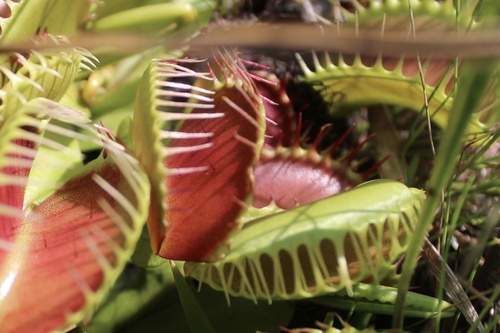




Photographs: iNaturalist contributors under the licences shown. Records: GBIF.org. Historical plates: Source Library (CC BY-SA 4.0; originals public domain). Summary text: Nature Library editors and Wikipedia (CC BY-SA). Medicinal and edibility notes are historical and educational, not advice. iNaturalist taxon 52658.