 NL·0029
Herbarium of the Nature Library
- Name
- Artemisia vulgaris
- Family
- Asteraceae
- Native to
- Temperate Europe, Asia and North Africa; invasive in eastern North America
- Habitat
- Disturbed ground, Riverbanks, Temperate grassland
Mugwort
Artemisia vulgaris
Also calledBeifuß (German) · Artemisa (Spanish) · Armoise commune (French) · Nagadamani (Sanskrit, as applied in some Ayurvedic texts) · Běi ài 北艾 (Chinese) · Mucgwyrt (Old English)
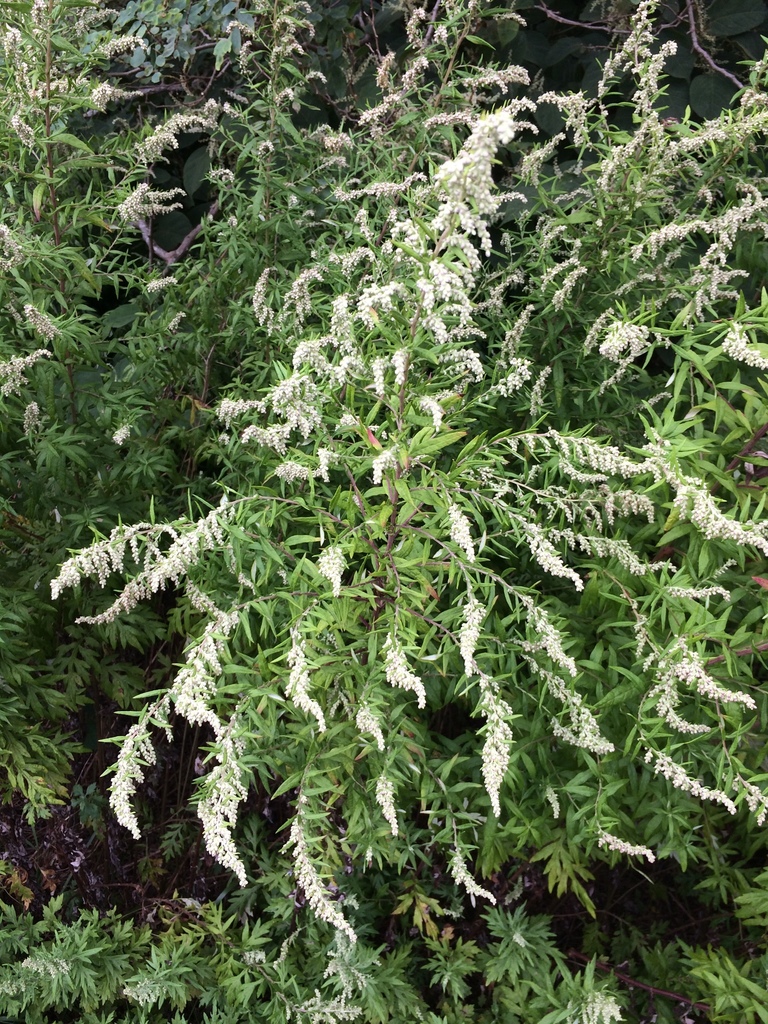
A tall, silver-backed roadside perennial named for Artemis, goddess of women and childbirth. It is the first of the Anglo-Saxon Nine Herbs, and in late summer one of Europe's worst hay-fever plants.
Artemisia vulgaris, commonly known as mugwort, common mugwort, or wormwood, is a species of flowering plant in the daisy family Asteraceae. It is one of several species in the genus Artemisia commonly known as mugwort, although Artemisia vulgaris is the species most often called mugwort. Mugworts have been used medicinally and as culinary herbs. Wikipedia
What it can do
- iSilvery, felted leaf undersides reflect heat and carry aromatic oil glands
- iiSpreads by rhizomes and can regrow from small root fragments, making it hard to eradicate
- iiiReleases huge amounts of wind-borne pollen; the allergen Art v 1 is a leading cause of late-summer hay fever
- ivIts aromatic compounds repel insects; sprigs were laid in shoes and linen
At the table
Eatenyoung leaves and shoots (sparingly) · flower buds (flavouring)
Used as a bitter flavouring for fatty meats and goose and, historically, in gruit ale before hops. It contains thujone, so avoid large amounts and avoid it entirely in pregnancy. Can cross-react in people with celery or spice allergies.
In the medicine cabinet
| Tradition | Use |
|---|---|
| European folk medicine | Bitter tea for poor appetite, indigestion and irregular or painful menstruation; laid in shoes against travel-weariness |
| Traditional Chinese Medicine | Mugwort leaf (ai ye, mainly the related A. argyi) is dried into moxa and burned over acupuncture points (moxibustion) |
| Ayurveda / South Asian folk | Leaves used for worms, fevers and menstrual complaints |
Weight of evidence
Traditional. Long historical use; little or no modern clinical evidence.
Active compounds
1,8-cineole, camphor, α- and β-thujone, sesquiterpene lactones, coumarins, flavonoids
Fruit & seed
Fruit
Cypsela (achene)
Ripens: Autumn
Minute brown achenes without a pappus.


Seed
~1 mm
Tiny, oblong, brown seeds
- Dispersal
- Wind, water, soil and machinery
- Germination
- Needs light; 1–2 weeks at 15–25 °C
Photographs from Wikimedia Commons under open licences; hover for the photographer, click for the file.
How to grow it
Hardiness (USDA zones)
USDA 3–8. Survives winters down to about -40 °C.
- Light
- Full sun to part shade
- Water
- Low–moderate
- Soil
- Any; thrives on disturbed, nitrogen-rich ground
- Propagation
- Seed or rhizome division
- To harvest
- Leaves from year 1, just before flowering
- Climates
- Temperate, Continental
- 1Grow in a sunk container or a contained bed, as it is invasive in North America
- 2Surface-sow or plant divisions in spring
- 3Cut leafy tops just as the flower buds form
- 4Hang to dry and strip the leaves
Can it grow where you are?
Where it lives
Recorded sightings
—
geo-referenced records in GBIF, from museums, herbaria and field observers.
Native range
Temperate Europe, Asia and North Africa; invasive in eastern North America
Drag the globe to turn it. Dots are where records exist, not a range map; darker means more records.
In the old herbals & bestiaries
Woodcuts and engravings matched from the Source Library’s scanned books by name. Plates marked “relative” show a close kin rather than this exact species. Click a plate to read the page it came from, with translation.

Book of Herbs
Hieronymus Bock (Tragus) · 1546 · p.292

Latin Herbal with German Synonyms
1486 · p.36

Living Images of Plants
Otto Brunfels · 1532 · p.426

Commentaries on the Six Books of Pedanius Dioscorides on Medical Matter
Pietro Andrea Mattioli · 1565 · p.1020

Collected Illustrations of the Three Realms: Plants
王圻, 王思義 · 1607 · p.56

On the Virtues of Herbs
Macer Floridus (Odo of Meung) · 1090 · p.16

On the Virtues of Herbs
Macer Floridus · 1150 · p.3

Latin Herbal
1484 · p.35

Latin Herbal with German Synonyms
1484 · p.65

Herbarius latinus (with Dutch synonyms)
1486 · p.33
In the stacks
Searching the stacks…
Every page naming Artemisia vulgaris in the Biodiversity Heritage Library →
Marginalia
The Old English Nine Herbs Charm in the 10th-century Lacnunga manuscript names Mucgwyrt first, calling it 'the oldest of plants'. Pliny wrote that a traveller carrying artemisia would not feel weary.
Curiosity
On St John's Eve, medieval Europeans wore mugwort garlands ('St John's girdle') and threw them into the midsummer bonfire to burn away bad luck.
Kinship

Photographs: iNaturalist contributors under the licences shown. Records: GBIF.org. Historical plates: Source Library (CC BY-SA 4.0; originals public domain). Summary text: Nature Library editors and Wikipedia (CC BY-SA). Medicinal and edibility notes are historical and educational, not advice. iNaturalist taxon 52856.