 NL·0677
Herbarium of the Nature Library
- Name
- Maratus volans
- Family
- Salticidae
- Native to
- Eastern Australia, mainly coastal New South Wales and south-eastern Queensland
- Habitat
- Heath, Open woodland, Coastal scrub
Peacock spider
Maratus volans
Also calledFlying peacock spider (English) · Pfauenspinne (German)
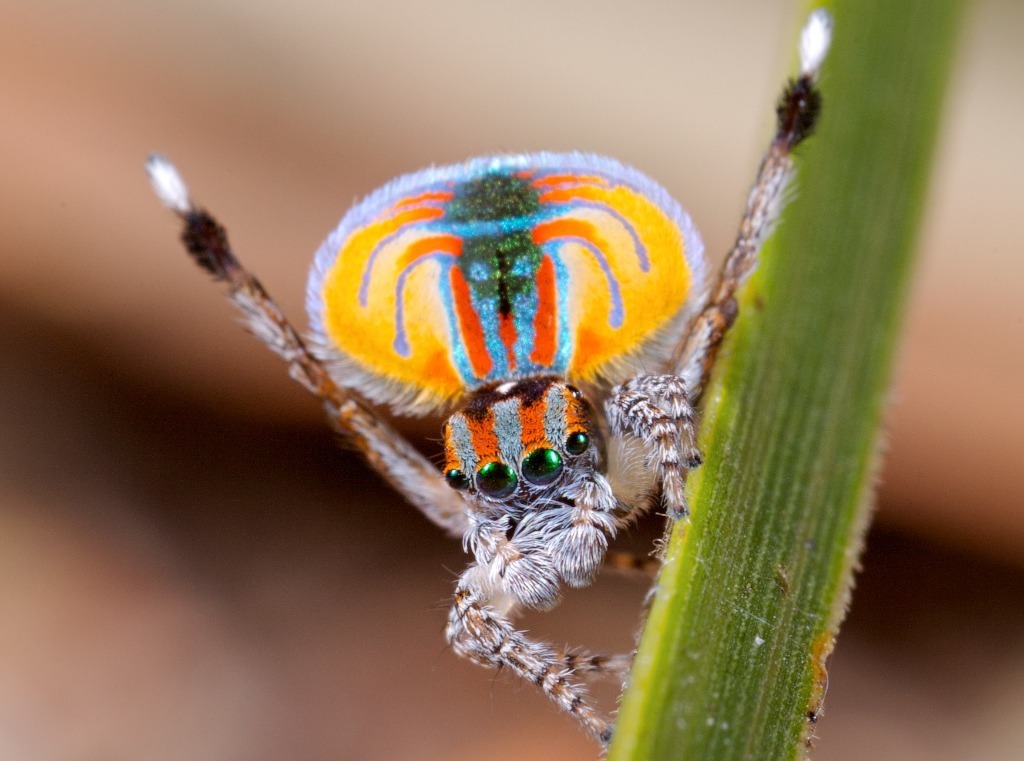
A jumping spider about 5 mm long whose males raise a brilliantly coloured flap on the abdomen like a peacock's fan and dance for females. If the female is not impressed she may eat him.
Maratus volans is a species in the jumping spider family (Salticidae), belonging to the genus Maratus. These spiders are native to certain areas in Australia and occupy a wide distribution of habitats. They have a specialized visual system that allows them to see the full visible spectrum as well as in the ultraviolet-range; this helps them detect and pursue prey. Males of this species are characterized by their colourful abdomen flaps, which are used to attract females during courtship. Wikipedia
What it can do
- iMales unfold and raise iridescent abdominal flaps during courtship
- iiCombines visual display with vibrations drummed through the ground
- iiiExcellent vision, including colour vision, typical of jumping spiders
In the field
Field marks
- aTiny jumping spider with large front eyes
- bMale abdomen patterned in red, orange, blue and green, with fold-out side flaps
- cMale third legs black with white tips, raised in display
- dFemales mottled brown and grey
- Not to be confused with
- Dozens of other Maratus species, most described since 2010, differ in the pattern and colours of the male's fan; females are very hard to tell apart.
- Where to see it
- Heath and bushland around Sydney (e.g. Ku-ring-gai Chase National Park) and in south-east Queensland.
- When
- Mature males Aug–Dec, displaying in the austral spring
Life & habits
- Diet
- Small insects and other arthropods, stalked and pounced on
- Habitat
- Leaf litter and low vegetation in heath, scrub and woodland
- Size
- About 4–5 mm
- Lifespan
- About one year
The male lifts his third pair of legs, raises his patterned flap, and sidesteps and shimmies in front of the female.
Where it lives
Recorded sightings
—
geo-referenced records in GBIF, from museums, herbaria and field observers.
Native range
Eastern Australia, mainly coastal New South Wales and south-eastern Queensland
Drag the globe to turn it. Dots are where records exist, not a range map; darker means more records.
In the old herbals & bestiaries
No plate in the Source Library names this exact species, so these show its closest relatives as the old naturalists drew them: same genus, or the same kind of animal. Click a plate to read the page it came from, with translation.

Jan Jonston — Naeukeurige beschryving van de natuur der viervoetige dieren (1660)
Relative · Jan Jonston · 1660 · p.467

Commentaries on the Six Books of Pedanius Dioscorides on Medical Matter
Relative · Pietro Andrea Mattioli · 1565 · p.487

History of Animals, Book II: On Oviparous Quadrupeds
Relative · Conrad Gessner · 1586 · p.573

Georg Wolfgang Knorr — Deliciae naturae selectae (1771)
Relative · Georg Wolfgang Knorr · 1771 · p.98

Books on Marine Fishes
Relative · Guillaume Rondelet · 1554 · p.596

Commentaries on the Six Books of Dioscorides
Relative · Pietro Andrea Mattioli · 1560 · p.341

Commentaries on the Six Books of Dioscorides
Relative · Pietro Andrea Mattioli · 1560 · p.304

Commentaries on the Six Books of Dioscorides on Medical Matter
Relative · Pietro Andrea Mattioli · 1563 · p.289

History of Animals, Book II: On Oviparous Quadrupeds
Relative · Conrad Gessner · 1586 · p.572

Compendium of Materia Medica
Relative · 李時珍 · 1596 · p.129
In the stacks
Searching the stacks…
Every page naming Maratus volans in the Biodiversity Heritage Library →
Marginalia
Octavius Pickard-Cambridge described it in 1874 and named it volans, 'flying', after a collector's report that the flaps helped it glide. The photographs and films of Jürgen Otto made peacock spiders internet-famous from the 2010s.
Curiosity
Its flaps cannot be used for gliding at all; they are purely for courtship.
Kinship





Fact-checked: 2 corrections made to this sheet. Photographs: iNaturalist contributors under the licences shown. Records: GBIF.org. Historical plates: Source Library (CC BY-SA 4.0; originals public domain). Summary text: Nature Library editors and Wikipedia (CC BY-SA). Medicinal and edibility notes are historical and educational, not advice. iNaturalist taxon 53605.