 NL·0167
Herbarium of the Nature Library
- Name
- Taxus brevifolia
- Family
- Taxaceae
- Native to
- Pacific Northwest of North America, from south-east Alaska to northern California, inland to Idaho and Montana
- Habitat
- Temperate rainforest, Old-growth conifer forest understorey, Riparian forest
Pacific yew
Taxus brevifolia
Also calledWestern yew (English) · Duǎn yè hóngdòushān 短叶红豆杉 (Chinese) · If de l'Ouest (French) · Pazifische Eibe (German) · Tejo del Pacífico (Spanish)
A slow-growing understorey conifer of Pacific Northwest old-growth forests. Loggers once burned it as trash, until its bark yielded paclitaxel (Taxol), one of the most important cancer drugs ever found.
Taxus brevifolia, the Pacific yew or western yew, is a species of conifer in the yew family, Taxaceae, native to the Pacific Northwest of North America. It is a small tree, thriving in moisture and otherwise tending to take the form of a shrub. Wikipedia
What it can do
- iBark contains paclitaxel, which freezes the microtubules that dividing cells need
- iiTolerates deep shade beneath Douglas fir and western hemlock
- iiiWood is extremely dense, springy and rot-resistant
- ivFoliage and seeds contain taxine alkaloids that can stop the heart
At the table
Foliage, bark and seeds are deadly poisonous (taxines). The red fleshy aril is the only non-toxic part, but the seed inside is lethal if chewed. Highly toxic to horses and cattle.
In the medicine cabinet
| Tradition | Use |
|---|---|
| Indigenous American (Pacific Northwest) | Several nations used bark or needle preparations as medicines for various ailments and topically, and prized the wood for bows, paddles, digging sticks and tools |
| Modern medicine | Paclitaxel (Taxol) for ovarian, breast and lung cancer and Kaposi sarcoma; also coats some coronary stents |
Weight of evidence
Strong. An approved drug, or consistent results in well-run clinical trials.
Active compounds
paclitaxel (taxol), baccatin III, 10-deacetylbaccatin III, taxine A, taxine B
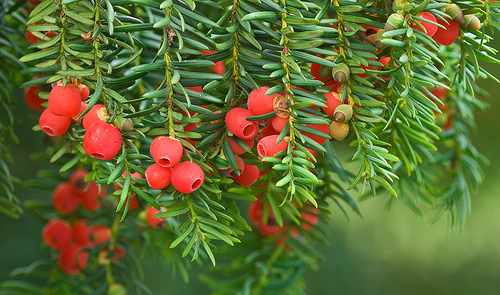
Fruit & seed
Fruit
Aril (fleshy seed cup; not a true fruit)
Ripens: Late summer–autumn
Bright red, juicy cup around a single dark seed; the seed is deadly.
Seed
~5–6 mm
Olive-brown, ovoid seed partly enclosed in a red aril
- Dispersal
- Birds swallow the arils and pass the seeds intact
- Germination
- Deeply dormant; warm then cold stratification over 1–2 years
How to grow it
Hardiness (USDA zones)
USDA 6–9. Survives winters down to about -23 °C.
- Light
- Shade to part shade
- Water
- Moderate
- Soil
- Moist, well-drained, humus-rich
- Propagation
- Stratified seed or semi-ripe cuttings
- To harvest
- Ornamental; very slow-growing
- Climates
- Temperate, Oceanic
- 1Root semi-ripe cuttings in autumn under mist, or sow seed outdoors to stratify naturally
- 2Plant in a cool, shady, sheltered spot
- 3Keep away from livestock and play areas
- 4Clippings are poisonous; dispose of them carefully
Can it grow where you are?
Where it lives
Recorded sightings
—
geo-referenced records in GBIF, from museums, herbaria and field observers.
Native range
Pacific Northwest of North America, from south-east Alaska to northern California, inland to Idaho and Montana
Drag the globe to turn it. Dots are where records exist, not a range map; darker means more records.
In the old herbals & bestiaries
No plate in the Source Library names this exact species, so these show its closest relatives as the old naturalists drew them: same genus, or the same kind of plant. Click a plate to read the page it came from, with translation.

Latin Herbal
Relative · 1484 · p.299

Herbarius latinus (with Dutch synonyms)
Relative · 1486 · p.297

Latin Herbal with German Synonyms
Relative · 1486 · p.300

Herbal of Virtues
Relative · 1499 · p.299

Commentaries on the Six Books of Dioscorides
Relative · Pietro Andrea Mattioli · 1560 · p.701

Commentaries on the Six Books of Dioscorides on Medical Matter
Relative · Pietro Andrea Mattioli · 1563 · p.646

Commentaries on the Six Books of Pedanius Dioscorides on Medical Matter
Relative · Pietro Andrea Mattioli · 1565 · p.1271

A New Herbal, or History of Plants
Relative · Rembert Dodoens (trans. Henry Lyte) · 1578 · p.793

Six Groups of the History of Plants
Relative · Rembert Dodoens · 1583 · p.868

The Dutch Herbarium or Herbal
Relative · Petrus Nylandt · 1670 · p.40
In the stacks
Searching the stacks…
Every page naming Taxus brevifolia in the Biodiversity Heritage Library →
Marginalia
In 1962 USDA botanist Arthur Barclay collected Pacific yew bark in Washington for a National Cancer Institute screening programme. Monroe Wall and Mansukh Wani isolated paclitaxel in 1966 and published its structure in 1971, and the clamour for bark led to the US Pacific Yew Act of 1992.
Curiosity
At first the bark of several mature trees was needed to treat a single patient. The drug is now made semi-synthetically from European yew needles or by plant-cell culture.
Kinship



Fact-checked: 2 corrections made to this sheet. Photographs: iNaturalist contributors under the licences shown. Records: GBIF.org. Historical plates: Source Library (CC BY-SA 4.0; originals public domain). Summary text: Nature Library editors and Wikipedia (CC BY-SA). Medicinal and edibility notes are historical and educational, not advice. iNaturalist taxon 55209.