 NL·0141
Herbarium of the Nature Library
- Name
- Fragaria × ananassa
- Family
- Rosaceae
- Native to
- Hybrid of cultivated origin (Brittany, France, c. 1750) from F. chiloensis (Chile) and F. virginiana (North America); cultivated worldwide
- Habitat
- Gardens and fields, Temperate grassland
Garden strawberry
Fragaria × ananassa
Also calledFresa (Spanish) · Morango (Portuguese) · Fraise (French) · Cǎoméi (Chinese) · Ichigo (Japanese) · Farawla (Arabic) · Toot farangi (Persian)
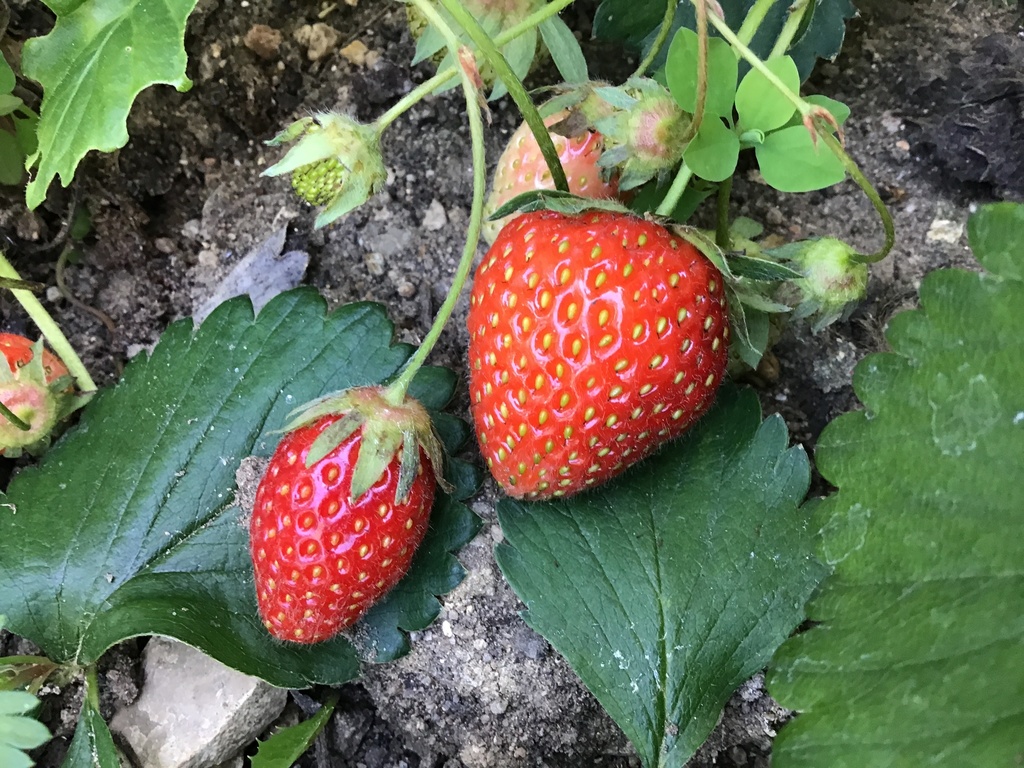
The garden strawberry is an 18th-century accident: a hybrid of a Chilean and a North American wild strawberry that crossed in a French garden around 1750. The red flesh is a swollen receptacle — the true fruits are the tiny 'seeds' on the outside.
The garden strawberry is a widely grown hybrid plant cultivated worldwide for its fruit. The genus Fragaria, the strawberries, is in the rose family, Rosaceae. The fruit is appreciated for its aroma, bright red colour, juicy texture, and sweetness. It is eaten either fresh or in prepared foods such as jam, ice cream, and chocolates. Artificial strawberry flavourings and aromas are widely used in commercial products. Botanically, the strawberry is not a berry, but an aggregate accessory fruit. Each apparent 'seed' on the outside of the strawberry is actually an achene, a botanical fruit with a seed inside it. Wikipedia
What it can do
- iOctoploid: carries eight sets of chromosomes
- iiSpreads by runners (stolons) that root to form new clone plants
- iiiEach 'seed' on the surface is a separate achene, a true fruit
- ivDay-neutral varieties fruit continuously regardless of day length
At the table
Eatenfruit · leaves (tea)
Fruit and leaves are safe. Strawberries are a common trigger of allergy-like reactions in children.
In the medicine cabinet
| Tradition | Use |
|---|---|
| European folk medicine | Leaf tea (mainly from wild strawberry) as a mild astringent for diarrhoea |
| Medieval European herbals | Fruit to cool fevers and cleanse the teeth |
Weight of evidence
Traditional. Long historical use; little or no modern clinical evidence.
Active compounds
vitamin C, ellagitannins, anthocyanins (pelargonidin), folate
Fruit & seed


Fruit
Aggregate accessory fruit
Ripens: Late spring to early summer; everbearers into autumn
Heart- to cone-shaped red fruit 2–5 cm, juicy and sweet, the swollen receptacle dotted with 200 or so tiny achenes.
Seed
~1 mm
Tiny yellow to reddish-brown achenes, about 1 mm, egg-shaped, set in shallow pits on the outside of the berry
- Dispersal
- Birds and mammals
- Germination
- Cold-stratify 2–4 weeks, surface-sow (needs light) at 18–22 °C; 1–6 weeks. Seedlings differ from the parent except for seed-bred F1 varieties
Photographs from Wikimedia Commons under open licences; hover for the photographer, click for the file.
How to grow it
Hardiness (USDA zones)
USDA 3–10 (varies by cultivar). Survives winters down to about -40 °C.
- Light
- Full sun
- Water
- Moderate; keep evenly moist, especially as fruit swells
- Soil
- Rich, well-drained, slightly acidic (pH 5.5–6.5); raised beds ideal
- Propagation
- Rooted runners; certified virus-free plants; some varieties by seed
- To harvest
- 60–90 days from spring planting (everbearers) or the following spring (June-bearers)
- Climates
- Temperate, Mediterranean, Subtropical (winter crop)
- 1Buy certified disease-free plants and set them 30–45 cm apart in late summer or early spring, with the crown exactly at soil level.
- 2Mulch with straw (hence the name) to keep fruit clean and the soil moist.
- 3Remove flowers in the first spring on June-bearers to build strong plants; water at soil level to avoid grey mould.
- 4Net against birds; pick fully red berries in the morning, with the cap on.
- 5After harvest, trim old leaves, root a few runners into pots for new plants, and replace beds every 3–4 years.
Can it grow where you are?
Where it lives
Recorded sightings
—
geo-referenced records in GBIF, from museums, herbaria and field observers.
Native range
Hybrid of cultivated origin (Brittany, France, c. 1750) from F. chiloensis (Chile) and F. virginiana (North America); cultivated worldwide
Drag the globe to turn it. Dots are where records exist, not a range map; darker means more records.
In the old herbals & bestiaries
Woodcuts and engravings matched from the Source Library’s scanned books by name. Plates marked “relative” show a close kin rather than this exact species. Click a plate to read the page it came from, with translation.

Living Images of Plants
Otto Brunfels · 1532 · p.378

Latin Herbal
1484 · p.137

Herbarius
1485 · p.138

Latin Herbal with German Synonyms
1486 · p.138

Ortus sanitatis
1491 · p.183

Notable Commentaries on the History of Plants
Leonhart Fuchs · 1549 · p.885

Commentaries on the Six Books of Dioscorides
Pietro Andrea Mattioli · 1560 · p.671

Latin Herbal with German Synonyms
1484 · p.165

Herbarius latinus (with French synonyms)
1486 · p.139

Herbarius latinus (with Dutch synonyms)
1486 · p.135
In the stacks
Searching the stacks…
Every page naming Fragaria × ananassa in the Biodiversity Heritage Library →
Marginalia
French spy and engineer Amédée-François Frézier brought Chilean strawberry plants to France in 1714; crossed with North American plants in Brittany, they produced the modern berry, named 'ananassa' for its supposed pineapple scent. Wimbledon has served strawberries and cream since 1877.
Curiosity
Botanically, a strawberry is not a berry — but a banana is.
Kinship



Photographs: iNaturalist contributors under the licences shown. Records: GBIF.org. Historical plates: Source Library (CC BY-SA 4.0; originals public domain). Summary text: Nature Library editors and Wikipedia (CC BY-SA). Medicinal and edibility notes are historical and educational, not advice. iNaturalist taxon 55366.