- Plants
- ›Vascular Plants
- ›flowering plants
- ›Dicots
- ›Nances, Willows, and Allies
- ›willow family
- ›Salix
- ›Longifoliae
- ›Longifoliae
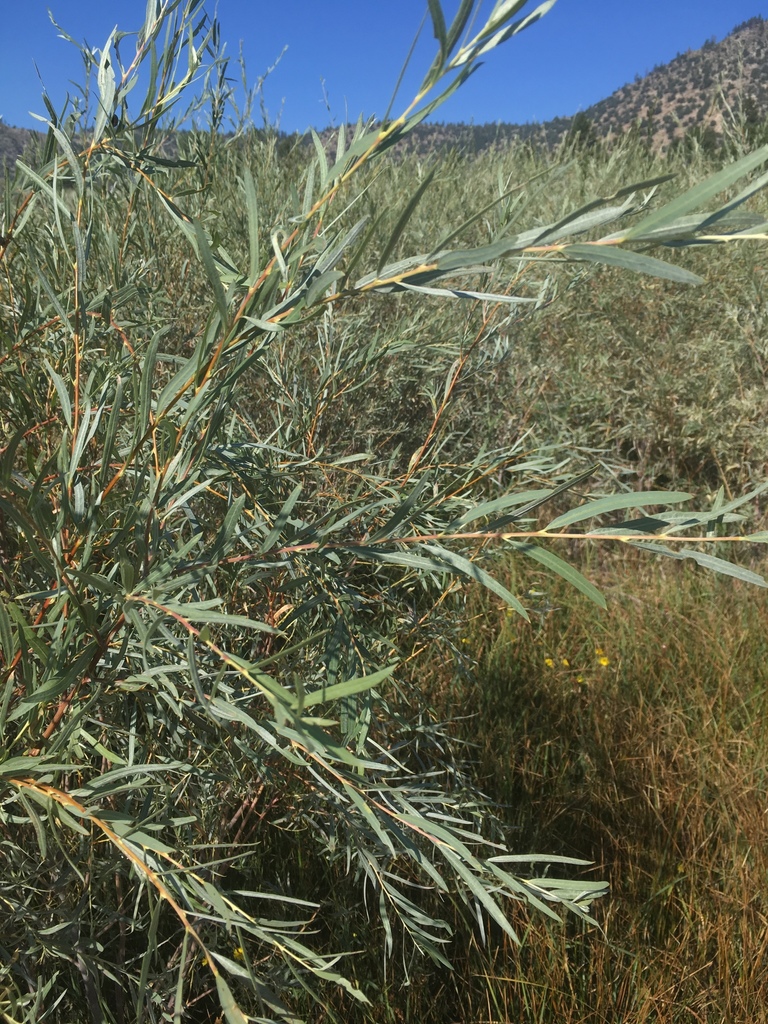
Narrowleaf Willow
Salix exigua
Salix exigua (sandbar willow, narrowleaf willow, or coyote willow; syn. S. argophylla, S. hindsiana, S. interior, S. linearifolia, S. luteosericea, S. malacophylla, S. nevadensis, and S. parishiana) is a species of willow native to most of North America except for the southeast and far north, occurring from Alaska east to New Brunswick, and south to northern Mexico. It is considered a threatened species in Massachusetts while in Connecticut, Maryland, and New Hampshire it is considered endangered.
From the article Salix exigua on Wikipedia (CC BY-SA), quoted section by section
Description
It is a deciduous shrub reaching 4–7 metres (13–23 ft) in height, exceptionally 7.6 m (25 ft) spreading by basal shoots to form dense clonal colonies. The leaves are narrow lanceolate, 4–12 centimetres (1+1⁄2–4+3⁄4 in) long and 2–10 millimetres (1⁄16–3⁄8 in) broad, green, to grayish with silky white hairs at least when young; the margin is entire or with a few irregular, widely spaced small teeth. The flowers are produced in catkins in late spring, after the leaves appear. It is dioecious, with staminate and pistillate catkins on separate plants, the male catkins up to 10 cm (4 in) long, the female catkins up to 8 cm (3 in) long. The fruit is a cluster of capsules, each containing numerous minute seeds embedded in shiny white silk.
What it does
The male flowers provide pollen for bees. It is a larval host to the California hairstreak, Lorquin's admiral, mourning cloak, sylvan hairstreak, tiger swallowtail, and viceroy.
Wikipedia: “Ecology”
At the table
This willow has many uses for Native Americans; the branches are used as flexible poles and building materials, the smaller twigs are used to make baskets, the bark is made into cord and string, and the bark and leaves have several medicinal uses. The Zuni people take an infusion of the bark for coughs and sore throats. The foliage is browsed by livestock.
Wikipedia: “Uses”
How it is grown
Salix exigua is cultivated as an ornamental tree. In the UK it has gained the Royal Horticultural Society's Award of Garden Merit.
Wikipedia: “Cultivation”
Where it lives
Recorded sightings
—
geo-referenced records in GBIF, from museums, herbaria and field observers.
Drag the globe to turn it. Dots are where records exist, not a range map; darker means more records.
In the stacks
Searching the stacks…
Every page naming Salix exigua in the Biodiversity Heritage Library →
This page is assembled live from iNaturalist, GBIF, Wikipedia, the Source Library and the Internet Archive. It is not yet part of the hand-edited codex. iNaturalist taxon 59008.