- Plants
- ›Vascular Plants
- ›flowering plants
- ›Dicots
- ›Nances, Willows, and Allies
- ›willow family
- ›Salix
- ›Protitea
- ›Humboldtianae
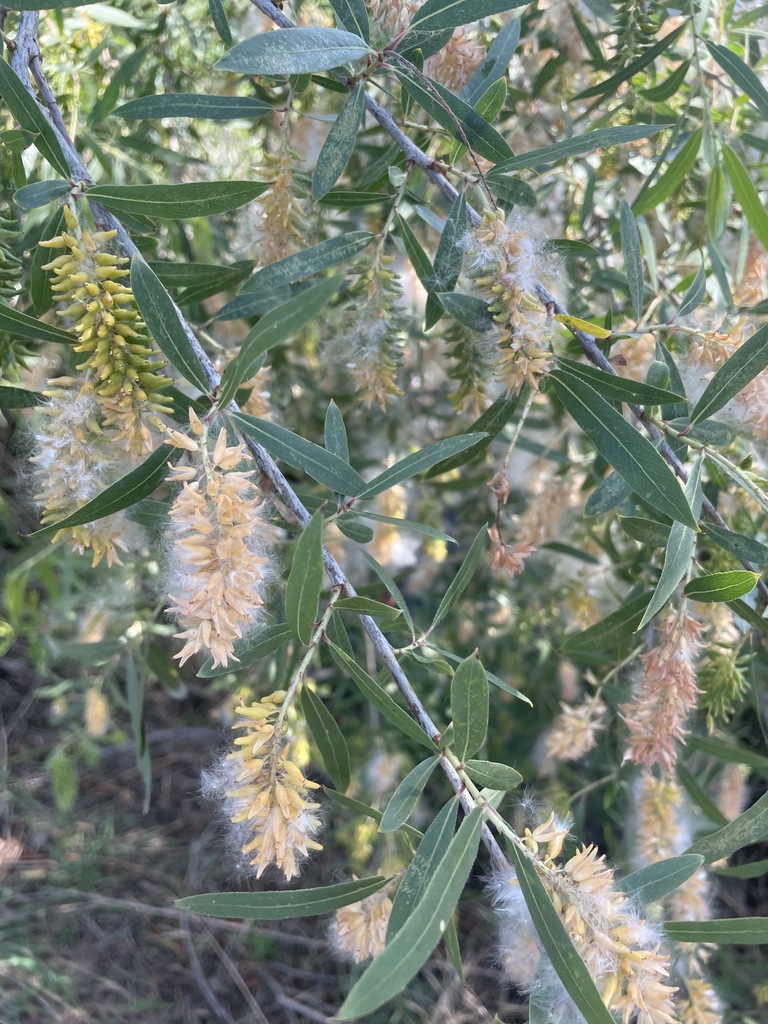
Goodding's willow
Salix gooddingii
Salix gooddingii is a species of willow known by the common name Goodding's willow, or Goodding's black willow. It was named for its collector, Leslie Newton Goodding.
Salix gooddingii is native to the southwestern United States and northern Mexico, where it grows in moist and wet habitat in many types of habitat from mountains to desert. It is a common riparian species. It is a tree growing to 3 to 30 m (9.8 to 98.4 ft) tall, with thick, furrowed, shreddy bark and many thin branches. The leaves are up to 13 cm long, generally lance-shaped, and finely serrated along the edges. The young leaves are coated in hairs. The inflorescence is a catkin of flowers up to 8 cm long. Sometimes it is considered a variant of Salix nigra.
Where it lives
Recorded sightings
—
geo-referenced records in GBIF, from museums, herbaria and field observers.
Drag the globe to turn it. Dots are where records exist, not a range map; darker means more records.
In the stacks
Searching the stacks…
Every page naming Salix gooddingii in the Biodiversity Heritage Library →
This page is assembled live from iNaturalist, GBIF, Wikipedia, the Source Library and the Internet Archive. It is not yet part of the hand-edited codex. iNaturalist taxon 60240.