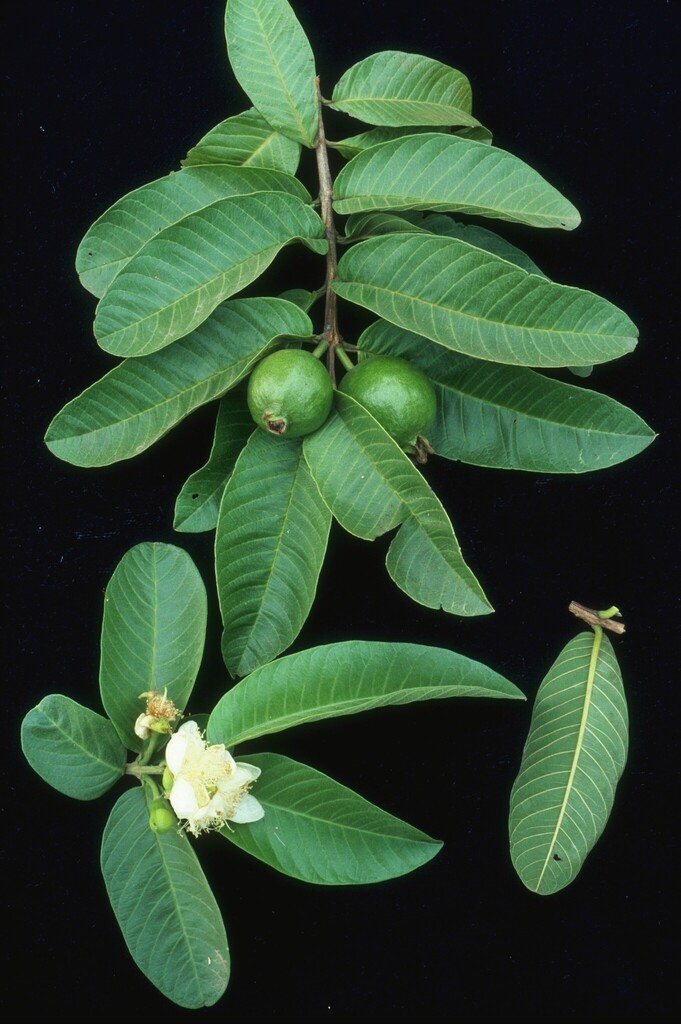
 NL·0109
Herbarium of the Nature Library
- Name
- Psidium guajava
- Family
- Myrtaceae
- Native to
- Tropical America from Mexico to northern South America; naturalised throughout the tropics
- Habitat
- Tropical dry forest, Pastures and disturbed ground, Homegardens
Guava
Psidium guajava
Also calledAmrood (Hindi/Urdu) · Peyara (Bengali) · Guayaba (Spanish) · Goiaba (Portuguese) · Fānshíliu (Chinese) · Jambu batu (Malay) · Mpera (Swahili)
A tough, small tropical American tree with peeling coppery bark and intensely fragrant fruit, often far richer in vitamin C than an orange. It thrives so well that it has become an invasive weed on many tropical islands.
Psidium guajava, the common guava, yellow guava, lemon guava, or apple guava is an evergreen shrub or small tree native to South America. It is pollinated by insects. When cultivated, it is pollinated mainly by the common honey bee, Apis mellifera. Wikipedia
What it can do
- iFruits within 2–4 years from seed and can crop twice a year
- iiTolerates drought, poor soils and periodic flooding
- iiiSpreads rapidly via bird- and pig-dispersed seed, invading Pacific islands such as the Galápagos
- ivPeeling, mottled coppery bark sheds in thin flakes
At the table
Eatenfruit (fresh, juice, paste, jelly) · leaves (tea)
Fruit, skin and seeds are eaten. Seeds are hard; eating many can cause constipation.
In the medicine cabinet
| Tradition | Use |
|---|---|
| Mexican and Caribbean folk medicine | Guava-leaf tea for diarrhoea and stomach ache |
| Ayurveda | Leaf chewed or used as mouthwash for toothache and mouth ulcers |
| Japanese functional foods | Guava-leaf polyphenol tea (approved FOSHU) for moderating post-meal blood sugar |
Weight of evidence
Moderate. Some clinical trials with promising but limited or mixed results.
Active compounds
quercetin, guaijaverin, tannins, vitamin C, lycopene (pink types)
Fruit & seed


Fruit
Berry
Ripens: Varies; often two crops a year (summer and winter)
Round to pear-shaped berry 4–12 cm, green to yellow skin; white, pink or red flesh, musky-sweet, with a central pulp full of seeds.

Seed
3–5 mm
Many small, hard, kidney-shaped to angular seeds, cream to pale-yellow, 3–5 mm, embedded in the central pulp
- Dispersal
- Birds, bats, pigs, monkeys
- Germination
- Soak 2 weeks or boil briefly to soften the coat, sow at 25–30 °C; 2–8 weeks
Photographs from Wikimedia Commons under open licences; hover for the photographer, click for the file.
How to grow it
Hardiness (USDA zones)
USDA 9b–12. Survives winters down to about -7 °C.
- Light
- Full sun
- Water
- Moderate; tolerates drought but fruits better with regular water
- Soil
- Adaptable — sand, clay, limestone; pH 5–7
- Propagation
- Air layering, cuttings, grafting; seed
- To harvest
- 2–4 years from seed, 1–2 years from layers
- Climates
- Tropical, Subtropical
- 1Plant an air-layered or grafted plant of a good variety ('Allahabad Safeda', 'Ruby Supreme') in full sun.
- 2Water regularly while establishing; mulch and feed every few months with balanced fertiliser.
- 3Prune after each crop to keep the tree 2–3 m tall and open; fruit forms on new growth.
- 4Bag young fruit with paper or mesh in areas with fruit flies.
- 5Pick when the skin turns from dark to light green or yellow and the fruit smells strongly; ripen at room temperature.
Can it grow where you are?
Where it lives
Recorded sightings
—
geo-referenced records in GBIF, from museums, herbaria and field observers.
Native range
Tropical America from Mexico to northern South America; naturalised throughout the tropics
Drag the globe to turn it. Dots are where records exist, not a range map; darker means more records.
In the old herbals & bestiaries
Woodcuts and engravings matched from the Source Library’s scanned books by name. Plates marked “relative” show a close kin rather than this exact species. Click a plate to read the page it came from, with translation.

Flora Sinensis (Chinese-Latin Natural History)
Michał Boym · 1656 · p.43

Florentine Codex, Vol. 3 (Books 10-12)
Bernardino de Sahagún · 1577 · p.561

Christoph Jakob Trew — Uitgezochte planten (1771)
Christoph Jakob Trew · 1771 · p.176

Rariorum Plantarum Historia (with Fungorum Historia)
Carolus Clusius · 1601 · p.636

Historia naturalis Brasiliae
Willem Piso / Georg Marcgraf · 1648 · p.250

De Indiae utriusque re naturali et medica
Willem Piso · 1658 · p.181

Elements of Botany
Joseph Pitton de Tournefort · 1719 · p.194

The Ambonese Herbal (Herbarium Amboinense), Vol. 1
Georg Eberhard Rumphius · 1741 · p.229
In the stacks
Searching the stacks…
Every page naming Psidium guajava in the Biodiversity Heritage Library →
Marginalia
Spanish chronicler Gonzalo Fernández de Oviedo described guavas in the Caribbean in 1526, and the Portuguese carried them to India, where Allahabad guavas became famous. Guava paste eaten with cheese ('Romeo y Julieta') is a classic in Brazil and the Caribbean.
Curiosity
Guava fruit can hold about four times the vitamin C of an orange by weight — roughly 228 mg per 100 g.
Kinship
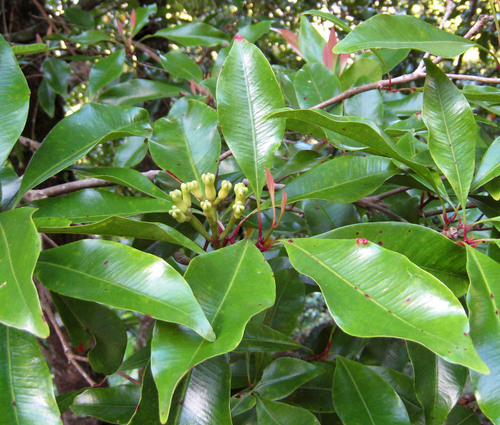

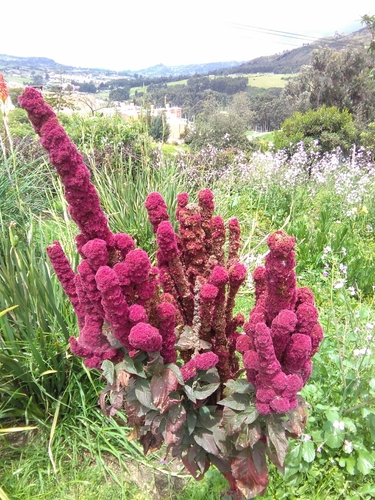



Fact-checked: 1 correction made to this sheet. Photographs: iNaturalist contributors under the licences shown. Records: GBIF.org. Historical plates: Source Library (CC BY-SA 4.0; originals public domain). Summary text: Nature Library editors and Wikipedia (CC BY-SA). Medicinal and edibility notes are historical and educational, not advice. iNaturalist taxon 62859.