 NL·0148
Herbarium of the Nature Library
- Name
- Coffea arabica
- Family
- Rubiaceae
- Native to
- South-western Ethiopia, the Boma Plateau of South Sudan and Mount Marsabit in Kenya; cultivated in tropical highlands worldwide
- Habitat
- Afromontane forest understorey, Tropical highland plantations
Arabica coffee
Coffea arabica
Also calledBunn (Arabic) · Qahwa (Arabic, the drink) · Buna (Amharic) · Kahve (Turkish) · Kāfēi (Chinese) · Kahawa (Swahili) · Café (Spanish/Portuguese)
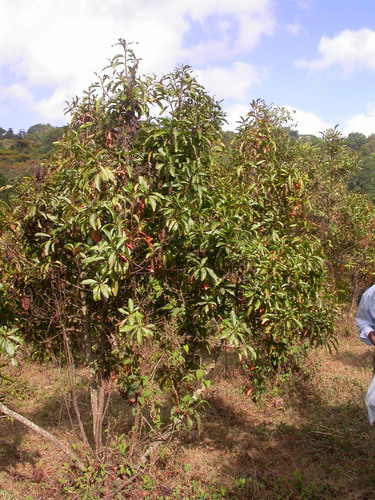
An evergreen shrub of Ethiopia's highland forests whose roasted seeds make about 60% of the world's coffee. A natural hybrid of two wild species, it is unusual in its genus for being self-fertile, and wild populations are Endangered by deforestation and climate change.
Coffea arabica, also known as the Arabica coffee, is a species of flowering plant in the coffee and madder family Rubiaceae. It is believed to be the first species of coffee to have been cultivated and is the dominant cultivar, representing about 60% of global production. Coffee produced from the less acidic, more bitter, and more highly caffeinated robusta bean makes up most of the remaining coffee production. The natural populations of Coffea arabica are restricted to the forests of South Ethiopia, South Sudan, and Yemen. Wikipedia
What it can do
- iAllotetraploid hybrid of Coffea canephora and Coffea eugenioides
- iiSelf-pollinating, unlike almost all other Coffea species
- iiiCaffeine in seeds and leaves deters insects and inhibits competing seedlings
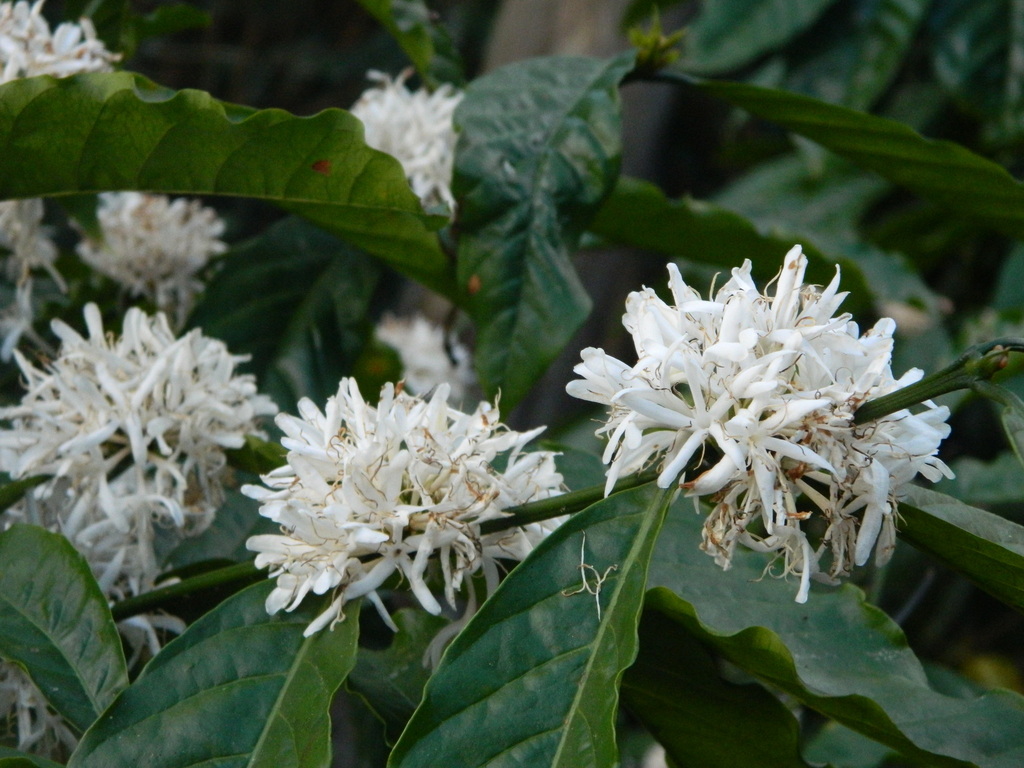
- ivJasmine-scented white flowers open all at once after the first rains
At the table
Eatenseeds (roasted, brewed) · fruit pulp (cascara tea) · leaves (brewed as tea in Ethiopia and Sumatra)
Beans, cherry husk and leaves are used for drinks. Caffeine overdose from concentrated products can be dangerous.
In the medicine cabinet
| Tradition | Use |
|---|---|
| Sufi devotional practice (Yemen) | Coffee drunk to stay awake during night prayers in the 15th century |
| Modern medicine | Caffeine is an approved drug, used with analgesics for headache and for apnoea in premature infants |
| Ethiopian folk medicine | Coffee leaves and husks brewed with butter or salt as a tonic |
Weight of evidence
Strong. An approved drug, or consistent results in well-run clinical trials.
Active compounds
caffeine, chlorogenic acids, trigonelline, cafestol, kahweol
Fruit & seed


Fruit
Drupe ('cherry')
Ripens: Varies by region; 6–9 months after flowering
Oval cherry 1–1.5 cm, green ripening to bright red or yellow, with thin sweet pulp around two seeds back to back.

Seed
8–12 mm
Pale greenish-grey to bluish 'green beans', oval, about 1 cm long, flat on one face with a central S-shaped groove, domed on the other; covered by a papery parchment and a silver skin. A single round seed ('peaberry') forms in some cherries
- Dispersal
- Birds and mammals eat the cherries
- Germination
- Remove pulp, sow fresh seed in parchment 1 cm deep at 25–30 °C in shade; slow, 6–10 weeks
Photographs from Wikimedia Commons under open licences; hover for the photographer, click for the file.
How to grow it
Hardiness (USDA zones)
USDA 10–12; best in frost-free tropical highlands (900–2,000 m). Survives winters down to about -1 °C.
- Light
- Partial shade; tolerates sun with ample water
- Water
- Moderate–high, with a short dry season to trigger flowering
- Soil
- Deep, well-drained, slightly acidic (pH 5–6.5), rich volcanic or forest loam
- Propagation
- Seed (comes reasonably true because self-pollinating); cuttings of selected lines
- To harvest
- 3–4 years to first crop
- Climates
- Tropical highland, Subtropical
- 1Sow fresh seed of a named variety (e.g. 'Typica', 'Bourbon', or rust-resistant 'Castillo') in shaded nursery bags.
- 2Transplant at 6–12 months, 2–2.5 m apart, under light shade trees that also protect against wind.
- 3Mulch, feed with compost, and water during dry spells, while allowing a short dry spell before the main rains to induce mass flowering.
- 4Prune to control height (1.5–2 m) and remove old unproductive stems periodically; watch for coffee leaf rust.
- 5Hand-pick only fully red cherries; process by washing and fermenting or by sun-drying whole cherries.
Can it grow where you are?
Where it lives
Recorded sightings
—
geo-referenced records in GBIF, from museums, herbaria and field observers.
Native range
South-western Ethiopia, the Boma Plateau of South Sudan and Mount Marsabit in Kenya; cultivated in tropical highlands worldwide
Drag the globe to turn it. Dots are where records exist, not a range map; darker means more records.
In the old herbals & bestiaries
No plate in the Source Library names this exact species, so these show its closest relatives as the old naturalists drew them: same genus, or the same kind of plant. Click a plate to read the page it came from, with translation.

A key to physic, and the occult sciences
Relative · Sibly, Ebenezer · 1810 · p.556

The Anatomy of Plants (Vol. 1)
Relative · Nehemiah Grew · n.d. · p.554

The Book of Household Management
Relative · Mrs Isabella Beeton · 1861 · p.950

Complete Treatise on Agricultural Administration
Relative · Xu Guangqi · 1909 · p.755

Ten Books of Exotic Things
Relative · Carolus Clusius · 1605 · p.256

On the Simple Medicines from the West Indies
Relative · Nicolas Monardes · 1574 · p.220
In the stacks
Searching the stacks…
Every page naming Coffea arabica in the Biodiversity Heritage Library →
Marginalia
Ethiopian legend credits the goatherd Kaldi with noticing his goats dancing after eating coffee cherries. Coffee houses spread from Yemen to Mecca, Cairo and Istanbul by the 16th century, and Ottoman authorities repeatedly tried to ban them as places of sedition.
Curiosity
The Typica coffee of much of the Caribbean and Latin America traces to a few plants: one given to Louis XIV in 1714 was the source of seedlings Gabriel de Clieu carried to Martinique around 1720, sharing his water ration with it on the voyage.
Kinship

Photographs: iNaturalist contributors under the licences shown. Records: GBIF.org. Historical plates: Source Library (CC BY-SA 4.0; originals public domain). Summary text: Nature Library editors and Wikipedia (CC BY-SA). Medicinal and edibility notes are historical and educational, not advice. iNaturalist taxon 64342.