- Plants
- ›Vascular Plants
- ›flowering plants
- ›Dicots
- ›pinks, cactuses, and allies
- ›cacti
- ›globular cacti, moonlight cacti, torch cacti, and allies
- ›Trichocereeae
- ›Cleistocactus
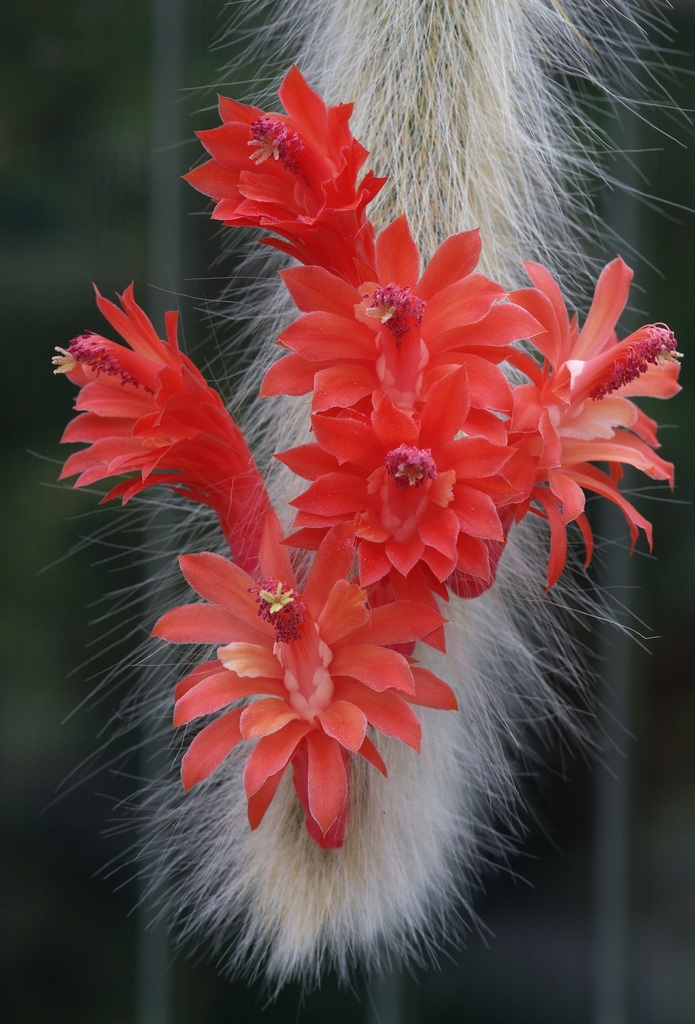
Cleistocactus colademononis
Cleistocactus winteri is a succulent of the family Cactaceae. Its common name is the golden rat tail. Cleistocactus colademononis, which has gained the Royal Horticultural Society's Award of Garden Merit, is sometimes considered to be a subspecies, Cleistocactus winteri subsp. colademono.
From the article Cleistocactus winteri on Wikipedia (CC BY-SA), quoted section by section
Description
This plant is a columnar cactus that forms huge tangled mounds of fairly rapid growth hanging or creeping, green shoots, up to 90 centimetres (35 in) high with stems 2 to 2.5 centimetres (3⁄4 to 1 in) in diameter and 16 to 17 ribs, with 50 spines 0.4 to 1 centimetre (1⁄8 to 3⁄8 in) long. The brown areoles on it are close together. It has many short bristly golden spines that are flexible, thin and straight and literally cover the surface of the stems. The approximately 20 stronger central spines are 5 to 10 millimeters long. The plant requires water during the summer and to be kept dry in the winter. It reproduces by seeds and cuttings. It has salmon-pink flowers in spring and summer that are 4 to 6 centimetres (1+1⁄2 to 2+1⁄4 in) long and 5 centimetres (2 in) in diameter. Depending on the position of the shoots, the flowers are bent upwards to outwards to upright. The bracts are orange-red. The outer ones are radiating to slightly reflexed, the inner ones distinctly shorter and erect. Its flowers survive for a few days before transitioning to fruit for a short period of time which are 1 centimetre (3⁄8 in) long. The stamens and style protrude from the flower. The barrel-shaped, green to reddish-green fruits are 7 to 10 millimeters long and reach the same diameter.
Range & habitat
Cleistocactus winteri is distributed in the Bolivian department of Santa Cruz in the province of Florida at altitudes of about 1400 to 1500 meters where it hangs on rocks.
Wikipedia: “Distribution”
Where it lives
Recorded sightings
—
geo-referenced records in GBIF, from museums, herbaria and field observers.
Drag the globe to turn it. Dots are where records exist, not a range map; darker means more records.
In the stacks
Searching the stacks…
Every page naming Cleistocactus colademononis in the Biodiversity Heritage Library →
This page is assembled live from iNaturalist, GBIF, Wikipedia, the Source Library and the Internet Archive. It is not yet part of the hand-edited codex. iNaturalist taxon 707436.