- Plants
- ›Vascular Plants
- ›flowering plants
- ›Dicots
- ›Nances, Willows, and Allies
- ›willow family
- ›Salix
- ›Vetrix
- ›Phylicifoliae
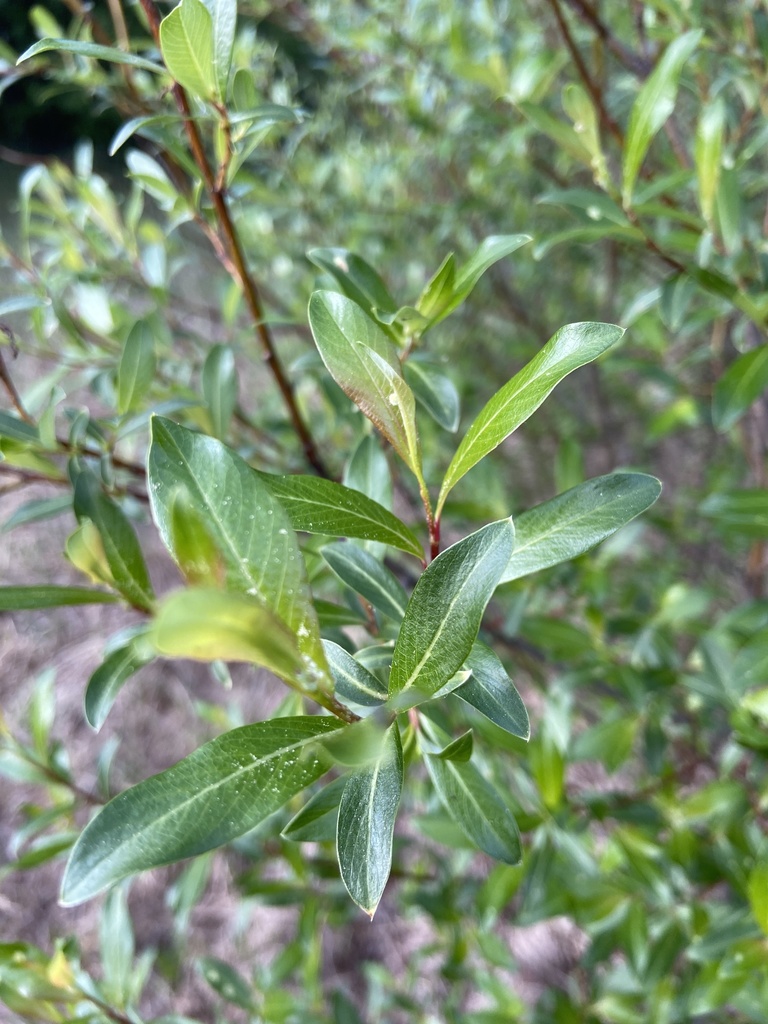
tea-leafed willow
Salix planifolia
Salix planifolia is a species of willow known by the common names planeleaf willow, diamondleaf willow, and tea-leafed willow. It is native to northern and western North America, including most of Canada and the western United States. It grows in many types of arctic and alpine habitats in the north, and mountainous areas in the southern part of its range.
From the article Salix planifolia on Wikipedia (CC BY-SA), quoted section by section
Description
Salix planifolia is a shrub varying in size from low and bushy, to long thickets, to a treelike form 9 m (30 ft) in height. The leaves are generally oval in shape with pointed tips, measuring up to 6.5 cm long. They are smooth-edged or serrated, glossy on the upper surface, and sometimes with silky hairs. The inflorescence is a catkin of flowers a few centimeters long. Salix pulchra, also commonly called diamondleaf or tealeaf willow and sometimes treated as a subspecies of S. planifolia (S. planifolia ssp. pulchra), is now treated as a distinct species.
Where it lives
Recorded sightings
—
geo-referenced records in GBIF, from museums, herbaria and field observers.
Drag the globe to turn it. Dots are where records exist, not a range map; darker means more records.
In the stacks
Searching the stacks…
Every page naming Salix planifolia in the Biodiversity Heritage Library →
This page is assembled live from iNaturalist, GBIF, Wikipedia, the Source Library and the Internet Archive. It is not yet part of the hand-edited codex. iNaturalist taxon 78951.