 NL·0172
Herbarium of the Nature Library
- Name
- Vitis vinifera
- Family
- Vitaceae
- Native to
- Wild subspecies sylvestris from Western Europe to the Caucasus and Central Asia; cultivated worldwide in temperate and Mediterranean climates
- Habitat
- Riparian woodland (wild), Mediterranean hillsides, Vineyards
Grape vine
Vitis vinifera
Also calledAngoor (Hindi/Urdu/Persian) · 'Inab (Arabic) · Gefen (Hebrew) · Pútáo (Chinese) · Uva / Vid (Spanish) · Üzüm (Turkish) · Drākṣā (Sanskrit)
The Eurasian grape was domesticated in the South Caucasus and Near East around 8,000 years ago, where the oldest known wine residues were found in Georgian pottery. Thousands of cultivars, from 'Cabernet Sauvignon' to 'Thompson Seedless', are clones propagated by cuttings.
Vitis vinifera, the common grape vine, is a species of flowering plant, native to the Mediterranean region, Central Europe, and southwestern Asia, from Morocco and Portugal north to southern Germany and east to northern Iran. As of 2012, there were between 5,000 and 10,000 varieties of Vitis vinifera grapes though only a few are of commercial significance for wine and table grape production. Wikipedia
What it can do
- iClimbs using coiling tendrils that wrap around supports within hours of touching them
- iiDomestication turned a dioecious wild vine into self-pollinating hermaphrodite cultivars
- iiiFruit skin hosts wild yeasts that can ferment crushed grapes into wine unaided
- ivCan live and fruit for centuries; a vine in Maribor, Slovenia, is over 400 years old
At the table
Eatenfruit (fresh, dried as raisins, juiced, fermented) · leaves (stuffed, e.g. dolma) · seed oil
Fruit and leaves are eaten widely. Grapes and raisins are toxic to dogs and can cause kidney failure.
In the medicine cabinet
| Tradition | Use |
|---|---|
| Ayurveda | Drākṣā (raisins) as a cooling laxative and in tonics such as Drākṣārishta |
| European herbal medicine | Red vine leaf extract for chronic venous insufficiency (heavy, swollen legs) |
| Unani | Raisins (munaqqa) for coughs and as a nutritive |
Weight of evidence
Moderate. Some clinical trials with promising but limited or mixed results.
Active compounds
resveratrol, proanthocyanidins, tartaric acid, quercetin
Fruit & seed
Fruit
Berry
Ripens: Late summer to autumn
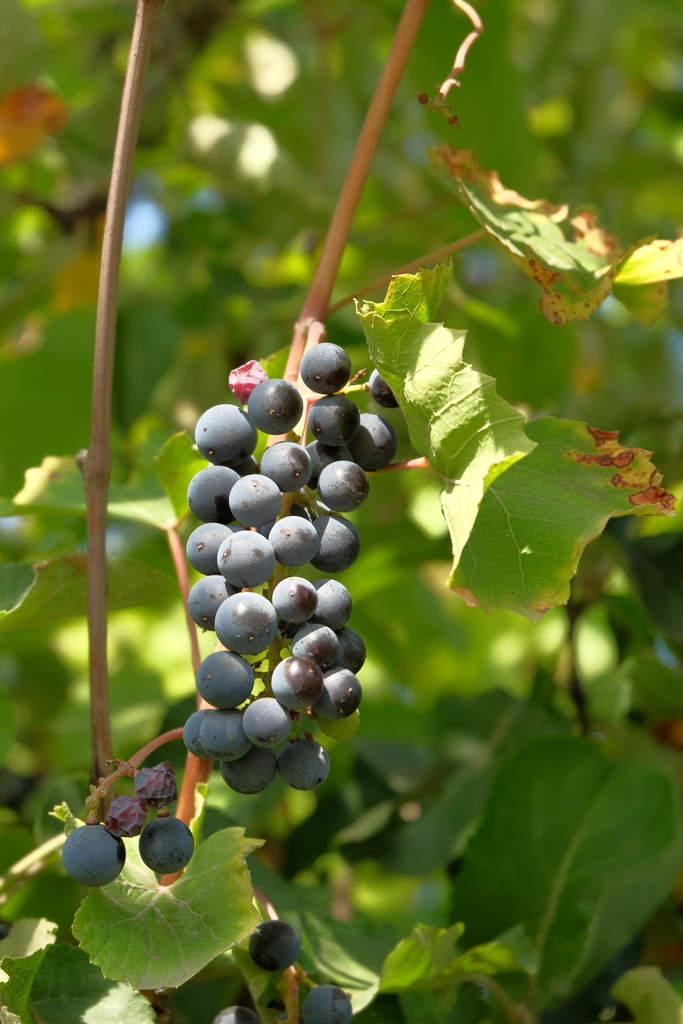
Round to oval berries 1–3 cm in tight bunches; skin green, golden, red, purple or blue-black with a waxy bloom; juicy translucent flesh.
Seed
4–7 mm
Pear- or teardrop-shaped pips with a short beak, light to dark brown, 4–7 mm long, with a hard woody coat; usually 1–4 per berry (absent or vestigial in seedless types)
- Dispersal
- Birds and mammals
- Germination
- Cold-stratify 2–3 months at 2–4 °C, then sow at 20–25 °C; 2–8 weeks. Offspring differ from the parent
How to grow it
Hardiness (USDA zones)
USDA 6–10 (vinifera); hybrids and American species to 4. Survives winters down to about -23 °C.
- Light
- Full sun
- Water
- Low–moderate; mild water stress after fruit set improves flavour
- Soil
- Deep, well-drained, even stony or poor; pH 5.5–7.5
- Propagation
- Hardwood cuttings of 3–4 buds taken in winter; grafting onto phylloxera-resistant rootstock where the pest is present
- To harvest
- First crop in year 2–3; full crop by year 4–5
- Climates
- Mediterranean, Temperate, Semi-arid
- 1Select a variety for your heat and season length; where phylloxera or nematodes occur, buy vines grafted onto resistant American rootstock.
- 2Plant in winter or early spring beside a sturdy trellis, wire fence or pergola, 1.5–2.5 m apart.
- 3In year one, let one strong shoot grow and tie it up as the trunk; remove others.
- 4Each winter, prune hard — leave 2-bud spurs (spur pruning) or 1–2 long canes (cane pruning), since fruit forms on new shoots from last year's wood.
- 5Thin leaves around bunches for airflow, net against birds, and pick when berries taste sweet and seeds have turned brown.
Can it grow where you are?
Where it lives
Recorded sightings
—
geo-referenced records in GBIF, from museums, herbaria and field observers.
Native range
Wild subspecies sylvestris from Western Europe to the Caucasus and Central Asia; cultivated worldwide in temperate and Mediterranean climates
Drag the globe to turn it. Dots are where records exist, not a range map; darker means more records.
In the old herbals & bestiaries
Woodcuts and engravings matched from the Source Library’s scanned books by name. Plates marked “relative” show a close kin rather than this exact species. Click a plate to read the page it came from, with translation.

On the Names of Plants
Hieronymus Bock (Tragus) · 1552 · p.1128

Ortus sanitatis
1491 · p.480

Notable Commentaries on the History of Plants
Leonhart Fuchs · 1542 · p.118

Notable Commentaries on the History of Plants
Leonhart Fuchs · 1549 · p.116

On Medical Materials in Six Books
Dioscorides · 1550 · p.669

De medicinali materia libri sex
Dioscorides · 1552 · p.677

Commentaries on the Six Books of Dioscorides
Pietro Andrea Mattioli · 1560 · p.824

Commentaries on the Six Books of Dioscorides on Medical Matter
Pietro Andrea Mattioli · 1563 · p.740

Commentaries on the Six Books of Pedanius Dioscorides on Medical Matter
Pietro Andrea Mattioli · 1565 · p.1492

Discourses on the Six Books of Dioscorides
Dioscorides; Pietro Andrea Mattioli (comm.) · 1568 · p.1558
In the stacks
Searching the stacks…
Every page naming Vitis vinifera in the Biodiversity Heritage Library →
Marginalia
Clay jars at Gadachrili Gora in Georgia hold wine residues from about 6000 BCE, and wine was central to the rites of Dionysus and the Christian Eucharist. Persian poets such as Omar Khayyam and Hafez made the vine and its wine a symbol of mystical intoxication.
Curiosity
Nearly every European wine vine today grows on American rootstock, after the aphid-like phylloxera devastated Europe's vineyards in the 1860s–1890s.
Kinship



Photographs: iNaturalist contributors under the licences shown. Records: GBIF.org. Historical plates: Source Library (CC BY-SA 4.0; originals public domain). Summary text: Nature Library editors and Wikipedia (CC BY-SA). Medicinal and edibility notes are historical and educational, not advice. iNaturalist taxon 79519.