- Animals
- ›Arthropods
- ›Hexapods
- ›Insects
- ›Winged and Once-winged Insects
- ›Butterflies and Moths
- ›Butterflies
- ›Brush-footed Butterflies
- ›Leafwing Butterflies
- ›Dragon-headed Caterpillars
- ›Charaxes
- ›Charaxes
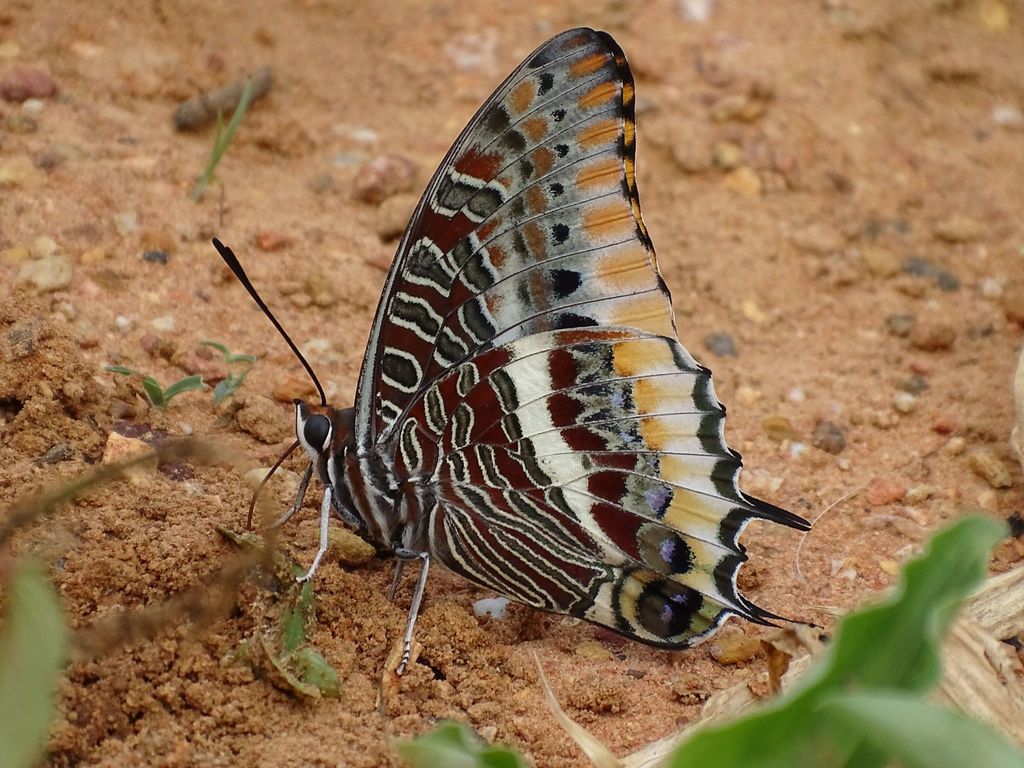
Cream-bordered Charaxes
Charaxes epijasius
Charaxes epijasius, the cream-bordered charaxes or Sahel charaxes, is a butterfly in the family Nymphalidae. It flies through most of the Savannah of the Afrotropical realm except southern Africa.
From the article Charaxes epijasius on Wikipedia (CC BY-SA), quoted section by section
Description
Charaxes epijasius is a medium to large butterfly. West African and Ethiopian examples tend to be smaller than more central and eastern African specimens. The male has a wingspan of 62–84 mm in West Africa, up to 80-95mm further east, females larger up to 95-102mm. Each hindwing bears two tails, characteristic of most species of the genus, which tend to curve slightly towards each other to a variable degree. The upperside ground colour of the wings is very dark brownish-black, with a slight purplish bloom. Forewing sometimes with suggestion of slightly lighter discal bars, usually with no post-discal spots on the forewing, though sometimes one or two near the costa, often faint; hindwing with pale whitish-yellow patch near costal border, dusted with blackish scales; admarginal outer band of both wings light golden-yellow colour, divided by black-scaled veins. Hindwing has a post-discal broad wedge of bright sky blue clearly demarcated from the admarginal yellow by a well-defined black scalloped border. The underside has a characteristic mosaic appearance, in common with other members of the Charaxes jasius species Group, traversed by a jumble of bands and of brown, reddish, and grey-blackish patches, all edged with a filigree of white. Beyond the inner mosaic, a white complete discal band bridges across fore- to hindwings, tapering down towards the forewing costa. …
Range & habitat
This tropical savannah species occurs in Africa from Senegal (the Type Location) in the west, encompassing all the Sub-Saharan savanna belt countries to Nigeria, Cameroun, Central African Republic, across to South Sudan, north-eastwards to Ethiopia, and southwards to Uganda, SW Kenya, and the non-forested margins of N & NE Democratic Republic of Congo. It is not known to occur in Rwanda, Burundi, Tanzania, or any of Southern Africa.
Wikipedia: “Distribution”
What it does
Life-sized colour plates and detailed description of the larval and pupal stages of C. epijasius and related species were illustrated by Dr. V. G. L. van Someren.
Egg. Canary yellow eggs, 1.25mm diameter, are laid singly on the leaves or stem of the larval foodplant. They are spherical with slight flattening of the top which has shallow radial fluting. By 48hrs, a fertile egg will develop a brown ring around the top. Shortly prior to hatching at 7–10 days, it changes to olive-yellow with a black head
Larva. The larva eats the shell immediately after emerging. At first the yellowish olive 1st Instar larva closely resembles that of other species in the jasius subgroup, but after the first moult it is bright emerald green with very fine papillation, which separates it from related species C. castor. It has a yellow lateral line. The facial disc is green. The head bears 4 long pointed pink-tipped horns. The 5th and final larval stage lasts 14–18 days (up to 28 days), when it becomes slightly translucent and ready to pupate.
Pupa. The well-camouflaged pupa, at 26-28mm, is green with red spiracle dots. It attaches suspended by a silken pad to the underneath of a leaf or stem on the host plant. Emergence takes place at 10 days up to 4 weeks, depending on environmental temperature and humidity. Cool and dry conditions delay emergence.
Wikipedia: “Life cycle”
At the table
A wide variety of foodplants have been identified including grasses eg Sorghum bicolor (L.) Moench [=S. roxburghii], the West African shrub Lonchocarpus cyanescens (Schumach. & Thonn.) Benth., Cassine spp., the Red Spikethorn shrub & tree Gymnosporia senegalensis (Lam.) Loes., and the African shrub & tree Pleurostylia africana Loes. (Celastraceae).
Wikipedia: “Larval food plants”
In human culture
Charaxes epijasius is a fast-flying butterfly that displays male territorial behaviour, particularly hill-topping. Where a vantage point such as an Acacia tree is present, both sexes sometimes can be seen demonstrating a circling display behaviour. The adults of both sexes will suck at tree-sap, often crowded up to twenty at a source, and especially fermenting fruit juices, which can be used to bait the species. Males are also attracted to pungent foul attractants such as decomposing carcasses and animal excrement. C. epijasius can be seen through most of the year, except towards the end of the dry season: in Benin the adult is absent from the end of January to the beginning of April.
Life cycle. Life-sized colour plates and detailed description of the larval and pupal stages of C. epijasius and related species were illustrated by Dr. V. G. L. van Someren.
Egg. Canary yellow eggs, 1.25mm diameter, are laid singly on the leaves or stem of the larval foodplant. They are spherical with slight flattening of the top which has shallow radial fluting. By 48hrs, a fertile egg will develop a brown ring around the top. Shortly prior to hatching at 7–10 days, it changes to olive-yellow with a black head
Larva. The larva eats the shell immediately after emerging. …
Wikipedia: “Natural history”
Listen
Looking for field recordings…
Where it lives
Recorded sightings
—
geo-referenced records in GBIF, from museums, herbaria and field observers.
Drag the globe to turn it. Dots are where records exist, not a range map; darker means more records.
In the stacks
Searching the stacks…
Every page naming Charaxes epijasius in the Biodiversity Heritage Library →
This page is assembled live from iNaturalist, GBIF, Wikipedia, the Source Library and the Internet Archive. It is not yet part of the hand-edited codex. iNaturalist taxon 803493.