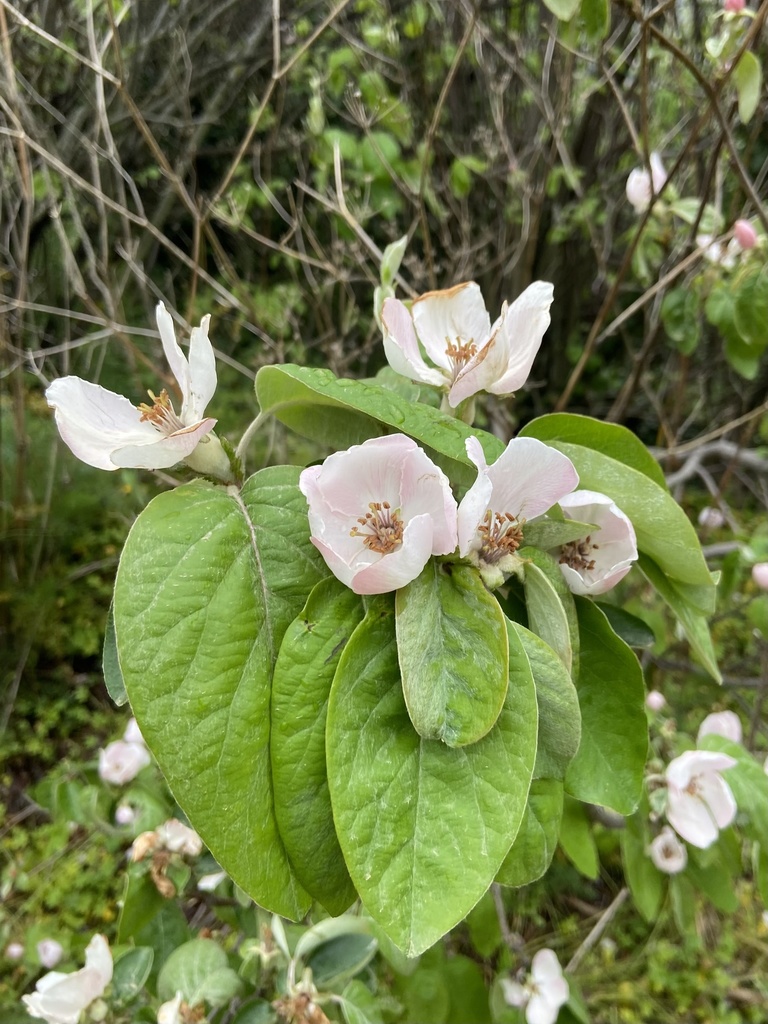
 NL·0140
Herbarium of the Nature Library
- Name
- Cydonia oblonga
- Family
- Rosaceae
- Native to
- The Caucasus, northern Iran, Turkmenistan and adjacent West Asia; cultivated across Europe, West and Central Asia and South America
- Habitat
- Mountain woodland, Orchards
Quince
Cydonia oblonga
Also calledBihi / Behi (Hindi/Urdu/Persian) · Safarjal (Arabic) · Ayva (Turkish) · Membrillo (Spanish) · Marmelo (Portuguese) · Kydóni (Greek) · Wēnpō (Chinese)
A small, crooked tree whose hard, golden, perfumed fruit is almost inedible raw but turns rosy-pink and fragrant when slowly cooked. The quince was the 'golden apple' of much ancient Greek myth, and its jelly-like paste gave the world the word 'marmalade'.
The quince is the sole member of the genus Cydonia in the Malinae subtribe of the Rosaceae family. It is a deciduous tree that bears hard, aromatic bright golden-yellow pome fruit, similar in appearance to a pear. Ripe quince fruits are hard, tart, and astringent. They are eaten raw or processed into jam, quince cheese, or alcoholic drinks. Wikipedia
What it can do
- iFruit flesh turns from white to deep pink-red when cooked long, as tannins convert to anthocyanin-like pigments
- iiSelf-fertile; large single flowers appear after the leaves, escaping most frosts
- iiiUsed worldwide as a dwarfing rootstock for pears
- ivSeed coat produces a thick mucilage when soaked
At the table
Eatenfruit (cooked into paste, jelly, stews; raw in mild varieties) · seed mucilage (soaked whole seeds)
Fruit is safe, mostly cooked. Seeds contain amygdalin and should not be crushed or eaten; whole soaked seeds are used only for their outer mucilage.
In the medicine cabinet
| Tradition | Use |
|---|---|
| Unani | Bihidana (quince-seed mucilage) for sore throats, coughs and dry skin |
| Persian traditional medicine | Quince syrup for nausea, vomiting and reflux; small trials report benefit in GERD |
Weight of evidence
Traditional. Long historical use; little or no modern clinical evidence.
Active compounds
pectin, tannins, mucilage (seed coat), amygdalin (seed kernel)
Fruit & seed


Fruit
Pome
Ripens: Autumn
Large pear- or apple-shaped pome 7–12 cm, covered in grey down when young, ripening to golden yellow and intensely fragrant; hard, astringent, gritty cream flesh.
Seed
6–8 mm
Many dark-brown, glossy, wedge-shaped seeds about 6–8 mm, packed in the five core chambers and coated in a gel that swells when wet
- Dispersal
- Mammals
- Germination
- Cold-stratify 60–90 days, sow in spring; usually propagated vegetatively
Photographs from Wikimedia Commons under open licences; hover for the photographer, click for the file.
How to grow it
Hardiness (USDA zones)
USDA 5–9. Survives winters down to about -29 °C.
- Light
- Full sun
- Water
- Moderate; tolerates damp soil better than apples
- Soil
- Deep, moist, well-drained loam, pH 6–7; becomes chlorotic on chalk
- Propagation
- Hardwood cuttings, layering, budding onto quince rootstock
- To harvest
- 3–5 years
- Climates
- Temperate, Mediterranean, Continental
- 1Plant a named variety (e.g. 'Vranja', 'Meech's Prolific', 'Isfahan') in full sun in moist but well-drained soil.
- 2Water during dry summers; a single tree is enough as quinces are self-fertile.
- 3Prune lightly in winter just to thin crowded and crossing branches — fruit forms at the tips of shoots, so avoid hard tip pruning.
- 4Watch for fireblight and leaf blight; remove infected shoots promptly.
- 5Pick in mid-to-late autumn when fully yellow and fragrant, before hard frost; store separately as their scent taints other fruit.
Can it grow where you are?
Where it lives
Recorded sightings
—
geo-referenced records in GBIF, from museums, herbaria and field observers.
Native range
The Caucasus, northern Iran, Turkmenistan and adjacent West Asia; cultivated across Europe, West and Central Asia and South America
Drag the globe to turn it. Dots are where records exist, not a range map; darker means more records.
In the old herbals & bestiaries
Woodcuts and engravings matched from the Source Library’s scanned books by name. Plates marked “relative” show a close kin rather than this exact species. Click a plate to read the page it came from, with translation.

Book of Herbs
Hieronymus Bock (Tragus) · 1546 · p.823

Notable Commentaries on the History of Plants
Leonhart Fuchs · 1549 · p.406

Commentaries on the Six Books of Dioscorides
Pietro Andrea Mattioli · 1560 · p.269

The Anatomy of Plants (Vol. 2)
Nehemiah Grew · 1682 · p.530

A New Herbal, or History of Plants
Rembert Dodoens (trans. Henry Lyte) · 1578 · p.732

Commentaries on the Six Books of Dioscorides
Pietro Andrea Mattioli · 1560 · p.253

The Book of Health: The Art of Distillation
Brunschwig, Hieronymus · 1505 · p.167

Garden of Health
1507 · p.92

Notable Commentaries on the History of Plants
Leonhart Fuchs · 1542 · p.408

On the Names of Plants
Hieronymus Bock (Tragus) · 1552 · p.1111
In the stacks
Searching the stacks…
Every page naming Cydonia oblonga in the Biodiversity Heritage Library →
Marginalia
Plutarch records that Solon's laws had Athenian brides eat a quince before entering the bridal chamber, and many scholars think the golden apples of the Hesperides were quinces. Portuguese 'marmelada', quince paste, gave English its word marmalade.
Curiosity
A ripe quince left in a room will perfume it for weeks — medieval Europeans kept them in linen chests.
Kinship



Photographs: iNaturalist contributors under the licences shown. Records: GBIF.org. Historical plates: Source Library (CC BY-SA 4.0; originals public domain). Summary text: Nature Library editors and Wikipedia (CC BY-SA). Medicinal and edibility notes are historical and educational, not advice. iNaturalist taxon 82853.