- Plants
- ›Vascular Plants
- ›flowering plants
- ›monocots
- ›Agaves, Orchids, Irises, and Allies
- ›Orchids
- ›Higher Epidendroid Orchids
- ›Cymbidieae
- ›Cymbidium Alliance Orchids
- ›Dipodium
- ›Dipodium
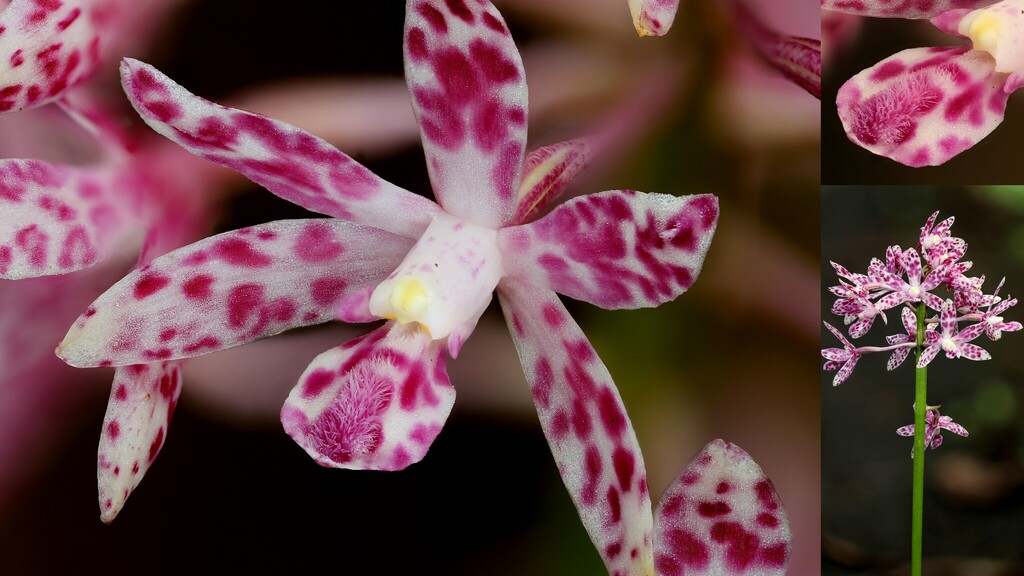
Bell-flower Hyacinth Orchid
Dipodium campanulatum
Dipodium campanulatum, commonly known as the bell-flower hyacinth orchid, is a leafless mycoheterotroph orchid that is endemic to south-eastern Australia. In summer it has up to thirty five white flowers with large, dark red spots and blotches.
From the article Dipodium campanulatum on Wikipedia (CC BY-SA), quoted section by section
Description
Dipodium campanulatum is a leafless, tuberous, perennial herb. For most of the year, plants are dormant and have no above-ground presence. The flowering stem reaches to a height of 400–700 mm (20–30 in) and appears between December and February. It bears between fifteen and thirty five slightly bell-shaped white flowers with large, dark red spots and blotches. The flowers are 15–30 mm (0.6–1 in) wide on a pedicel 10–18 mm (0.4–0.7 in) long. The sepals and petals are 12–14 mm (0.5–0.6 in) long, 3–5 mm (0.1–0.2 in) wide and all are free from each other with their tips curved slightly forwards. The labellum is 12–16 mm (0.5–0.6 in) long, 5–6 mm (0.20–0.24 in) wide with a narrow central band of mauve hairs up to 0.5 mm (0.02 in) long.
Range & habitat
The bell-flower hyacinth orchid occurs in South Australia near the Victorian border and near Apsley in Victoria. Associated tree species include stringybark (Eucalyptus baxteri or Eucalyptus arenacea) and Eucalyptus leucoxylon. Other associated species include wattles Acacia spp., bracken Pteridium esculentum, cranberry heath (Astroloma humifusum) and magenta storksbill (Pelargonium rodneyanum).
Wikipedia: “Distribution and habitat”
What it does
Pollination of this species, as for all species in the genus, is by native bees and wasps.
Wikipedia: “Ecology”
How it is grown
No leafless species of Dipodium has been sustained in cultivation due to the inability to replicate its association with mycorrhizal fungi in a horticultural context.
== References ==
Wikipedia: “Cultivation”
Where it lives
Recorded sightings
—
geo-referenced records in GBIF, from museums, herbaria and field observers.
Drag the globe to turn it. Dots are where records exist, not a range map; darker means more records.
In the stacks
Searching the stacks…
Every page naming Dipodium campanulatum in the Biodiversity Heritage Library →
This page is assembled live from iNaturalist, GBIF, Wikipedia, the Source Library and the Internet Archive. It is not yet part of the hand-edited codex. iNaturalist taxon 829435.