- Plants
- ›Vascular Plants
- ›flowering plants
- ›Dicots
- ›pinks, cactuses, and allies
- ›cacti
- ›globular cacti, moonlight cacti, torch cacti, and allies
- ›Pachycereae
- ›Echinocereus
- ›Triglochidiatus
- ›Scheeria
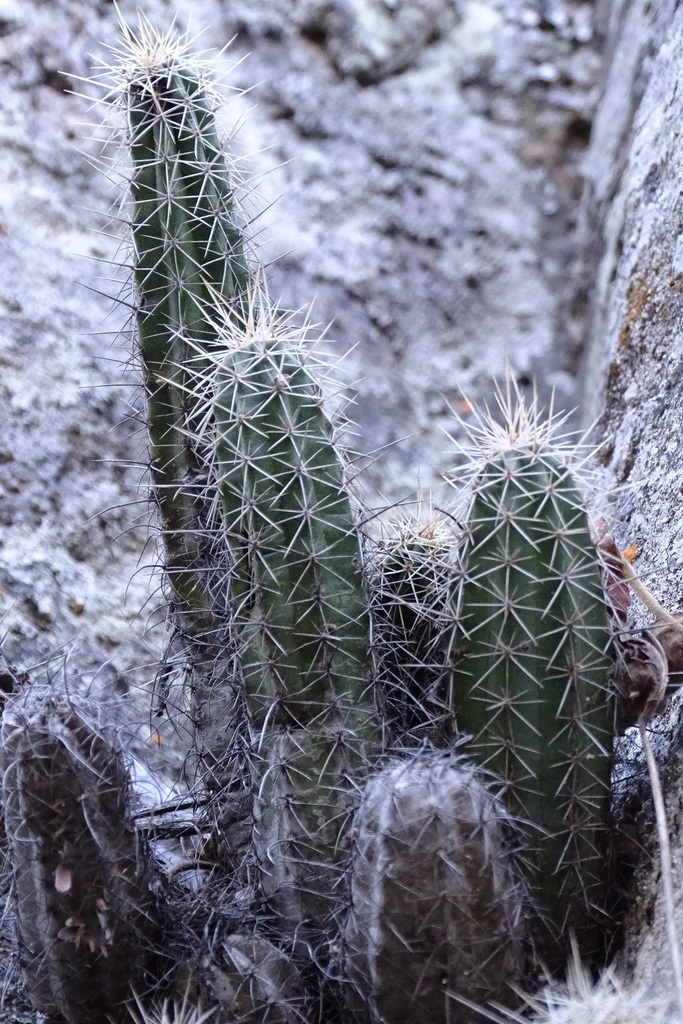
Echinocereus sanpedroensis
Echinocereus scheeri is a species of hedgehog cactus in the family Cactaceae, native to northern Mexico. With its dramatic offsets, it has gained the Royal Horticultural Society's Award of Garden Merit.
From the article Echinocereus scheeri on Wikipedia (CC BY-SA), quoted section by section
Description
Echinocereus scheeri usually grows with numerous shoots sprouting from its base and sometimes forms upright but usually splayed or creeping groups. The cylindrical shoots are tapered towards their tip. They are 10 to 70 cm (3.9 to 27.6 in) long and have a diameter of 1.5 to 4 cm (0.59 to 1.57 in). There are four to ten clearly blunt ribs, which are straight and occasionally tuberous on their sides. The up to four white to brownish central spines, which can also be missing, are 0.1 to 2 cm (0.039 to 0.787 in) long. The usually 6 to 13 white to light brown radial spines are 1 to 7 mm (0.039 to 0.276 in) long. The tubular-funnel-shaped flowers are pink to orange to scarlet. They appear along the sides of the shoots from sharply pointed buds, are 6 to 12 cm (2.4 to 4.7 in) long and reach 4 to 6 cm (1.6 to 2.4 in) in diameter. The short egg-shaped fruits are bright green and contain white pulp. They tear open lengthwise and are covered with slightly sloping thorns. Chromosome count is 2n=22.
Range & habitat
Echinocereus scheeri is distributed in the Mexican states of Sonora, Sinaloa, Chihuahua and Durango.
Wikipedia: “Distribution”
Where it lives
Recorded sightings
—
geo-referenced records in GBIF, from museums, herbaria and field observers.
Drag the globe to turn it. Dots are where records exist, not a range map; darker means more records.
In the stacks
Searching the stacks…
Every page naming Echinocereus sanpedroensis in the Biodiversity Heritage Library →
This page is assembled live from iNaturalist, GBIF, Wikipedia, the Source Library and the Internet Archive. It is not yet part of the hand-edited codex. iNaturalist taxon 858366.