- Plants
- ›Vascular Plants
- ›flowering plants
- ›Dicots
- ›pinks, cactuses, and allies
- ›cacti
- ›globular cacti, moonlight cacti, torch cacti, and allies
- ›Trichocereeae
- ›Trichocereus
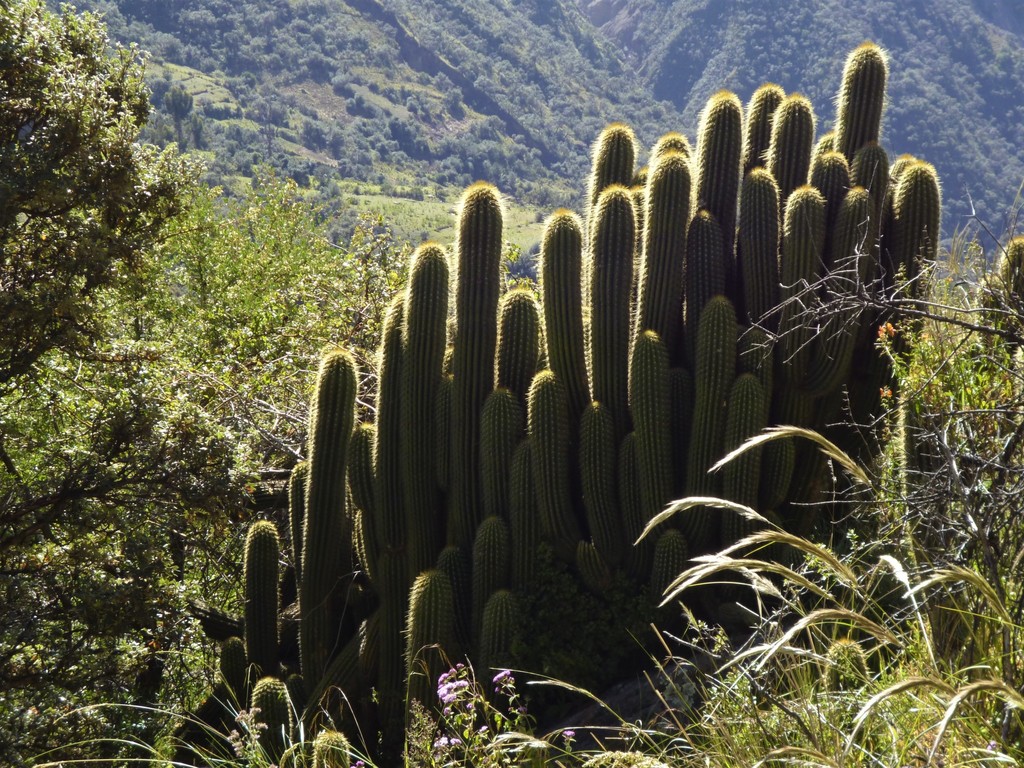
Trichocereus tunariensis
Leucostele tunariensis is a species of columnar cactus native to South America.
From the article Leucostele tunariensis on Wikipedia (CC BY-SA), quoted section by section
Description
Leucostele tunariensis exhibits a columnar growth pattern, branching from the base and attaining heights between 2 and 3 meters. The green shoots are club-shaped to cylindrical, with a diameter of up to 12 centimeters and 16 to 21 sharp-edged ribs. Gray oval areoles, spaced about 1 centimeter apart, decorate these ribs, each bearing approximately 17 spines ranging from 0.5 to 6 centimeters. Notably, these spines lack differentiation into central and peripheral categories, with some pointing downwards. The plant produces funnel-shaped, pink to red flowers near the shoot tips that bloom at night. These flowers measure 15 to 17 centimeters in length and have a diameter ranging from 12 to 15 centimeters. Another distinctive feature is the spherical, green fruits, with a diameter of 5 centimeters and a length of up to 4 centimeters.
Range & habitat
Leucostele tunariensis is native to the Cochabamba department in Bolivia, specifically in the Cercado province on Cerro Tunari at elevations between 3000 and 3800 meters.
Wikipedia: “Distribution”
Where it lives
Recorded sightings
—
geo-referenced records in GBIF, from museums, herbaria and field observers.
Drag the globe to turn it. Dots are where records exist, not a range map; darker means more records.
In the stacks
Searching the stacks…
Every page naming Trichocereus tunariensis in the Biodiversity Heritage Library →
This page is assembled live from iNaturalist, GBIF, Wikipedia, the Source Library and the Internet Archive. It is not yet part of the hand-edited codex. iNaturalist taxon 870262.