 NL·0097
Herbarium of the Nature Library
- Name
- Azadirachta indica
- Family
- Meliaceae
- Native to
- Indian subcontinent and drier parts of mainland Southeast Asia; widely planted across Africa, the Middle East, Australia and the Americas
- Habitat
- Dry tropical forest, Savanna, Arid scrub
Neem
Azadirachta indica
Also calledNimba (Sanskrit) · Neem (Hindi/Urdu) · Āzād-dirakht-i-hindī (Persian, 'free tree of India') · Dogonyaro (Hausa) · Margosa (Anglo-Portuguese) · Yìndù liàn 印度楝 (Chinese)
A fast-growing, drought-hardy evergreen of the Indian subcontinent, known in Sanskrit as sarva roga nivarini, 'healer of all ailments'. Its seeds yield azadirachtin, one of the most powerful natural insect deterrents known.
Azadirachta indica, commonly known as neem, margosa, nimtree or Indian lilac, is a tree in the Mahogany family Meliaceae. It is one of the two species in the genus Azadirachta. It is native to the Indian subcontinent and to parts of Southeast Asia, but is naturalized and grown around the world in tropical and subtropical areas. Its fruits and seeds are the source of neem oil. Nim is a Hindustani noun derived from Sanskrit nimba (निंब). Wikipedia
What it can do
- iSeeds contain azadirachtin, which stops many insects feeding and disrupts their moulting, at very low doses
- iiSurvives on as little as 400–1,200 mm of rain a year and puts down a deep taproot
- iiiGrows quickly on degraded, stony and alkaline soils; widely planted to hold back the Sahel
- ivStays in leaf through the dry season and casts dense shade
At the table
Eatenyoung leaves (cooked, bitter) · flowers · ripe fruit pulp
Tender leaves and flowers are eaten in small amounts in South Asian dishes, such as Bengali neem-begun and the Ugadi pachadi of South India. Neem seed oil is toxic if swallowed and has caused fatal encephalopathy and liver failure in infants. Never give neem oil by mouth.
In the medicine cabinet
| Tradition | Use |
|---|---|
| Ayurveda | Bitter leaves and bark for skin diseases, fever, intestinal worms and blood purification; twigs used as a chewing stick (datun) for teeth |
| Unani | Leaves and bark used as a blood purifier and antiseptic for boils, eczema and wounds |
| West African traditional medicine | Dogonyaro leaf and bark decoctions widely used against fever and malaria |
| Siddha | Leaf paste and oil applied for skin infections, smallpox and chickenpox care |
Weight of evidence
Traditional. Long historical use; little or no modern clinical evidence.
Active compounds
azadirachtin, nimbin, nimbidin, salannin, gedunin, quercetin
Fruit & seed
Fruit
Drupe
Ripens: Early to mid summer (June–August in India)
Olive-like, 1.5–2 cm, ripening yellow with thin sweetish pulp around one hard seed.


Seed
~1–1.5 cm
Single oily kernel inside a hard shell
- Dispersal
- Birds and bats eat the fruit
- Germination
- Fresh seed only, as viability falls within weeks; 1–3 weeks at 25–35 °C
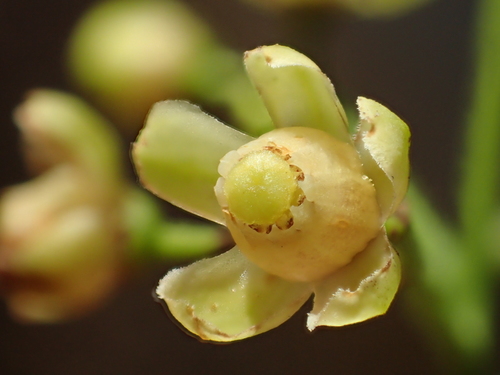
Photographs from Wikimedia Commons under open licences; hover for the photographer, click for the file.
How to grow it
Hardiness (USDA zones)
USDA 10–12. Survives winters down to about -1 °C.
- Light
- Full sun
- Water
- Low once established
- Soil
- Any well-drained soil; tolerates poor, stony and alkaline ground; dislikes waterlogging
- Propagation
- Fresh seed or cuttings
- To harvest
- Leaves within a year; fruit from 3–5 years
- Climates
- Tropical, Semi-arid
- 1Sow freshly cleaned seed within days of collection
- 2Transplant seedlings at 3–4 months into a sunny, frost-free site
- 3Water through the first dry season only
- 4Prune to shape, as it tolerates heavy lopping
Can it grow where you are?
Where it lives
Recorded sightings
—
geo-referenced records in GBIF, from museums, herbaria and field observers.
Native range
Indian subcontinent and drier parts of mainland Southeast Asia; widely planted across Africa, the Middle East, Australia and the Americas
Drag the globe to turn it. Dots are where records exist, not a range map; darker means more records.
In the old herbals & bestiaries
Woodcuts and engravings matched from the Source Library’s scanned books by name. Plates marked “relative” show a close kin rather than this exact species. Click a plate to read the page it came from, with translation.

Jan Moninckx; Maria Moninckx — Moninckx Atlas, vol. 2 (1686)
Jan Moninckx; Maria Moninckx · 1686 · p.18

Ortus sanitatis
1491 · p.54

Tractado de las Drogas y Medicinas de las Indias Orientales
Cristóvão da Costa · 1578 · p.314

Rariorum Plantarum Historia (with Fungorum Historia)
Carolus Clusius · 1601 · p.48

Garden of Health
Jacob Meydenbach · 1491 · p.54

Garden of Health
1507 · p.45

Six Groups of the History of Plants
Rembert Dodoens · 1583 · p.857

Compendium of Materia Medica
李時珍 · 1596 · p.17

De Indiae utriusque re naturali et medica
Willem Piso · 1658 · p.501

The Dutch Herbarium or Herbal
Petrus Nylandt · 1670 · p.43
In the stacks
Searching the stacks…
Every page naming Azadirachta indica in the Biodiversity Heritage Library →
Marginalia
Neem is worshipped in many Indian villages as an embodiment of the goddess Shitala or Mariamman, and its leaves are hung over doorways at Gudi Padwa and Ugadi. The Charaka Samhita and Sushruta Samhita both prescribe nimba for skin disease.
Curiosity
In 2000 the European Patent Office revoked a patent on a neem-based fungicide, finding that its use had long been known in India. The case became a landmark in fights over 'biopiracy'.
Kinship




Photographs: iNaturalist contributors under the licences shown. Records: GBIF.org. Historical plates: Source Library (CC BY-SA 4.0; originals public domain). Summary text: Nature Library editors and Wikipedia (CC BY-SA). Medicinal and edibility notes are historical and educational, not advice. iNaturalist taxon 319135.