 NL·0201
Herbarium of the Nature Library
- Name
- Armillaria ostoyae
- Family
- Physalacriaceae
- Native to
- Temperate Northern Hemisphere conifer forests: Europe, North America, Asia
- Habitat
- Conifer forest, Temperate forest, Montane forest
Dark honey fungus (humongous fungus)
Armillaria ostoyae
Also calledDunkler Hallimasch (German) · Opyonok (Russian) · Armillaire obscure (French) · Humongous fungus (English)
A single individual of this root-rotting fungus in Oregon's Blue Mountains spreads underground across about 965 hectares, making it one of the largest organisms on Earth. Its estimated age runs from about 2,400 to 8,650 years. Above ground it sends up clusters of brown, ring-stemmed honey mushrooms in autumn.
Armillaria ostoyae is a pathogenic species of fungus in the family Physalacriaceae. It has decurrent gills and the stipe has a ring. The mycelium invades the sapwood of trees, and is able to disseminate over great distances under the bark or between trees in the form of black rhizomorphs ("shoestrings"). In most areas of North America, it can be distinguished from other Armillaria species by its cream-brown colors, prominent cap scales, and a well-developed ring. Wikipedia
What it can do
- iSpreads through soil via black, bootlace-like rhizomorphs that can extend metres per year
- iiKills living conifers by colonising roots and the cambium beneath the bark
- iiiIts mycelium in rotting wood glows faintly green ('foxfire')
- ivFeeds the Chinese medicinal orchid Gastrodia elata (tianma), which has no chlorophyll and digests Armillaria
- vOregon's 'humongous fungus' (Malheur National Forest) is a single genetic individual covering about 965 ha
At the table
Eatenyoung caps (thoroughly cooked)
Eaten widely in Eastern Europe, but only well cooked; raw or undercooked it causes stomach upset, and some people react even to cooked ones. Deadly lookalike: Galerina marginata (funeral bell), a smaller brown wood-rotting mushroom with amatoxins and a rusty-brown spore print, which can grow among honey fungus. Also confused with Pholiota and toxic Hypholoma fasciculare (sulphur tuft, greenish gills, purple-black spores). Honey fungus has a white spore print. Take a spore print of every cap in doubtful collections.
Fruiting body & spores
Spores
Spore print white to cream; spores ellipsoid, smooth, about 8–11 × 5–7 µm
- Dispersal
- Wind-borne basidiospores; it mainly spreads vegetatively by rhizomorphs and root contact
Where it lives
Recorded sightings
—
geo-referenced records in GBIF, from museums, herbaria and field observers.
Native range
Temperate Northern Hemisphere conifer forests: Europe, North America, Asia
Drag the globe to turn it. Dots are where records exist, not a range map; darker means more records.
In the old herbals & bestiaries
No plate in the Source Library names this exact species, so these show its closest relatives as the old naturalists drew them: same genus, or the same kind of plant. Click a plate to read the page it came from, with translation.

Illustrations of British Mycology, First Series
Relative · Anna Maria Hussey (1805-1853) · n.d. · p.372

Illustrations of Fungi which Grow in Bavaria and the Palatinate around Ratisbon, Vols 1–2
Relative · Jacob Christian Schaeffer; C.H. Persoon (ed.) · 1800 · p.139

Illustrations of Fungi which Grow in Bavaria and the Palatinate around Ratisbon, Vols 1–2
Relative · Jacob Christian Schaeffer; C.H. Persoon (ed.) · 1800 · p.176

Illustrations of Fungi which Grow in Bavaria and the Palatinate around Ratisbon, Vols 3–4
Relative · Jacob Christian Schaeffer; C.H. Persoon (ed.) · 1800 · p.166

Illustrations of Fungi which Grow in Bavaria and the Palatinate around Ratisbon, Vols 3–4
Relative · Jacob Christian Schaeffer; C.H. Persoon (ed.) · 1800 · p.293

The Great Herbary with all the figures of the herbs
Relative · 1532 · p.63

Commentaries on the Six Books of Dioscorides
Relative · Pietro Andrea Mattioli · 1560 · p.460

Rariorum Plantarum Historia (with Fungorum Historia)
Relative · Carolus Clusius · 1601 · p.659

History of Rare Plants
Relative · Carolus Clusius · 1601 · p.649

Ten Books of Exotic Things
Relative · Carolus Clusius · 1605 · p.797
In the stacks
Searching the stacks…
Every page naming Armillaria ostoyae in the Biodiversity Heritage Library →
Marginalia
Foxfire, the glow of fungus-infested wood (often Armillaria), was noted by Aristotle. It is said to have lit the depth gauge of David Bushnell's 1775 submarine 'Turtle'. Russians pickle 'opyata' honey mushrooms by the barrel.
Curiosity
Researchers mapped the Oregon giant by genetically matching fungal samples from hundreds of dying trees across the forest.
Kinship

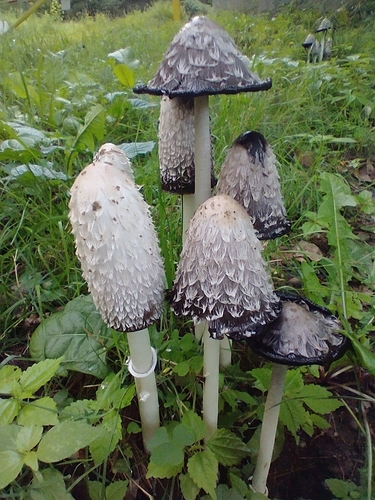


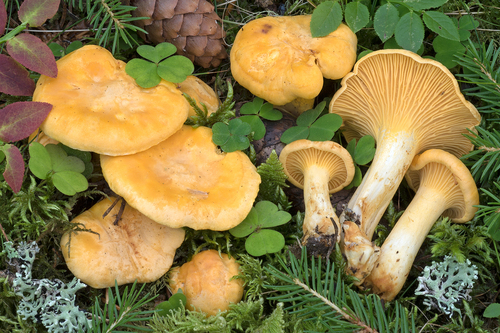
Photographs: iNaturalist contributors under the licences shown. Records: GBIF.org. Historical plates: Source Library (CC BY-SA 4.0; originals public domain). Summary text: Nature Library editors and Wikipedia (CC BY-SA). Medicinal and edibility notes are historical and educational, not advice. iNaturalist taxon 192381.