 NL·0202
Herbarium of the Nature Library
- Name
- Flammulina velutipes
- Family
- Physalacriaceae
- Native to
- Temperate Northern Hemisphere: Europe, Asia and North America; cultivated mainly in East Asia
- Habitat
- Temperate forest, Riparian woodland, Hedgerows
Velvet shank (enoki)
Flammulina velutipes
Also calledEnokitake (Japanese) · Jin zhen gu 金针菇 (Chinese) · Paengi beoseot (Korean) · Samtfußrübling (German) · Collybie à pied velouté (French)
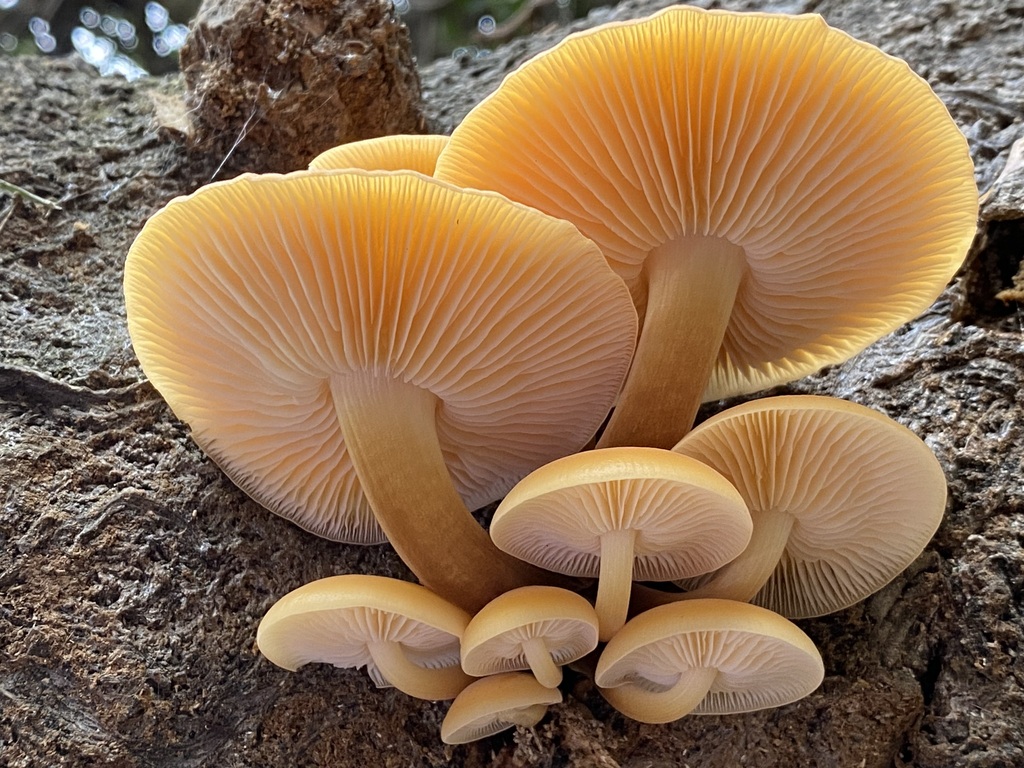
In the wild, this winter mushroom has sticky orange-brown caps on velvety dark stems and survives being frozen solid. Grown in the dark under high CO₂, the same fungus becomes enoki: long, pale noodle-like stems sold in Asian markets.
Flammulina velutipes, the velvet foot, velvet stem, velvet shank or wild enoki, is a species of gilled mushroom in the family Physalacriaceae. The species occurs in Europe and North America. Wikipedia
What it can do
- iFruits through winter and resumes growth after being frozen and thawed
- iiA white-rot decomposer of dead and dying hardwood (elm, willow, ash, gorse)
- iiiCultivated forms have long white stems because darkness and high CO₂ stretch the stalk
- ivContains flammutoxin, a pore-forming protein that is destroyed by cooking
At the table
Eatencaps and stems (thoroughly cooked)
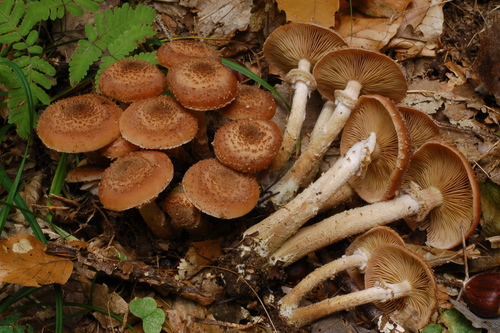
Edible but always cook enoki well. It contains heat-sensitive flammutoxin, and packaged enoki has caused deadly Listeria outbreaks (e.g. US 2016–2020) when eaten raw. Deadly wild lookalike: Galerina marginata (funeral bell), a brown wood-rotting mushroom with amatoxins that grows in the same habitats in autumn and early winter. Galerina has a rusty-brown spore print and often a ring; velvet shank has a white spore print, a velvety dark stem base and no ring. Sulphur tuft (Hypholoma fasciculare) is also confused with it.
Fruiting body & spores
Spores
Spore print white; spores ellipsoid to cylindrical, smooth, about 6.5–9 × 3–4 µm
- Dispersal
- Wind-borne basidiospores
How to cultivate it
Hardiness (USDA zones)
- Light
- Darkness (for white enoki) or low light
- Water
- Humidity 80–90%
- Soil
- Supplemented hardwood sawdust or corncob with rice bran, in bottles
- Propagation
- Grain or liquid spawn
- To harvest
- About 6–8 weeks
- Climates
- Cool temperate (indoors)
- 1Pack sterilised sawdust-bran mix into wide-mouthed bottles and inoculate with spawn
- 2Incubate at 18–22 °C for 3–4 weeks until fully colonised
- 3Scrape the surface and chill to 10–14 °C to induce pinning
- 4Wrap a paper or plastic collar around the bottle neck and keep in darkness with high CO₂ so stems grow long and pale
- 5Harvest the bundle when stems are 12–15 cm and cook before eating
Where it lives
Recorded sightings
—
geo-referenced records in GBIF, from museums, herbaria and field observers.
Native range
Temperate Northern Hemisphere: Europe, Asia and North America; cultivated mainly in East Asia
Drag the globe to turn it. Dots are where records exist, not a range map; darker means more records.
In the old herbals & bestiaries
Woodcuts and engravings matched from the Source Library’s scanned books by name. Plates marked “relative” show a close kin rather than this exact species. Click a plate to read the page it came from, with translation.

In the stacks
Searching the stacks…
Every page naming Flammulina velutipes in the Biodiversity Heritage Library →
Marginalia
Enokitake is named after the enoki tree (Celtis sinensis) on whose stumps it grows wild in Japan. Bottle cultivation of white enoki began in Nagano Prefecture, still Japan's main producer.
Curiosity
The Chinese name jin zhen gu means 'golden needle mushroom', after its thin stems.
Kinship


Photographs: iNaturalist contributors under the licences shown. Records: GBIF.org. Historical plates: Source Library (CC BY-SA 4.0; originals public domain). Summary text: Nature Library editors and Wikipedia (CC BY-SA). Medicinal and edibility notes are historical and educational, not advice. iNaturalist taxon 67594.