 NL·0160
Herbarium of the Nature Library
- Name
- Capsicum annuum
- Family
- Solanaceae
- Native to
- Southern North America to northern South America, domesticated in central-east Mexico; grown worldwide
- Habitat
- Tropical dry scrub (wild chiltepin), Gardens and farmland
Chilli pepper
Capsicum annuum
Also calledMirch (Hindi/Urdu) · Chīlli (Nahuatl) · Ají (Taíno/Spanish) · Làjiāo (Chinese) · Filfil ḥārr (Arabic) · Biber (Turkish) · Pilipili (Swahili) · Paprika (Hungarian)
The species behind bell peppers, jalapeños, cayenne, paprika and most chillies, domesticated in Mexico over 6,000 years ago. Its fiery capsaicin deters mammals while birds, which lack the pain receptor it triggers, eat the fruit and spread its seeds.
Capsicum annuum is a flowering plant in the family Solanaceae (nightshades), native to the northern regions of South America and to southwestern North America. The plant produces berries of many colors including red, green, and yellow, often with pungent taste. It is one of the oldest cultivated crops, with domestication dating back to around 6,000 years ago in regions of Mexico. The genus Capsicum has over 30 species but Capsicum annuum is the primary species in its genus, as it has been widely cultivated for human consumption for a substantial amount of time and has spread across the world. This species has many uses in culinary and ornamental applications. Wikipedia
What it can do
- iCapsaicin binds the TRPV1 heat-pain receptor in mammals but not in birds
- iiCapsaicin also protects seeds from Fusarium fungal attack
- iiiHeat is concentrated in the pale placental tissue, not the seeds themselves
- ivSpread from the Americas to India, China and Africa within a century of 1492
At the table
Eatenfruit (fresh, dried, smoked, powdered, pickled) · leaves (cooked, in Filipino tinola and Korean dishes)
Fruit is safe; very hot types can burn skin, eyes and the gut. Wash hands after cutting chillies.
In the medicine cabinet
| Tradition | Use |
|---|---|
| Mesoamerican (Aztec) | Chilli used for toothache, cough and to treat infections, recorded in the Florentine Codex |
| Modern medicine | High-strength capsaicin patches (Qutenza) are approved for nerve pain after shingles; low-dose creams for arthritis pain |
Weight of evidence
Strong. An approved drug, or consistent results in well-run clinical trials.
Active compounds
capsaicin, dihydrocapsaicin, vitamin C, capsanthin, β-carotene
Fruit & seed


Fruit
Berry
Ripens: Summer to autumn
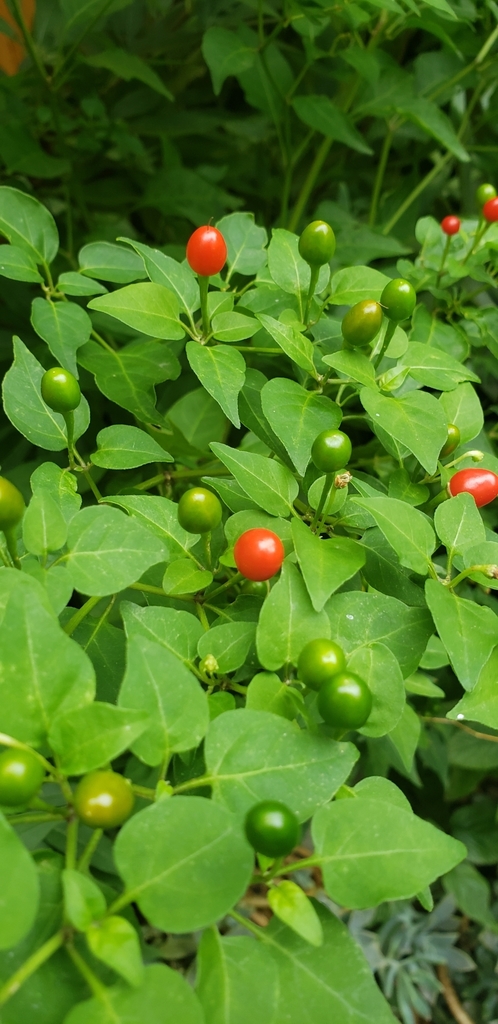
Hollow berry ranging from pea-sized wild chiltepins to 15 cm bell peppers; green ripening to red, yellow, orange, purple or brown; seeds attached to a pale central placenta.

Seed
3–5 mm
Flat, kidney- to disc-shaped, cream to pale-yellow seeds about 3–5 mm, smooth, clustered on the placenta
- Dispersal
- Birds (immune to the heat)
- Germination
- Sow 0.5 cm deep at 25–30 °C (bottom heat helps); sprouts in 7–21 days
Photographs from Wikimedia Commons under open licences; hover for the photographer, click for the file.
How to grow it
Hardiness (USDA zones)
Annual in temperate zones; short-lived perennial in USDA 10–12. Survives winters down to about -1 °C.
- Light
- Full sun
- Water
- Moderate; let the surface dry slightly between waterings
- Soil
- Fertile, well-drained loam, pH 6–7
- Propagation
- Seed; cuttings
- To harvest
- 60–90 days from transplanting (longer for very hot types)
- Climates
- Tropical, Subtropical, Temperate (summer), Mediterranean
- 1Sow indoors 8–10 weeks before the last frost on a warm mat; chillies need warmth to germinate.
- 2Transplant after night temperatures stay above 12 °C, 40–50 cm apart; pots of 10+ litres work well.
- 3Water evenly, mulch and feed with a potassium-rich fertiliser once flowers appear; pinch the first flowers on small plants to build size.
- 4Stake heavy-cropping plants; slight dryness near ripening increases heat.
- 5Snip fruit with scissors when green or fully coloured; dry on strings (ristras) or freeze. Overwinter plants indoors to crop earlier next year.
Can it grow where you are?
Where it lives
Recorded sightings
—
geo-referenced records in GBIF, from museums, herbaria and field observers.
Native range
Southern North America to northern South America, domesticated in central-east Mexico; grown worldwide
Drag the globe to turn it. Dots are where records exist, not a range map; darker means more records.
In Gerard's Herball, 1597

Second Booke · Chap. 66 · p. 292 · read the page →
Of Ginnie or Indian Pepper.
John Gerard, The Herball, or Generall Historie of Plantes, London, 1597. What England's best-known herbal said of chilli pepper, in its own spelling.
- The vertues
- Ginnie pepper hath the tafte of pepper, but not the power or vertue, notwithftanding in Spaine and fundrie parts of the Indies they do vfe to dreffe their meate therewith, as we do with Calecute pepper: but (faith my author) it hath in it a malitious qualitie, whereby it is an enimie to the liuer & other of the entrails; Auicen writeth that it killeth dogs. It is faide to die or colour like faffron, and being receiued in fuch fort as faffron is vfually taken, it warmeth the ftomacke, and helpeth greatly the digeftion of meates. It diffolueth the fwellings about the throte called the Kings Euill, as kernels and cold fwellings; and taketh away fpots and lentiles from the face, being applied therto with honie.
- The place
- These plants are brought from forren countries, as Ginnie, India, and those parts, into Spaine and Italy: from whence wee haue receiued seede for our English gardens, where they come to fruite bearing: but the cod doth not come to that bright red colour which naturally it is possessed with, which hath hapned by reason of these vnkindely yeeres that are past: but we expect better when God shall sen…
- The time
- The feedes hereof muft be fowen in a bed of hot horfedung, as muske Melons are, and remooued into a pot when it hath gotten three or fower leaues, that it may the more conueniently be carried from place to place to receiue the heate of the funne: and…
- The temperature
- Ginnie pepper is extreme hot and drie euen in the fourth degree: that is to faie, farre hotter and drier then Auicen fheweth dogs ginger to be.
- The names
- Actuarius calleth it in Greeke κεψικὸν, in Latin Capficum: & it is thought to be that which Auicenne nameth Zinziber caninum, or dogs Ginger: and Pliny Siliquaftrum, which is more like in tafte to pepper then is Panax, and it is therefore called Piperitis, as hee hath written in his 19. booke 12. chapter: Panax (faith he) hath the tafte of pepper and Siliquaftrum, for which caufe it is called Piperitis.
Gerard wrote within Galenic humoral medicine, and his opinions, including about the peoples of the Americas and their crops, are those of 1590s London. His “vertues” are history, not advice. Transcription: Source Library (CC BY-SA 4.0). The whole chapter in the Herball Room.
In the old herbals & bestiaries
Woodcuts and engravings matched from the Source Library’s scanned books by name. Plates marked “relative” show a close kin rather than this exact species. Click a plate to read the page it came from, with translation.

Notable Commentaries on the History of Plants
Leonhart Fuchs · 1542 · p.767

Notable Commentaries on the History of Plants
Leonhart Fuchs · 1542 · p.766

Hortus Eystettensis
Basilius Besler · 1640 · p.346

Book of Herbs
Hieronymus Bock (Tragus) · 1546 · p.733

Ten Books of Exotic Things
Carolus Clusius · 1605 · p.362

Introductio Generalis in Rem Herbariam
Augustus Quirinus Rivinus · 1690 · p.523

Maria Sibylla Merian — Dissertatio de generatione et metamorphosibus insectorum Surinamensium (1719)
Maria Sibylla Merian · 1719 · p.182

Six Groups of the History of Plants
Rembert Dodoens · 1583 · p.725

Six Groups of the History of Plants
Rembert Dodoens · 1583 · p.725

Hortus Eystettensis
Basilius Besler · 1640 · p.351
In the stacks
Searching the stacks…
Every page naming Capsicum annuum in the Biodiversity Heritage Library →
Marginalia
Columbus called chillies 'pimiento', mistaking them for relatives of black pepper, and Portuguese traders carried them to Goa, Bengal and Africa within decades. Today India is the world's largest producer, and the chilli is inseparable from Sichuan, Thai and Korean food.
Curiosity
Wild chiltepin, the ancestral chilli, is the official native spice of Texas.
Kinship

Photographs: iNaturalist contributors under the licences shown. Records: GBIF.org. Historical plates: Source Library (CC BY-SA 4.0; originals public domain). Summary text: Nature Library editors and Wikipedia (CC BY-SA). Medicinal and edibility notes are historical and educational, not advice. iNaturalist taxon 48514.