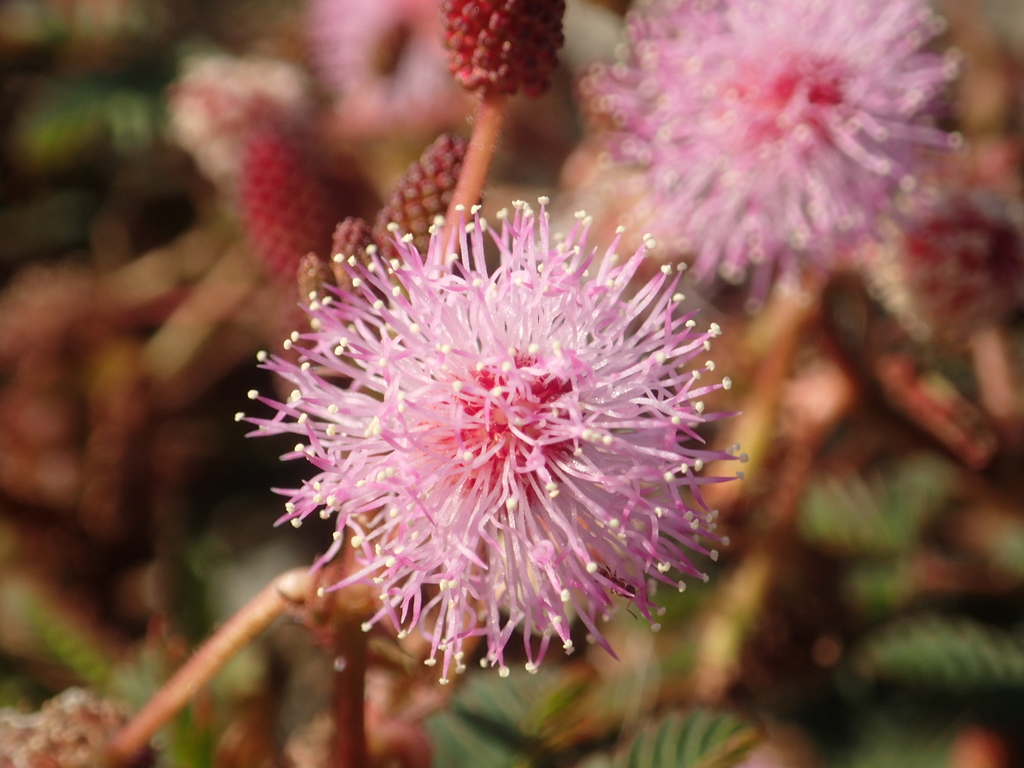
 NL·0066
Herbarium of the Nature Library
- Name
- Mimosa pudica
- Family
- Fabaceae
- Native to
- Tropical Central and South America; now a pantropical weed
- Habitat
- Tropical grassland, Disturbed ground, Roadsides
Sensitive plant (Touch-me-not)
Mimosa pudica
Also calledLajwanti / Chhui-mui (Hindi/Urdu) · Lajjalu (Sanskrit) · Hánxiūcǎo 含羞草 (Chinese, 'shy grass') · Makahiya (Tagalog: 'shy') · Dormilona (Spanish) · Mori-vivi (Puerto Rican Spanish) · Malu-malu (Malay) · Thottavadi (Tamil/Malayalam)
A plant that folds its leaves within seconds when touched. Electrical signals travel through the stem, and motor cells in swellings at the leaf bases suddenly lose water and collapse. Experiments suggest it can 'learn' to ignore harmless repeated disturbances.
Mimosa pudica is a creeping annual or perennial flowering plant of the pea/legume family Fabaceae. It is often grown for its curiosity value: the sensitive compound leaves quickly fold inward and droop when touched or shaken and re-open a few minutes later. For this reason, this species is commonly cited as an example of rapid plant movement. Like a number of other plant species, it undergoes changes in leaf orientation termed "sleep" or nyctinastic movement. The foliage closes during darkness and reopens in light. This was first studied by French scientist Jean-Jacques d'Ortous. In the UK it has gained the Royal Horticultural Society's Award of Garden Merit. Wikipedia
What it can do
- iFolds leaflets within seconds of touch, heat or shaking (seismonasty) using pulvinus motor cells
- iiSends electrical action potentials along its stem to coordinate leaf collapse
- iiiFolds its leaves at night on an internal circadian clock
- ivIn a 2014 experiment, stopped folding in response to repeated harmless drops and kept this 'memory' for weeks
- vFixes nitrogen through root nodules
At the table
Not eaten. Contains the amino acid mimosine, toxic to livestock in quantity (hair loss, poor growth). Stems carry small prickles.
In the medicine cabinet
| Tradition | Use |
|---|---|
| Ayurveda / Siddha | Roots and leaves (lajjalu) for bleeding piles, diarrhoea and wound healing |
| Traditional medicine in the Philippines and Africa | Leaf poultices for wounds and swellings |
Weight of evidence
Traditional. Long historical use; little or no modern clinical evidence.
Active compounds
mimosine, tannins, flavonoids
Fruit & seed

Fruit
Legume (pod)
Ripens: Most of the year in the tropics
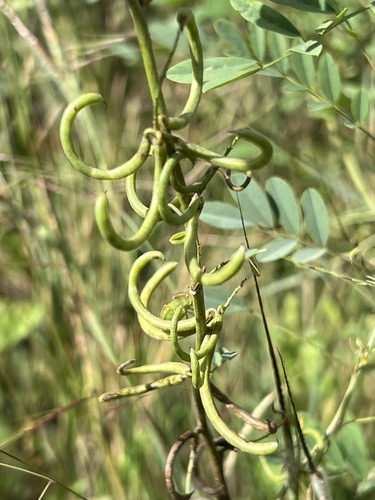
Clusters of small, bristly pods that break into one-seeded segments.
Seed
~2.5 mm
Flat, hard, brown seeds
- Dispersal
- Pod segments stick to fur and clothing
- Germination
- Soak in hot water overnight; sow at 20–30 °C, 1–3 weeks
Photographs from Wikimedia Commons under open licences; hover for the photographer, click for the file.
How to grow it
Hardiness (USDA zones)
USDA 9–11 (houseplant elsewhere). Survives winters down to about -7 °C.
- Light
- Full sun to bright light
- Water
- Moderate
- Soil
- Well-drained potting mix
- Propagation
- Seed
- To harvest
- Responsive leaves in a few weeks
- Climates
- Tropical, Subtropical
- 1Pour hot water over seeds and soak overnight
- 2Sow shallowly in warm, bright conditions
- 3Keep evenly moist and above 15 °C
- 4Grow in a pot where it is invasive outdoors
Can it grow where you are?
Where it lives
Recorded sightings
—
geo-referenced records in GBIF, from museums, herbaria and field observers.
Native range
Tropical Central and South America; now a pantropical weed
Drag the globe to turn it. Dots are where records exist, not a range map; darker means more records.
In the old herbals & bestiaries
Woodcuts and engravings matched from the Source Library’s scanned books by name. Plates marked “relative” show a close kin rather than this exact species. Click a plate to read the page it came from, with translation.

A key to physic, and the occult sciences
Sibly, Ebenezer · 1810 · p.585

Tractado de las Drogas y Medicinas de las Indias Orientales
Cristóvão da Costa · 1578 · p.274

Ten Books of Exotic Things
Carolus Clusius · 1605 · p.311

Description of Less Known and Rare Plants
Fabio Colonna · 1616 · p.160

Hortus Eystettensis
Basilius Besler · 1640 · p.226

A voyage to the islands Madera Barbados Jamaica Vol. 1
Hans Sloane · 1707 · p.546

Christoph Jakob Trew — Uitgezochte planten (1771)
Christoph Jakob Trew · 1771 · p.277
In the stacks
Searching the stacks…
Every page naming Mimosa pudica in the Biodiversity Heritage Library →
Marginalia
In 1729 French astronomer Jean-Jacques d'Ortous de Mairan kept a sensitive plant in total darkness and found its leaves still opened and closed daily, the first experiment showing an internal biological clock.
Curiosity
Monica Gagliano's 2014 experiment found habituated plants still 'remembered' to ignore harmless drops up to 28 days later.
Kinship


Photographs: iNaturalist contributors under the licences shown. Records: GBIF.org. Historical plates: Source Library (CC BY-SA 4.0; originals public domain). Summary text: Nature Library editors and Wikipedia (CC BY-SA). Medicinal and edibility notes are historical and educational, not advice. iNaturalist taxon 51921.