 NL·0134
Herbarium of the Nature Library
- Name
- Rafflesia arnoldii
- Family
- Rafflesiaceae
- Native to
- Rainforests of Sumatra and Borneo
- Habitat
- Tropical lowland and hill rainforest
Corpse lily (Rafflesia)
Rafflesia arnoldii
Also calledPadma raksasa (Indonesian) · Bunga bangkai ('corpse flower', Malay/Indonesian) · Puspa langka (Indonesian national 'rare flower') · Monster flower (English) · 大王花 dàwánghuā (Chinese)
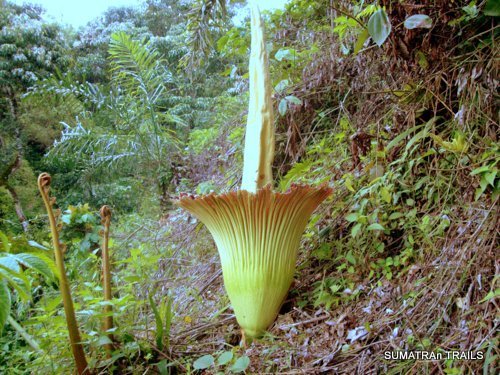
One of the largest single flowers on Earth, up to about a metre across and weighing up to roughly 11 kg. Rafflesia has no leaves, stems or roots: it lives as threads inside a jungle vine and appears only when a cabbage-like bud bursts through the bark and opens into a flower that smells of rotting meat.
Rafflesia arnoldii is a species of flowering plant in the parasitic genus Rafflesia within the family Rafflesiaceae. It is native to the rainforests of Sumatra and Borneo. Wikipedia
What it can do
- iIs a holoparasite with no leaves, stem, roots or chlorophyll, living as cell strands inside Tetrastigma vines
- iiProduces flowers up to about 1 m across, the largest single flowers known
- iiiMimics a carcass in colour, texture and smell to attract carrion flies as pollinators
- ivHas lost its chloroplast genome, and has taken up many genes from its host by horizontal gene transfer
At the table
Not eaten as food. Buds are harvested in some areas for traditional medicine, which threatens wild populations.
Fruit & seed
Fruit
Fleshy berry-like fruit
Ripens: Months after pollination
Round, rough fruit with oily pulp and thousands of tiny seeds.
Seed
<1 mm
Minute seeds with oily pulp
- Dispersal
- Probably small mammals such as tree shrews, and ants
- Germination
- Only on Tetrastigma host vines; how infection happens is poorly understood
Where it lives
Recorded sightings
—
geo-referenced records in GBIF, from museums, herbaria and field observers.
Native range
Rainforests of Sumatra and Borneo
Drag the globe to turn it. Dots are where records exist, not a range map; darker means more records.
In the stacks
Searching the stacks…
Every page naming Rafflesia arnoldii in the Biodiversity Heritage Library →
Marginalia
A guide working for Joseph Arnold and Stamford Raffles found it in Sumatra in 1818; Arnold died shortly afterward and the plant was named after both men. It is one of Indonesia's three national flowers.
Curiosity
Each flower lasts only about five to seven days, after a bud that took roughly nine months to a year to develop.
Kinship


Fact-checked: 1 correction made to this sheet. Photographs: iNaturalist contributors under the licences shown. Records: GBIF.org. Historical plates: Source Library (CC BY-SA 4.0; originals public domain). Summary text: Nature Library editors and Wikipedia (CC BY-SA). Medicinal and edibility notes are historical and educational, not advice. iNaturalist taxon 337568.