 NL·0744
Herbarium of the Nature Library
- Name
- Theraphosa blondi
- Family
- Theraphosidae
- Native to
- Northern South America: Venezuela, Guyana, Suriname, French Guiana and northern Brazil
- Habitat
- Tropical rainforest
Goliath birdeater
Theraphosa blondi
Also calledMygale de Leblond (French) · Tarántula Goliat (Spanish) · Aranha-golias (Portuguese)
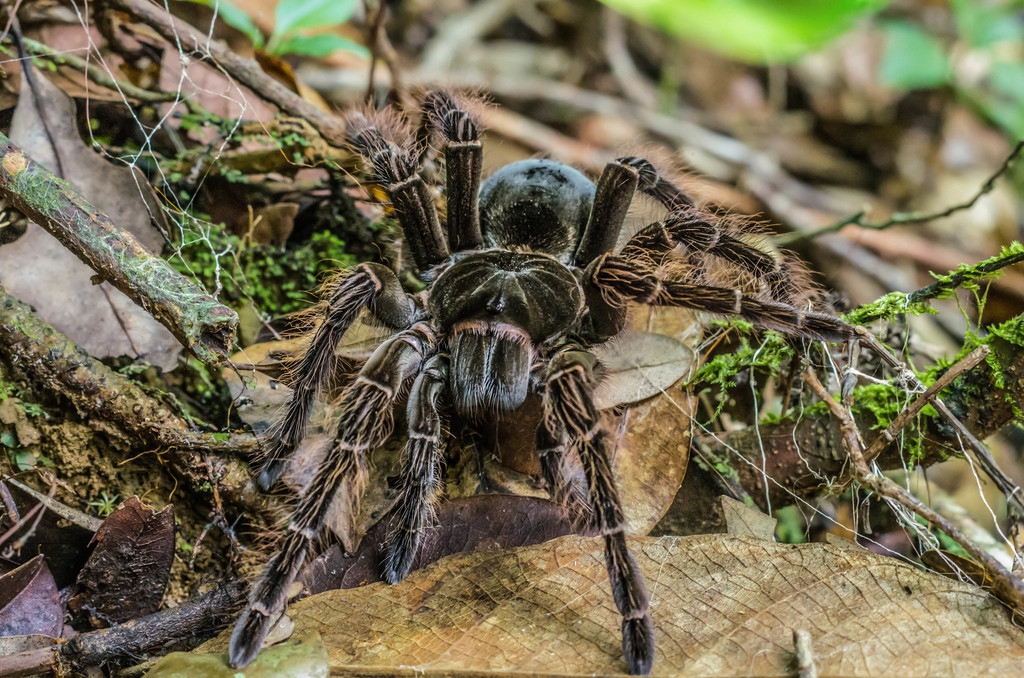
The heaviest spider in the world, a tarantula of northern South American rainforests that can weigh over 150 g with a leg span near 30 cm. Despite its name it seldom eats birds, feeding mostly on earthworms, insects and frogs.
The Goliath birdeater is a large spider that belongs to the tarantula family Theraphosidae. Found in northern South America, it is the largest spider in the world by mass and body length, and second to the giant huntsman spider by leg span. It is also considerably longer than the largest known prehistoric spider, Mongolarachne, that had a body length of 2.46 centimeters (0.97 in). It is also called the Goliath tarantula or Goliath bird-eating spider; the practice of calling theraphosids "bird-eating" derives from an early 18th-century copper engraving by Maria Sibylla Merian that shows one eating a hummingbird. Despite the spider's name, it rarely preys on birds. Wikipedia
What it can do
- iHeaviest spider known, recorded at over 170 g
- iiFlicks clouds of barbed, irritating hairs from its abdomen at attackers
- iiiMakes a loud hissing sound by rubbing bristles on its legs
- ivFangs about 2–4 cm long
In the field
Field marks
- aEnormous, heavy-bodied, hairy brown tarantula
- bUniform brown with faint pale rings on the legs
- cLarge, rounded abdomen with a bald patch where irritating hairs have been flicked
- dMature males lack the tibial hooks found in similar Theraphosa
- Not to be confused with
- Pinkfoot goliath (Theraphosa apophysis) has pinkish feet and males with tibial hooks. Burgundy goliath (T. stirmi) is darker with reddish hairs. Giant huntsman (Heteropoda maxima) of Laos has a wider leg span but is flat and lightweight.
- Where to see it
- Rainforests of Guyana, Suriname and southern Venezuela; often kept in zoos and by tarantula hobbyists.
- When
- Year-round; nocturnal
Life & habits
- Diet
- Earthworms, large insects, frogs, lizards and small rodents; birds only rarely
- Habitat
- Deep burrows in moist soil of swampy or upland rainforest
- Size
- Leg span up to about 28–30 cm; body up to about 12 cm
- Lifespan
- Females 15–25 years; males only a few years
It sits at its burrow entrance at night and ambushes passing prey, detecting vibrations through silk threads laid around the opening.
Where it lives
Recorded sightings
—
geo-referenced records in GBIF, from museums, herbaria and field observers.
Native range
Northern South America: Venezuela, Guyana, Suriname, French Guiana and northern Brazil
Drag the globe to turn it. Dots are where records exist, not a range map; darker means more records.
In the stacks
Searching the stacks…
Every page naming Theraphosa blondi in the Biodiversity Heritage Library →
Marginalia
The name 'bird-eater' traces back to Maria Sibylla Merian's 1705 Metamorphosis insectorum Surinamensium, which showed a large tarantula eating a hummingbird in Suriname.
Curiosity
Its venom is weak to humans, roughly comparable to a wasp sting; the hairs it flicks are usually the bigger nuisance.
Kinship





Fact-checked: 1 correction made to this sheet. Photographs: iNaturalist contributors under the licences shown. Records: GBIF.org. Historical plates: Source Library (CC BY-SA 4.0; originals public domain). Summary text: Nature Library editors and Wikipedia (CC BY-SA). Medicinal and edibility notes are historical and educational, not advice. iNaturalist taxon 205163.