 NL·0183
Herbarium of the Nature Library
- Name
- Boletus edulis
- Family
- Boletaceae
- Native to
- Temperate and boreal Northern Hemisphere; introduced with pines and oaks to southern Africa, Australia and New Zealand
- Habitat
- Temperate forest, Boreal forest, Conifer plantation
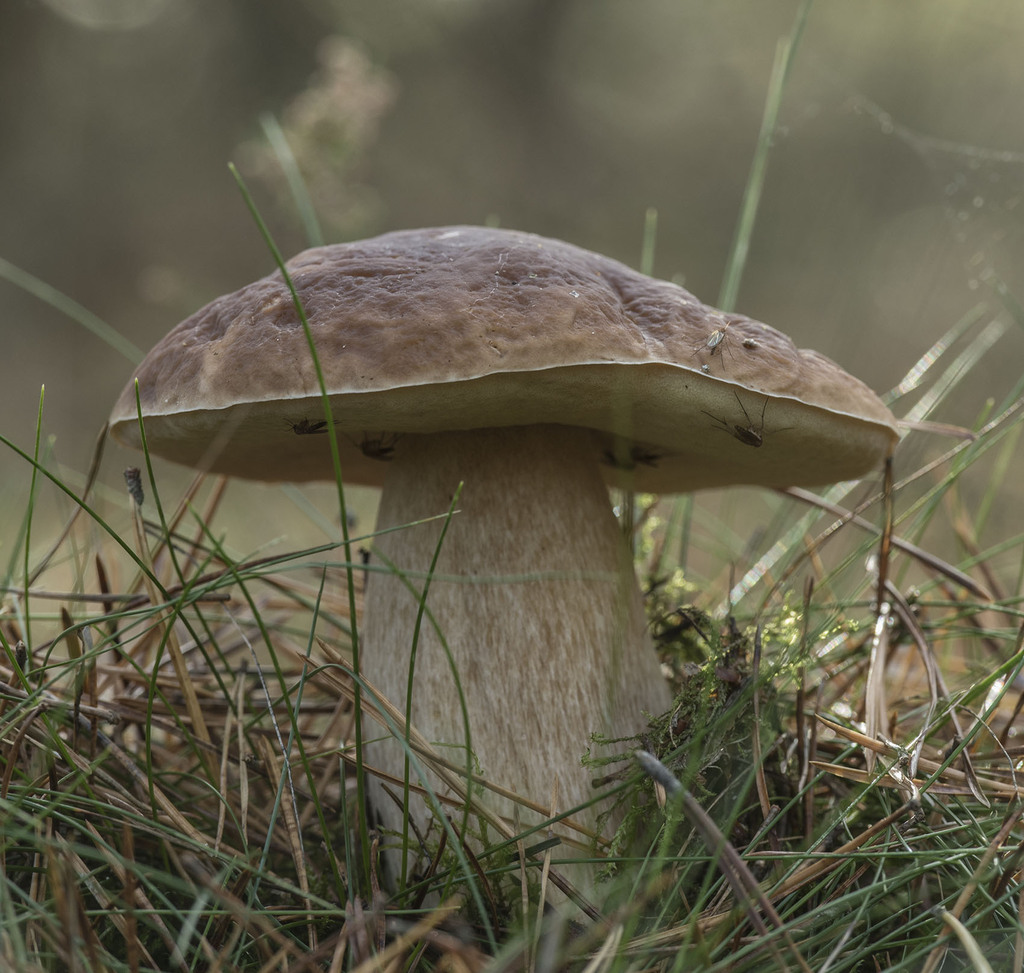
Porcini (penny bun, king bolete)
Boletus edulis
Also calledPorcino (Italian) · Cèpe de Bordeaux (French) · Steinpilz (German) · Belyi grib (Russian) · Prawdziwek (Polish)
A stout, bun-capped mushroom with a sponge of pores instead of gills and a fat, net-patterned stem. It is one of the most traded wild mushrooms in the world and gives Italian cooking its deep, nutty dried porcini flavour.
Boletus edulis is a basidiomycete fungus, and the type species of the genus Boletus. It is prized as an edible mushroom. Wikipedia
What it can do
- iEctomycorrhizal with pine, spruce, fir, oak, beech, chestnut and birch
- iiPores start white and turn yellow-olive as spores mature, without bruising blue
- iiiCan produce fruiting bodies weighing over 3 kg
- ivAccumulates selenium and, in polluted areas, radiocaesium from the soil
At the table
Eatenwhole fruiting body (cooked or dried)
Choice edible. Lookalikes: the bitter bolete (Tylopilus felleus), with pinkish pores and a dark net, is not dangerous but ruins a dish; Satan's bolete (Rubroboletus satanas) and other red-pored, blue-staining boletes cause severe gastric poisoning. Rule of thumb: avoid boletes with red or orange pores or flesh that quickly turns blue. Never eat raw in quantity.
Fruiting body & spores
Spores
Spore print olive-brown; spores spindle-shaped (fusiform), smooth, about 12–17 × 4–5.5 µm
- Dispersal
- Wind-borne basidiospores released from the pore tubes
Where it lives
Recorded sightings
—
geo-referenced records in GBIF, from museums, herbaria and field observers.
Native range
Temperate and boreal Northern Hemisphere; introduced with pines and oaks to southern Africa, Australia and New Zealand
Drag the globe to turn it. Dots are where records exist, not a range map; darker means more records.
In the old herbals & bestiaries
Woodcuts and engravings matched from the Source Library’s scanned books by name. Plates marked “relative” show a close kin rather than this exact species. Click a plate to read the page it came from, with translation.

Histoire des Champignons de la France, Vol 2
Pierre Bulliard · 1791 · p.65

Illustrations of British Mycology, First Series
Anna Maria Hussey (1805-1853) · n.d. · p.350

Illustrations of Fungi which Grow in Bavaria and the Palatinate around Ratisbon, Vols 1–2
Jacob Christian Schaeffer; C.H. Persoon (ed.) · 1800 · p.347

Histoire des Champignons de la France, Vol 2
Pierre Bulliard · 1791 · p.313
In the stacks
Searching the stacks…
Every page naming Boletus edulis in the Biodiversity Heritage Library →
Marginalia
Italians call it porcino ('piglet'). The Latin name 'edulis' (edible) was given by Pierre Bulliard in 1782. Dried porcini have been traded across the Alps for centuries.
Curiosity
Despite intense effort, nobody has cultivated porcini commercially. Every porcino sold is wild-picked.
Kinship


Fact-checked: 1 correction made to this sheet. Photographs: iNaturalist contributors under the licences shown. Records: GBIF.org. Historical plates: Source Library (CC BY-SA 4.0; originals public domain). Summary text: Nature Library editors and Wikipedia (CC BY-SA). Medicinal and edibility notes are historical and educational, not advice. iNaturalist taxon 48701.