 NL·0043
Herbarium of the Nature Library
- Name
- Opuntia ficus-indica
- Family
- Cactaceae
- Native to
- Domesticated in central Mexico; naturalised throughout the Mediterranean, North and East Africa, the Middle East, India and Australia
- Habitat
- Arid and semi-arid scrub, Mediterranean hillsides, Field boundaries
Prickly pear
Opuntia ficus-indica
Also calledNopal (Nahuatl nōpalli) · Tuna (Spanish, fruit) · Higo chumbo (Spanish) · Ṣabbār / Sabra (Arabic/Hebrew) · Karmus al-hindi (Moroccan Arabic) · Beles (Tigrinya) · Bajtar tax-xewk (Maltese) · Fico d'India (Italian)
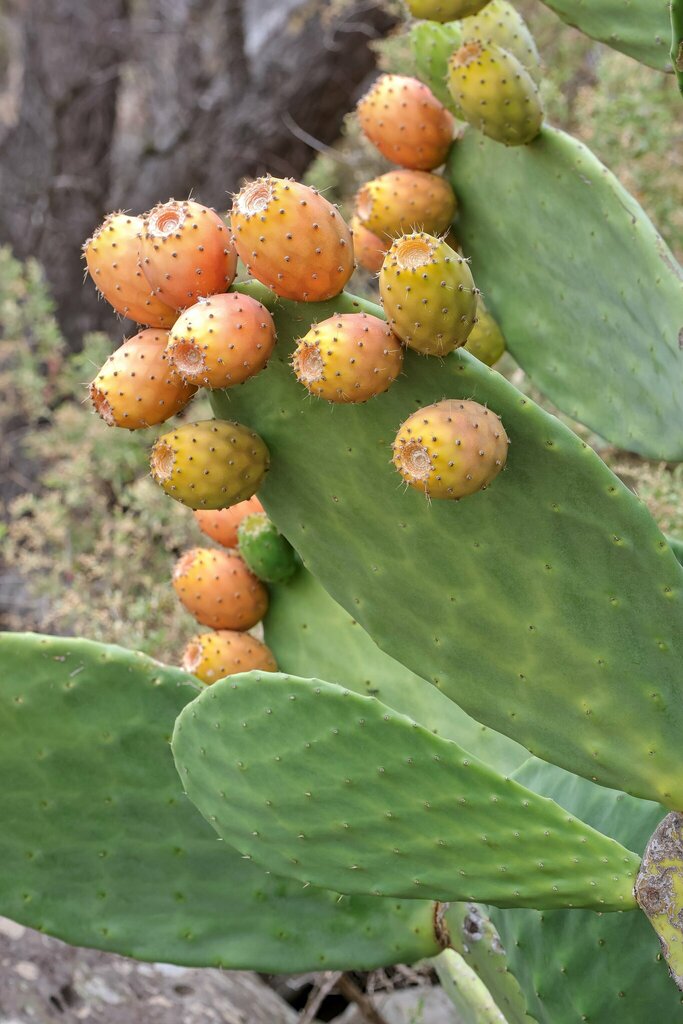
A large, paddle-jointed cactus domesticated in central Mexico, cultivated for its sweet fruit (tunas) and tender young pads (nopales). It also hosts the cochineal insect, source of the brilliant carmine red that dyed European royalty's robes and still colours food.
Opuntia ficus-indica, the Indian fig opuntia, fig opuntia, or prickly pear, is a species of cactus that has long been a domesticated crop plant grown in agricultural economies throughout arid and semiarid parts of the world. O. ficus-indica is the most widespread and most commercially important cactus. It is grown primarily as a fruit crop, and also for the vegetable nopales and other uses. Cacti are good crops for dry areas because they efficiently convert water into biomass. O. ficus-indica is the most widespread of the long-domesticated cactuses. Opuntia species hybridize easily, but the wild origin of O. ficus-indica is likely to have been in central Mexico, where its closest genetic relatives are found. Wikipedia
What it can do
- iCAM photosynthesis lets it fix carbon at night, using up to 5 times less water than grain crops
- iiAny pad that touches soil can root into a new plant
- iiiHosts cochineal scale insects, whose carminic acid gives carmine dye
- ivPrickly pears became notorious weeds in Australia (mainly O. stricta), famously cleared by the Cactoblastis moth; O. ficus-indica itself is invasive in South Africa
At the table
Eatenfruit (tunas, peeled) · young pads (nopales, cooked) · flowers · seed oil
Fruit and young pads are eaten. Remove the tiny barbed hair-like spines (glochids) carefully — they lodge in skin and mouth. Eating very many seeds can cause intestinal blockage.
In the medicine cabinet
| Tradition | Use |
|---|---|
| Mexican traditional medicine | Nopal pads eaten to lower blood sugar in diabetes, with small clinical studies showing reduced post-meal glucose |
| Mediterranean folk medicine | Flowers as a tea for kidney stones and diarrhoea |
Weight of evidence
Moderate. Some clinical trials with promising but limited or mixed results.
Active compounds
betalains (betanin, indicaxanthin), mucilage, pectin, vitamin C
Fruit & seed


Fruit
Berry
Ripens: Late summer to autumn
Barrel- or egg-shaped berry 5–10 cm, green, yellow, orange, red or purple, studded with tufts of tiny spines; juicy, sweet, melon-like flesh of the same colour, full of seeds.
Seed
3–5 mm
Hard, flattened, round to kidney-shaped seeds 3–5 mm, beige to light brown, with a thick woody coat; 100–300 per fruit
- Dispersal
- Birds, mammals and tortoises
- Germination
- Slow; scarify and sow at 25–30 °C in gritty mix; 2–8 weeks. Pads are the usual propagation
Photographs from Wikimedia Commons under open licences; hover for the photographer, click for the file.
How to grow it
Hardiness (USDA zones)
USDA 8–11. Survives winters down to about -12 °C.
- Light
- Full sun
- Water
- Very low
- Soil
- Sandy, rocky, very well-drained; tolerates poor and alkaline soils
- Propagation
- Single pads (cladodes)
- To harvest
- 2–3 years from a planted pad
- Climates
- Semi-arid, Mediterranean, Hot arid, Subtropical
- 1Cut a healthy pad with tongs or thick gloves and let the cut end dry for 1–2 weeks until calloused.
- 2Plant it upright, one-third buried, in dry, gritty soil in full sun; do not water for the first 2–3 weeks.
- 3Water occasionally in the first summer; established plants need almost none.
- 4Harvest young pads (nopalitos) in spring when 15–20 cm long, and scrape off spines before cooking.
- 5Pick fruit with tongs when fully coloured, roll it in sand or burn off the glochids, then slice off the ends and peel.
Can it grow where you are?
Where it lives
Recorded sightings
—
geo-referenced records in GBIF, from museums, herbaria and field observers.
Native range
Domesticated in central Mexico; naturalised throughout the Mediterranean, North and East Africa, the Middle East, India and Australia
Drag the globe to turn it. Dots are where records exist, not a range map; darker means more records.
In the old herbals & bestiaries
Woodcuts and engravings matched from the Source Library’s scanned books by name. Plates marked “relative” show a close kin rather than this exact species. Click a plate to read the page it came from, with translation.

History of the Plants of New Spain, Volume 3
Francisco Hernández (1517-1587) · 1946 · p.259

A voyage to the islands Madera Barbados Jamaica Vol. 1
Hans Sloane · 1707 · p.25

Kircher: China Illustrata (1667)
Athanasius Kircher · 1667 · p.256

The Embassy of the Dutch East India Company to the Tartar Cham
Johan Nieuhof · 1665 · p.439

Tractado de las Drogas y Medicinas de las Indias Orientales
Cristóvão da Costa · 1578 · p.104

Hortus Eystettensis
Basilius Besler · 1640 · p.381

Hortus Eystettensis
Basilius Besler · 1640 · p.382

Commentaries on the Six Books of Dioscorides
Pietro Andrea Mattioli · 1560 · p.499

De rerum varietate
Cardano, Girolamo · 1557 · p.958

Commentaries on the Six Books of Dioscorides
Pietro Andrea Mattioli · 1560 · p.484
In the stacks
Searching the stacks…
Every page naming Opuntia ficus-indica in the Biodiversity Heritage Library →
Marginalia
The Aztec founding legend says their wandering people would build their city where they saw an eagle perched on a nopal cactus — the image on Mexico's flag and the origin of Tenochtitlan. In Israel 'sabra', the prickly pear, is the nickname for native-born Israelis: prickly outside, sweet inside.
Curiosity
Carmine from cochineal insects on prickly pear was Spain's second most valuable export from the Americas after silver.
Kinship


Fact-checked: 1 correction made to this sheet. Photographs: iNaturalist contributors under the licences shown. Records: GBIF.org. Historical plates: Source Library (CC BY-SA 4.0; originals public domain). Summary text: Nature Library editors and Wikipedia (CC BY-SA). Medicinal and edibility notes are historical and educational, not advice. iNaturalist taxon 64119.