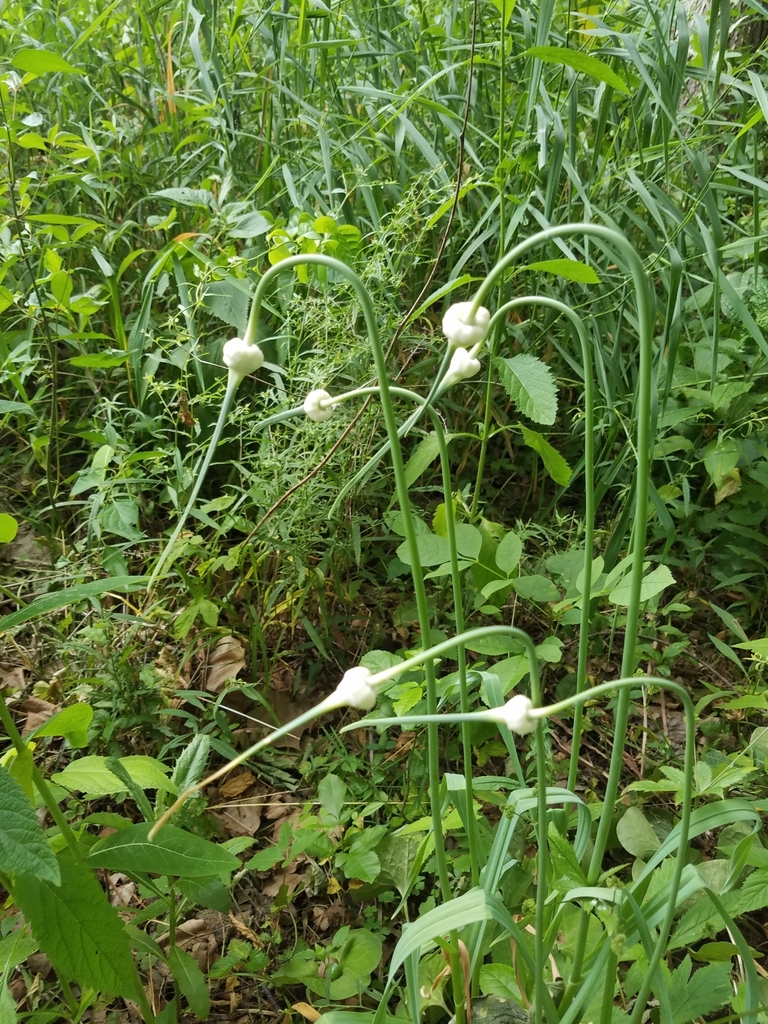
 NL·0004
Herbarium of the Nature Library
- Name
- Allium sativum
- Family
- Amaryllidaceae
- Native to
- Derived from wild Allium in Central Asia (Tian Shan region); known only in cultivation
- Habitat
- Montane steppe, Farmland
Garlic
Allium sativum
Also calledLahsun (Hindi/Urdu) · Lashuna / Rasona (Sanskrit) · Thūm ثوم (Arabic) · Sīr (Persian) · Dàsuàn 大蒜 (Chinese) · Ajo (Spanish)
A bulb so long domesticated that most varieties no longer set seed, propagated clove by clove for over five thousand years. Its sharp smell forms only when the cells are crushed, as a chemical defence.
Garlic is a species of bulbous flowering plants in the genus Allium. Its close relatives include the onion, shallot, leek, chives, Welsh onion, and Chinese onion. Garlic is native to Central Asia, northeastern Iran and the foothills of Himalayas. It has naturalized in many other parts of the world, including Mediterranean Europe and China. There are two subspecies and hundreds of varieties of garlic. Wikipedia
What it can do
- iCrushing mixes alliin with the enzyme alliinase to make allicin, a pungent antimicrobial defence compound
- iiMost cultivars are sterile, making tiny bulbils in the flower head instead of seed
- iiiNeeds a winter chill to divide into cloves
At the table
Eatenbulb (cloves) · green leaves · flower stalks (scapes) · bulbils
Widely eaten. Toxic to dogs and cats, causing anaemia. Garlic stored in oil at room temperature can grow botulism bacteria.
In the medicine cabinet
| Tradition | Use |
|---|---|
| Ayurveda | Lashuna as a rasayana for heart, joints, cough and worms; the Bower Manuscript opens with its praise |
| Unani | Thum used for chest complaints, as an antidote to poisons, and as an aphrodisiac |
| Traditional Chinese Medicine | Dasuan to kill parasites, treat dysentery and reduce swellings |
| European folk medicine | Raw cloves and syrups for colds, infections and 'thinning the blood' |
Weight of evidence
Moderate. Some clinical trials with promising but limited or mixed results.
Active compounds
alliin, allicin, ajoene, diallyl disulfide, S-allyl cysteine
Seed
Seed
Most cultivars do not produce true seed; flower heads carry bulbils
- Dispersal
- Human propagation of cloves and bulbils
- Germination
- Plant cloves instead
How to grow it
Hardiness (USDA zones)
USDA 3–9. Survives winters down to about -40 °C.
- Light
- Full sun
- Water
- Moderate; dry before harvest
- Soil
- Loose, fertile, well-drained
- Propagation
- Cloves
- To harvest
- 8–9 months from autumn planting
- Climates
- Temperate, Continental, Mediterranean
- 1Plant cloves pointed end up, 5 cm deep and 15 cm apart, in autumn
- 2Mulch over winter and weed in spring
- 3Snap off flower scapes of hardneck types to grow larger bulbs
- 4Lift when the lower third of the leaves have browned; cure in an airy place for 2–3 weeks
Can it grow where you are?
Where it lives
Recorded sightings
—
geo-referenced records in GBIF, from museums, herbaria and field observers.
Native range
Derived from wild Allium in Central Asia (Tian Shan region); known only in cultivation
Drag the globe to turn it. Dots are where records exist, not a range map; darker means more records.
In Gerard's Herball, 1597

First Booke · Chap. 88 · p. 140 · read the page →
Of Garlick.
John Gerard, The Herball, or Generall Historie of Plantes, London, 1597. What England's best-known herbal said of garlic, in its own spelling.
- The vertues
- Being eaten it heateth the bodie extremely, attenuateth and maketh thin, thicke and grosse humors; cutteth such as are tough and clammie, digesteth and consumeth them, also openeth obstructions, is an enimie to all colde poisons, and to the bitings of venemous beasts: and therefore Galen nameth it Theriaca rusticorum, or the husbandmans Treacle. It yeeldeth to the body no nourishment at all, it engendreth naughtie and sharpe blood. Therefore such as are of a hot complexion must especially abstaine from it. But if it be boiled in water vntill such time as it hath lost his sharpnes, it is the lesse forcible, and retaineth no longer his euill iuice, iuice, as Galen writeth. It taketh away the roughnes of the throte, it helpeth an old cough, it prouoketh vrine, it breaketh the stone, and consumeth winde, it is a remedie for the dropsie proceeding of a colde cause. It killeth wormes in the belly, and driueth them foorth. The milke also wherein it hath been sodden, is giuen to yoong children with good successe against the wormes.
- The place
- Garlick is seldome sowen of seede, but planted in gardens of the small cloues in Nouember and December, and sometimes in Februarie and March.
- The temperature
- Garlick is very sharpe, hot, and drie, as Galen saith, in the fourth degree, and exulcerateth the skin by raising of blisters.
- The names
- It is called in Latine Allium: in Greeke σκοροδον: the apothecaries keepe the Latine name: the Germanes call it Knoblauch; the low Dutch Look: the Spaniards Aios, Alho: the Italians Aglio: the French Ail or Aux: the Bohemians Czesnek: the English Garlicke and poore mens Treacle.
Gerard wrote within Galenic humoral medicine, and his opinions, including about the peoples of the Americas and their crops, are those of 1590s London. His “vertues” are history, not advice. Transcription: Source Library (CC BY-SA 4.0). The whole chapter in the Herball Room.
In the old herbals & bestiaries
Woodcuts and engravings matched from the Source Library’s scanned books by name. Plates marked “relative” show a close kin rather than this exact species. Click a plate to read the page it came from, with translation.

Notable Commentaries on the History of Plants
Leonhart Fuchs · 1549 · p.768

Compendium of Materia Medica: Illustrated Volume Middle of Middle
李時珍 · 1596 · p.63

History of Rare Plants Observed in Pannonia
Carolus Clusius · 1583 · p.229

Latin Herbal
1484 · p.225

Latin Herbal with German Synonyms
1486 · p.26

De medicinali materia libri sex
Dioscorides · 1552 · p.320

History of Rare Plants Observed in Pannonia
Carolus Clusius · 1583 · p.219

Hortus Eystettensis
Basilius Besler · 1640 · p.70

On the Virtues of Herbs
Macer Floridus (Odo of Meung) · 1090 · p.23

On the Virtues of Herbs
Macer Floridus · 1150 · p.29
In the stacks
Searching the stacks…
Every page naming Allium sativum in the Biodiversity Heritage Library →
Marginalia
Herodotus wrote that an inscription on the Great Pyramid recorded the radishes, onions and garlic given to the builders. The Bower Manuscript, a Sanskrit medical collection of the late 5th or early 6th century CE found near Kucha, opens with a treatise on garlic that tells the legend of its origin.
Curiosity
Medieval Europeans called garlic 'the poor man's treacle', from theriac, the costly universal antidote.
Kinship



Fact-checked: 1 correction made to this sheet. Photographs: iNaturalist contributors under the licences shown. Records: GBIF.org. Historical plates: Source Library (CC BY-SA 4.0; originals public domain). Summary text: Nature Library editors and Wikipedia (CC BY-SA). Medicinal and edibility notes are historical and educational, not advice. iNaturalist taxon 75363.