 NL·0162
Herbarium of the Nature Library
- Name
- Solanum lycopersicum
- Family
- Solanaceae
- Native to
- Wild ancestor (Solanum pimpinellifolium) in coastal Ecuador and Peru; domesticated in Mesoamerica; grown worldwide
- Habitat
- Dry coastal valleys (wild), Gardens and farmland
Tomato
Solanum lycopersicum
Also calledTamatar (Hindi/Urdu) · Xītomatl (Nahuatl) · Jitomate (Mexican Spanish) · Fānqié / Xīhóngshì (Chinese) · Banadura / Ṭamāṭim (Arabic) · Gojeh farangi (Persian) · Nyanya (Swahili)
A sprawling Andean nightshade, domesticated in Mexico, that Europeans long feared as poisonous before it conquered Italian and then world cuisine. Its pea-sized wild ancestor still grows in coastal Ecuador and Peru.
The tomato is a plant whose fruit is an edible berry that is eaten as a vegetable. The tomato is a member of the nightshade family that includes tobacco, potato, and chili peppers. It originated from western South America, and may have been domesticated there, in Mexico, or in Central America. The Spanish introduced tomatoes to Eurasia in the Columbian exchange in the 16th century. Wikipedia
What it can do
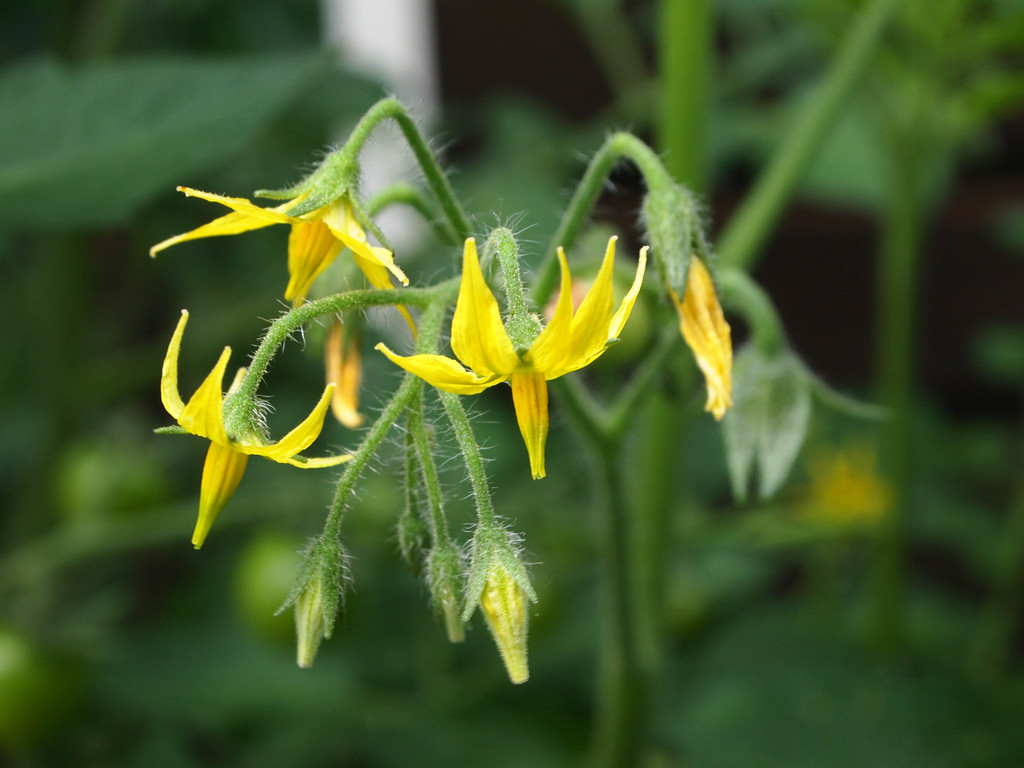
- iFlowers are buzz-pollinated: bumblebees vibrate them to release pollen
- iiGlandular hairs on stems release the distinctive 'tomato' smell and trap small insects
- iiiFruit ripening is triggered by the plant hormone ethylene
- ivStems lying on soil sprout roots along their length
At the table
Eatenfruit (raw, cooked, dried)
Ripe fruit is safe. Leaves and stems contain tomatine and other glycoalkaloids and are mildly toxic, especially to pets; green fruit has small amounts that are usually harmless when cooked.
In the medicine cabinet
| Tradition | Use |
|---|---|
| Mesoamerican folk medicine | Fruit and leaves applied to skin infections and sore throats |
| Modern nutrition science | Lycopene from cooked tomatoes studied for prostate and cardiovascular health, with mixed results |
Weight of evidence
Traditional. Long historical use; little or no modern clinical evidence.
Active compounds
lycopene, β-carotene, tomatine (leaves, green fruit), naringenin chalcone
Fruit & seed

Fruit
Berry
Ripens: Summer to autumn (year-round under cover)
Juicy berry 1–15 cm, round, oval, plum- or heart-shaped; red, yellow, orange, pink, green-striped or near-black; fleshy walls around gel-filled seed chambers.


Seed
~3 mm
Flat, round to kidney-shaped, pale tan to buff seeds about 3 mm across, covered in fine silky hairs and coated in jelly in the fruit
- Dispersal
- Birds, tortoises (in the Galápagos) and mammals
- Germination
- Sow 0.5 cm deep at 20–28 °C; sprouts in 5–10 days. Ferment saved seed in its jelly for 2–3 days, then rinse and dry
Photographs from Wikimedia Commons under open licences; hover for the photographer, click for the file.
How to grow it
Hardiness (USDA zones)
Annual warm-season crop; frost-tender perennial in USDA 10–12. Survives winters down to about -1 °C.
- Light
- Full sun (6–8+ hours)
- Water
- Moderate, steady; irregular watering causes splitting and blossom-end rot
- Soil
- Rich, well-drained loam, pH 6–7
- Propagation
- Seed; side-shoot cuttings root in water
- To harvest
- 60–100 days from transplanting
- Climates
- Temperate (summer), Mediterranean, Subtropical, Tropical highland
- 1Sow indoors 6–8 weeks before the last frost; pot on seedlings when they have true leaves.
- 2After frost, harden off and plant deeply — bury the stem up to the first leaves, as it will root along its length.
- 3Stake or cage plants; on cordon (indeterminate) varieties, pinch out side shoots in leaf axils.
- 4Water deeply at the base and mulch to keep moisture even; feed with a high-potassium fertiliser once fruit sets.
- 5Pick when fully coloured; at season's end, ripen green fruit indoors in a bag with a banana.
Can it grow where you are?
Where it lives
Recorded sightings
—
geo-referenced records in GBIF, from museums, herbaria and field observers.
Native range
Wild ancestor (Solanum pimpinellifolium) in coastal Ecuador and Peru; domesticated in Mesoamerica; grown worldwide
Drag the globe to turn it. Dots are where records exist, not a range map; darker means more records.
In Gerard's Herball, 1597

Second Booke · Chap. 55 · p. 275 · read the page →
Of apples of Loue.
John Gerard, The Herball, or Generall Historie of Plantes, London, 1597. What England's best-known herbal said of tomato, in its own spelling.
- The vertues
- In Spaine and those hot regions they vse to eate the apples prepared and boiled with pepper, salt, and oile: but they yeelde very little nourishment to the bodie, and the same naught and corrupt. Likewise they do eate the apples with oile, vineger and pepper mixed together for sauce to their meate, euen as we in these cold countries do mustarde.
- The place
- Apples of Loue do growe in Spaine, Italie, and such hot countries, from whence my selfe haue receiued seedes for my garden, where they do increase and prosper.
- The time
- It is sowen in the beginning of Aprill in a bed of hot horse dung after the maner of muske Melons and such like colde fruits.
- The temperature
- The golden Apple with the whole herbe it selfe is colde, yet not fully so colde as Mandrake, after the opinion of Dodonaeus: but in my iudgement it is very colde, yea perhaps in the highest degree of coldnesse: my reason is, bicause I haue in the hottest time of sommer cut away the superfluous braun…
- The names
- The apple of Loue is called in Latine Pomum Aureum, Poma Amoris, and Lycopersium, of some Glaucium: in English apples of Loue, and golden apples: in French Pommes d'amours: howbeit there be other golden apples whereof the poets do fable growing in the gardens of the daughters of Hesperus, which a dragon was appointed to keepe, who, as they fable, was killed by Hercules.
Gerard wrote within Galenic humoral medicine, and his opinions, including about the peoples of the Americas and their crops, are those of 1590s London. His “vertues” are history, not advice. Transcription: Source Library (CC BY-SA 4.0). The whole chapter in the Herball Room.
In the old herbals & bestiaries
Woodcuts and engravings matched from the Source Library’s scanned books by name. Plates marked “relative” show a close kin rather than this exact species. Click a plate to read the page it came from, with translation.

Hortus Eystettensis
Basilius Besler · 1640 · p.341

Hortus Eystettensis
Basilius Besler · 1640 · p.342

Six Groups of the History of Plants
Rembert Dodoens · 1583 · p.476

Treasury of Medical Matters of New Spain
Francisco Hernández · 1651 · p.342

The Book of Household Management
Mrs Isabella Beeton · 1861 · p.306

The Book of Household Management
Mrs Isabella Beeton · 1861 · p.664
In the stacks
Searching the stacks…
Every page naming Solanum lycopersicum in the Biodiversity Heritage Library →
Marginalia
The Italian herbalist Pietro Andrea Mattioli called it 'pomi d'oro' (golden apples) in 1544, and Europeans grew it as an ornamental for decades fearing it was poisonous. The Spanish town of Buñol throws well over 100 tonnes of tomatoes each August at La Tomatina.
Curiosity
In 1893 the US Supreme Court ruled (Nix v. Hedden) that the tomato is legally a vegetable, though botanically a fruit.
Kinship

Fact-checked: 1 correction made to this sheet. Photographs: iNaturalist contributors under the licences shown. Records: GBIF.org. Historical plates: Source Library (CC BY-SA 4.0; originals public domain). Summary text: Nature Library editors and Wikipedia (CC BY-SA). Medicinal and edibility notes are historical and educational, not advice. iNaturalist taxon 51737.