 NL·0178
Herbarium of the Nature Library
- Name
- Amanita muscaria
- Family
- Amanitaceae
- Native to
- Temperate and boreal Northern Hemisphere; introduced with pine plantations to Australia, New Zealand, South Africa and South America
- Habitat
- Boreal forest, Temperate forest, Birch woodland, Conifer plantation
Fly agaric
Amanita muscaria
Also calledFliegenpilz (German) · Mukhomor (Russian) · Beni-tengu-take (Japanese) · Amanite tue-mouches (French) · Ovolo malefico (Italian)
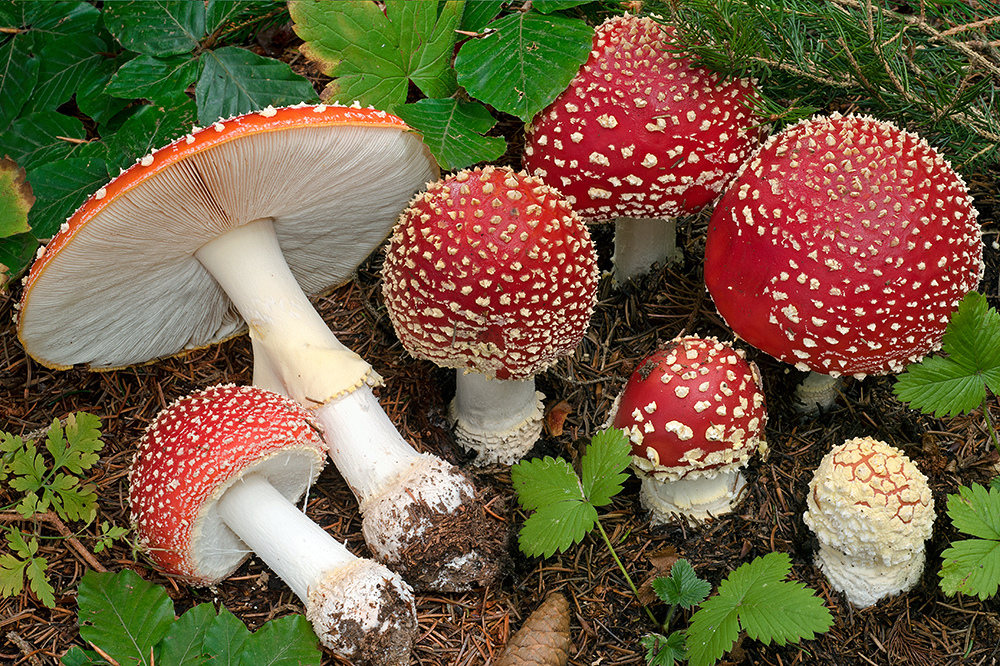
The red-capped, white-spotted toadstool of fairy tales. It is a mycorrhizal partner of birch, pine and spruce, and it carries the psychoactive, poisonous compounds ibotenic acid and muscimol.
Amanita muscaria, commonly known as the fly agaric or fly amanita or simply red toadstool, is a basidiomycete fungus of the genus Amanita. Its name may come from its historical use to kill flies or from the effects it causes. It is a distinctive, large, white-gilled mushroom typically featuring a bright red cap covered with white warts. The complex genetic diversity of A. muscaria suggests that it is a species complex. It is a widely distributed mushroom native to temperate and boreal forests of the Northern Hemisphere, now also naturalised in the Southern Hemisphere, forming symbiotic relationships with various trees and spreading invasively in some regions. Wikipedia
What it can do
- iForms ectomycorrhizal partnerships with birch, pine, spruce and fir, trading soil nutrients for tree sugars
- iiProduces ibotenic acid, which converts to the more potent muscimol when dried
- iiiIts white 'warts' are fragments of the universal veil that wrapped the young button
- ivSpread around the Southern Hemisphere on the roots of plantation pines
At the table
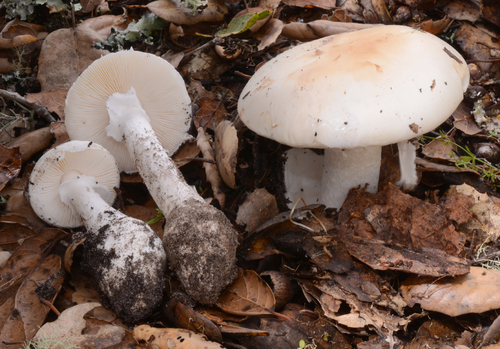
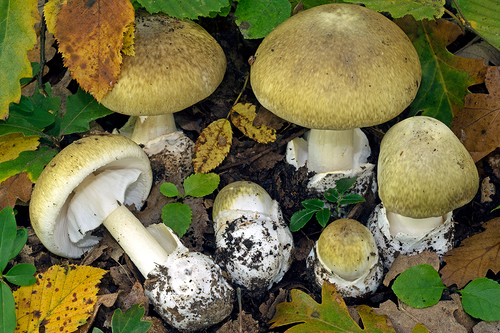
Poisonous. Ibotenic acid and muscimol cause vomiting, confusion, delirium, muscle twitching and deep sleep. Deaths are rare but have been recorded. Some regions eat it after prolonged parboiling, but this is risky and not recommended. Young white buttons can be confused with deadly Amanita species and with puffballs.
Fruiting body & spores
Spores
Spores (not seeds): spore print white; spores broadly ellipsoid, smooth, inamyloid, about 9–13 × 6.5–9 µm
- Dispersal
- Wind-borne basidiospores shed from the free white gills
Where it lives
Recorded sightings
—
geo-referenced records in GBIF, from museums, herbaria and field observers.
Native range
Temperate and boreal Northern Hemisphere; introduced with pine plantations to Australia, New Zealand, South Africa and South America
Drag the globe to turn it. Dots are where records exist, not a range map; darker means more records.
In the old herbals & bestiaries
Woodcuts and engravings matched from the Source Library’s scanned books by name. Plates marked “relative” show a close kin rather than this exact species. Click a plate to read the page it came from, with translation.

An History of Fungusses, growing about Halifax (Vols 1-2)
James Bolton · 1788 · p.236

Illustrations of Fungi which Grow in Bavaria and the Palatinate around Ratisbon, Vols 1–2
Jacob Christian Schaeffer; C.H. Persoon (ed.) · 1800 · p.141

Rariorum Plantarum Historia (with Fungorum Historia)
Carolus Clusius · 1601 · p.662

Histoire des Champignons de la France, Vol 2
Pierre Bulliard · 1791 · p.127

Les champignons de la France : histoire, description, culture, usages des espèces comestibles, vénéneuses, suspectes, employés dans les arts, l'industrie, l'économie domestique et la médecine
Cordier, François Simon · n.d. · p.527

History of Rare Plants
Carolus Clusius · 1601 · p.656

Herbarium Portatile, Oder Behendes Kräuter- und Gewächs-Buch: Darinn nicht allein 1363. so wol Einheimische als Außländndische Kräuter mit Lateinisch und Deutscher Benennung abgebildet, sondern auch die meisten, so in der Medicin gebräuchlich, kürtzlich erkläret werden
Panckow, Thomas · 1656 · p.40
In the stacks
Searching the stacks…
Every page naming Amanita muscaria in the Biodiversity Heritage Library →
Marginalia
Siberian peoples such as the Koryak used it ritually. R. Gordon Wasson's 1968 book 'Soma: Divine Mushroom of Immortality' proposed it as the Soma of the Rig Veda. The name 'fly agaric' comes from the old European practice of crumbling it into milk to stupefy flies.
Curiosity
Muscimol passes into urine largely unchanged. Accounts from Siberia describe people drinking the urine of someone who had eaten the mushroom to get the effect a second time.
Kinship

Photographs: iNaturalist contributors under the licences shown. Records: GBIF.org. Historical plates: Source Library (CC BY-SA 4.0; originals public domain). Summary text: Nature Library editors and Wikipedia (CC BY-SA). Medicinal and edibility notes are historical and educational, not advice. iNaturalist taxon 48715.