 NL·0180
Herbarium of the Nature Library
- Name
- Amanita phalloides
- Family
- Amanitaceae
- Native to
- Europe; introduced to North America (notably California and the Pacific Northwest), Australia, southern Africa and South America
- Habitat
- Temperate forest, Oak woodland, Urban parks
Death cap
Amanita phalloides
Also calledGrüner Knollenblätterpilz (German) · Amanite phalloïde (French) · Oronja verde (Spanish) · Tignosa verdognola (Italian)
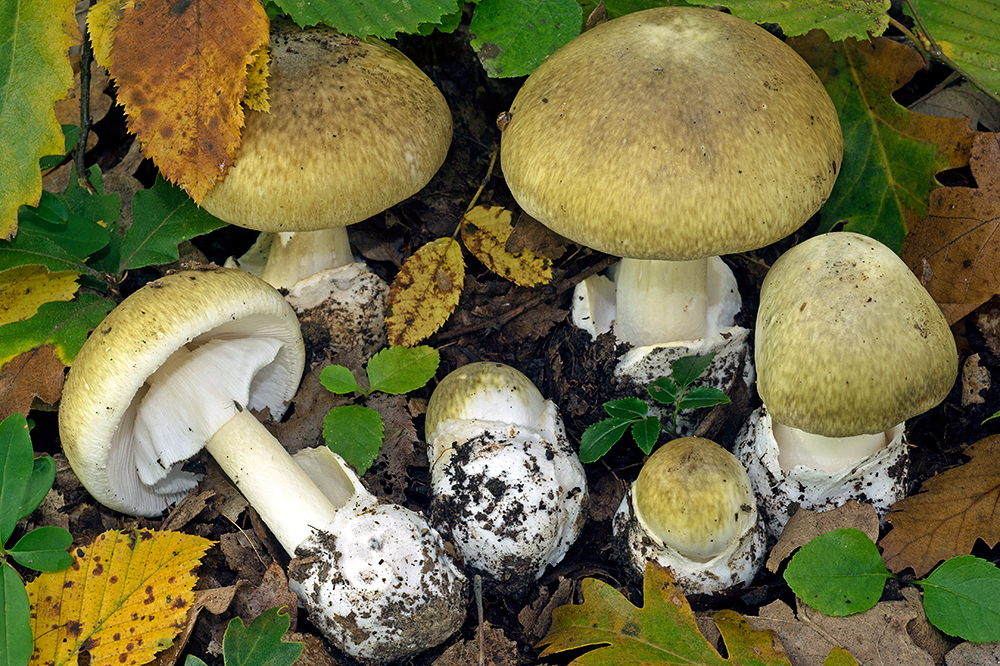
The world's deadliest mushroom, responsible for most fatal mushroom poisonings. Half a cap can kill an adult. It has an olive-green cap, white gills, a skirt-like ring and a sac-like volva at the base, and is reported to taste pleasant.
Amanita phalloides, commonly known as the death cap, is a deadly poisonous basidiomycete fungus and mushroom, one of many in the genus Amanita. Originating in Europe but later introduced to other parts of the world since the late twentieth century, A. phalloides forms ectomycorrhizae with various broadleaved trees. In some cases, the death cap has been introduced to new regions with the cultivation of non-native species of oak, chestnut, and pine. The large fruiting bodies appear in summer and autumn; the caps are generally greenish in colour with a white stipe and gills. The cap colour is variable, including white forms, and is thus not a reliable identifier. Wikipedia
What it can do
- iProduces amatoxins (chiefly α-amanitin), which block RNA polymerase II and destroy liver cells
- iiIts toxins survive cooking, drying and freezing
- iiiSymptoms are delayed 6–12 hours and are followed by a deceptive 'honeymoon' remission before liver failure
- ivHas spread to new continents as a mycorrhizal hitchhiker on imported oak and chestnut roots
At the table
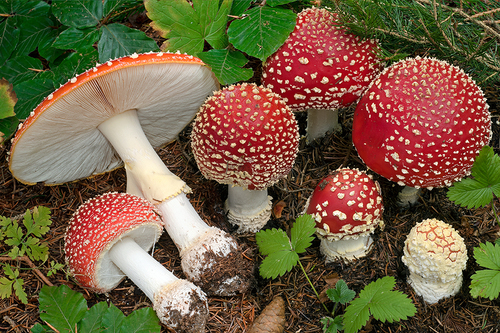
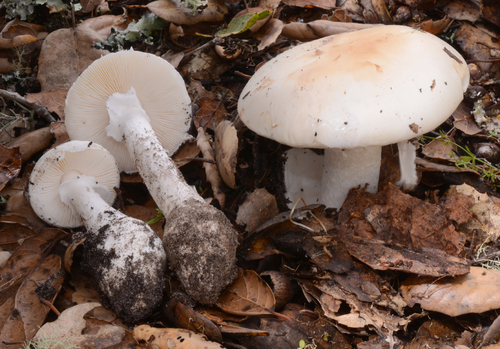
Deadly. No part is safe, and cooking does not destroy the amatoxins. Victims have mistaken it for edible paddy-straw mushrooms (Volvariella volvacea), Asian Amanita species, field mushrooms (Agaricus), green Russula and young puffballs. Suspected ingestion is a medical emergency, even if the person feels well.
Fruiting body & spores
Spores
Spore print white; spores globose to subglobose, smooth, amyloid, about 8–10.5 × 7–9 µm
- Dispersal
- Wind-borne basidiospores; also spread as mycorrhizae on transplanted tree roots
Where it lives
Recorded sightings
—
geo-referenced records in GBIF, from museums, herbaria and field observers.
Native range
Europe; introduced to North America (notably California and the Pacific Northwest), Australia, southern Africa and South America
Drag the globe to turn it. Dots are where records exist, not a range map; darker means more records.
In the old herbals & bestiaries
Woodcuts and engravings matched from the Source Library’s scanned books by name. Plates marked “relative” show a close kin rather than this exact species. Click a plate to read the page it came from, with translation.

In the stacks
Searching the stacks…
Every page naming Amanita phalloides in the Biodiversity Heritage Library →
Marginalia
Ancient historians wrote that the Roman emperor Claudius died in 54 CE after Agrippina served him poisoned mushrooms. A death cap is often suggested as the culprit, though this is speculation. Voltaire wrote that a dish of mushrooms killed the Holy Roman Emperor Charles VI in 1740 and so changed the course of Europe.
Curiosity
The deadly amanitin is so specific in blocking gene transcription that molecular biologists use it as a laboratory tool.
Kinship

Fact-checked: 1 correction made to this sheet. Photographs: iNaturalist contributors under the licences shown. Records: GBIF.org. Historical plates: Source Library (CC BY-SA 4.0; originals public domain). Summary text: Nature Library editors and Wikipedia (CC BY-SA). Medicinal and edibility notes are historical and educational, not advice. iNaturalist taxon 52135.