 NL·0397
Herbarium of the Nature Library
- Name
- Anopheles gambiae
- Family
- Culicidae
- Native to
- Sub-Saharan Africa
- Habitat
- Savanna, Farmland, Villages, Wetlands
African malaria mosquito
Anopheles gambiae
Also calledMbu (Swahili) · Moustique anophèle (French) · Sauro (Hausa, mosquitoes generally)
A small mosquito that is one of the deadliest animals on Earth because its females transmit the malaria parasite Plasmodium falciparum. Malaria still kills around 600,000 people a year, most of them children in sub-Saharan Africa.
The Anopheles gambiae complex consists of at least seven morphologically indistinguishable species of mosquitoes in the genus Anopheles. The complex was recognised in the 1960s and includes the most important vectors of malaria in sub-Saharan Africa, particularly of the most dangerous malaria parasite, Plasmodium falciparum. It is one of the most efficient malaria vectors known. The An. gambiae mosquito additionally transmits Wuchereria bancrofti which causes lymphatic filariasis, a symptom of which is elephantiasis. Wikipedia
What it can do
- iFemales strongly prefer human blood and bite mainly at night, often indoors
- iiLarvae develop in small, sunlit, temporary pools such as puddles and hoofprints, in about a week
- iiiTransmits Plasmodium falciparum, the most lethal malaria parasite
- ivSome populations have evolved resistance to the insecticides on bed nets
In the field
Field marks
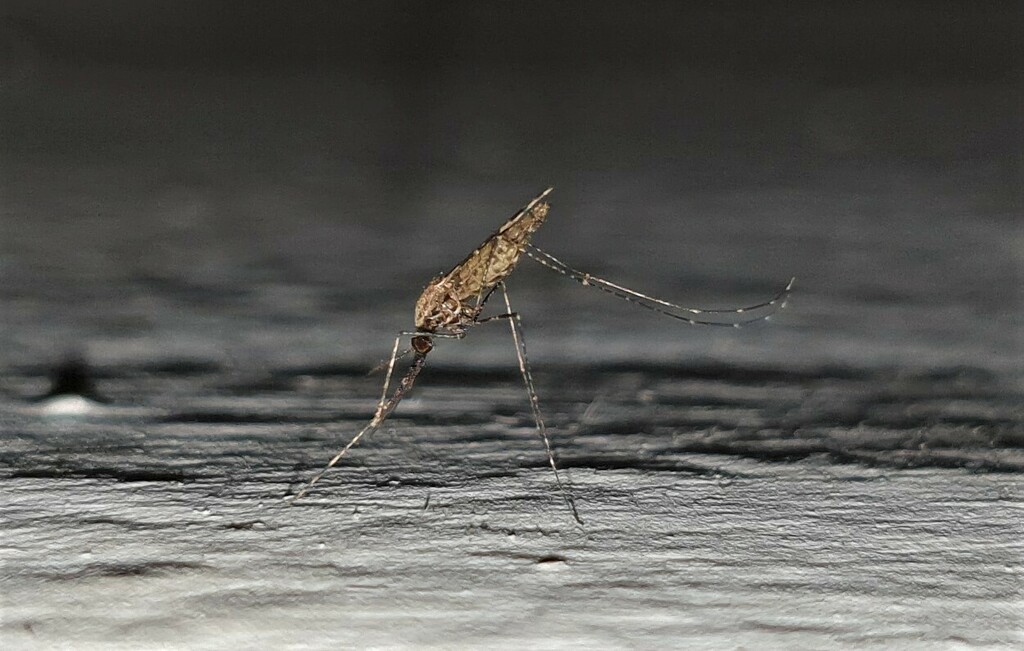
- aRests with body angled steeply to the surface, proboscis and body in a straight line
- bWings spotted with pale and dark scales
- cFemale palps as long as the proboscis
- dLarvae lie flat beneath the water surface (no breathing siphon)
- Not to be confused with
- Anopheles coluzzii and A. arabiensis are sibling species that look identical and are told apart only by DNA. Culex mosquitoes rest with the body parallel to the surface and have unspotted wings.
- Where to see it
- Villages and farmland across tropical Africa, especially in the rainy season.
- When
- Peaks in the rainy season when temporary pools form
Listen
Looking for field recordings…
Life & habits
- Diet
- Females take blood (mainly human) to develop eggs; both sexes drink nectar and plant juices
- Habitat
- Near people in rural and peri-urban Africa; larvae in shallow, sunny standing water
- Size
- About 4–5 mm
- Lifespan
- Adult females about 2–4 weeks
Males gather in dusk swarms over landmarks, and females fly into the swarm to mate once.
Where it lives
Recorded sightings
—
geo-referenced records in GBIF, from museums, herbaria and field observers.
Native range
Sub-Saharan Africa
Drag the globe to turn it. Dots are where records exist, not a range map; darker means more records.
In the old herbals & bestiaries
No plate in the Source Library names this exact species, so these show its closest relatives as the old naturalists drew them: same genus, or the same kind of animal. Click a plate to read the page it came from, with translation.

In the stacks
Searching the stacks…
Every page naming Anopheles gambiae in the Biodiversity Heritage Library →
Marginalia
Ronald Ross showed in 1897 that Anopheles mosquitoes carry malaria, winning a Nobel Prize in 1902. A member of the A. gambiae complex that invaded north-eastern Brazil in 1930 was eradicated by a campaign led by Fred Soper by 1940.
Curiosity
In 2018 a gene drive targeting the doublesex gene crashed caged populations of A. gambiae to zero within 7–11 generations.
Kinship




Photographs: iNaturalist contributors under the licences shown. Records: GBIF.org. Historical plates: Source Library (CC BY-SA 4.0; originals public domain). Summary text: Nature Library editors and Wikipedia (CC BY-SA). Medicinal and edibility notes are historical and educational, not advice. iNaturalist taxon 650010.