 NL·0303
Herbarium of the Nature Library
- Name
- Hottentotta tamulus
- Family
- Buthidae
- Native to
- India, Pakistan and eastern Nepal
- Habitat
- Dry scrub, Farmland, Villages
Indian red scorpion
Hottentotta tamulus
Also calledBichhu (Hindi/Urdu) · Vinchu (Marathi) · Thel (Tamil)
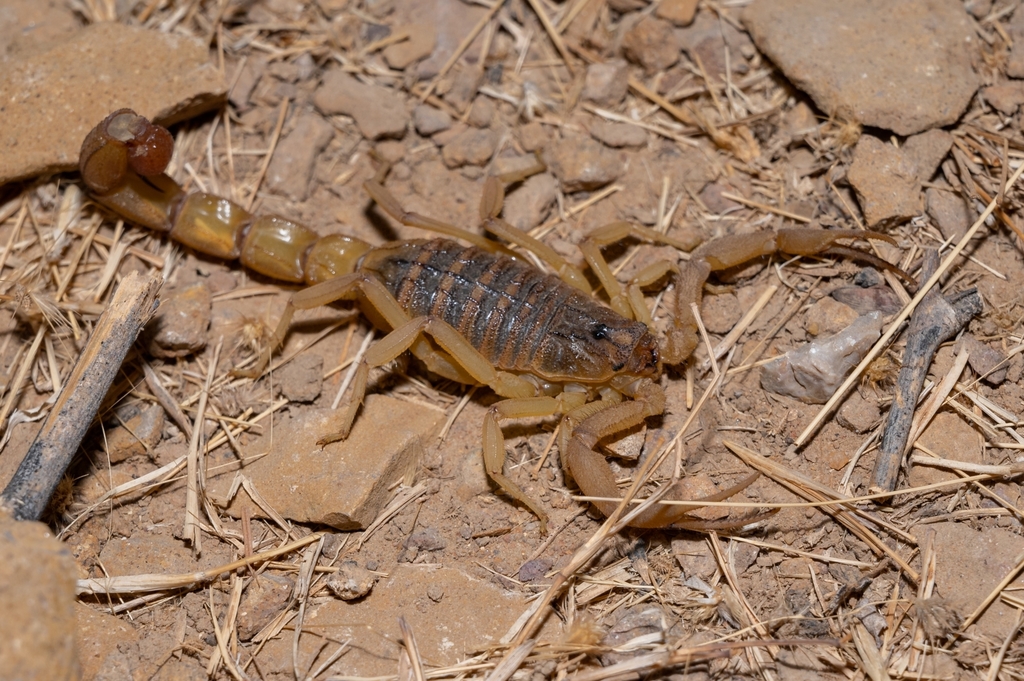
A reddish-brown scorpion of rural India and Pakistan, often described as the most lethal scorpion in the world. Its venom triggers a storm in the nervous system that damages the heart and lungs, but cheap treatment with the drug prazosin has made deaths far rarer.
Hottentotta tamulus, the Indian red scorpion, also known as the eastern Indian scorpion, is a species of scorpion of the family Buthidae. It occurs in most of India, eastern Pakistan and the eastern lowlands of Nepal, and recently from Sri Lanka. Wikipedia
What it can do
- iVenom causes a massive release of adrenaline-like hormones (autonomic storm)
- iiStings can cause high blood pressure, heart failure and fluid on the lungs
- iiiThrives around village houses, cattle sheds and stone walls
In the field
Field marks
- aReddish- to orange-brown body
- bRelatively slender pincers
- cThick, segmented tail with prominent ridges
- dDark-grey keels on the back of the abdomen
- Not to be confused with
- Giant forest scorpions (Heterometrus) are larger, shiny black with massive pincers and much weaker venom. Other Hottentotta and Lychas species are smaller or differently patterned.
- Where to see it
- Rural areas of Maharashtra, Gujarat, Tamil Nadu and Andhra Pradesh; most stings occur in the hot season and monsoon.
- When
- Year-round; most encountered in summer and monsoon
Life & habits
- Diet
- Insects and other small invertebrates
- Habitat
- Rubble, crevices in mud and stone walls, under stones, and inside village houses
- Size
- About 5–9 cm
It hunts at night and often hides in shoes, clothing and bedding, where most human stings happen.
Where it lives
Recorded sightings
—
geo-referenced records in GBIF, from museums, herbaria and field observers.
Native range
India, Pakistan and eastern Nepal
Drag the globe to turn it. Dots are where records exist, not a range map; darker means more records.
In the old herbals & bestiaries
No plate in the Source Library names this exact species, so these show its closest relatives as the old naturalists drew them: same genus, or the same kind of animal. Click a plate to read the page it came from, with translation.

Florentine Codex, Vol. 3 (Books 10-12)
Relative · Bernardino de Sahagún · 1577 · p.501

Garden of Health (Hortus Sanitatis)
Relative · Jacob Meydenbach · 1491 · p.539

History of Animals, Book II: On Oviparous Quadrupeds
Relative · Conrad Gessner · 1586 · p.453

The History of the Holy Grail
Relative · 1523 · p.163

Physiologia Kircheriana Experimentalis
Relative · Athanasius Kircher · 1680 · p.60

Commentaries on the Six Books of Dioscorides
Relative · Pietro Andrea Mattioli · 1560 · p.307

Commentaries on the Six Books of Dioscorides on Medical Matter
Relative · Pietro Andrea Mattioli · 1563 · p.292

Commentaries on the Six Books of Pedanius Dioscorides on Medical Matter
Relative · Pietro Andrea Mattioli · 1565 · p.490

History of Animals, Book II: On Oviparous Quadrupeds
Relative · Conrad Gessner · 1586 · p.454

Phytognomonica
Relative · Giambattista della Porta · 1588 · p.162
In the stacks
Searching the stacks…
Every page naming Hottentotta tamulus in the Biodiversity Heritage Library →
Marginalia
The rural Maharashtra physician Himmatrao Bawaskar showed from the 1980s that prazosin, a blood-pressure drug, counteracts the venom; in his patient series, death rates fell from around 30–40% to under 1%.
Curiosity
Children are at greatest risk, because the same dose of venom is far more concentrated in a small body.
Kinship




Photographs: iNaturalist contributors under the licences shown. Records: GBIF.org. Historical plates: Source Library (CC BY-SA 4.0; originals public domain). Summary text: Nature Library editors and Wikipedia (CC BY-SA). Medicinal and edibility notes are historical and educational, not advice. iNaturalist taxon 508191.