 NL·0781
Herbarium of the Nature Library
- Name
- Vespa mandarinia
- Family
- Vespidae
- Native to
- East Asia: Japan, Korea, eastern and central China, Taiwan and the Russian Far East; briefly established in British Columbia and Washington State (2019–2021), declared eradicated from the US in 2024
- Habitat
- Temperate forest, Low mountains, Farmland edge
Northern giant hornet
Vespa mandarinia
Also calledAsian giant hornet (English) · Ōsuzumebachi (Japanese) · Jangsu-malbeol (Korean) · Jīnhuán húfēng (Chinese)
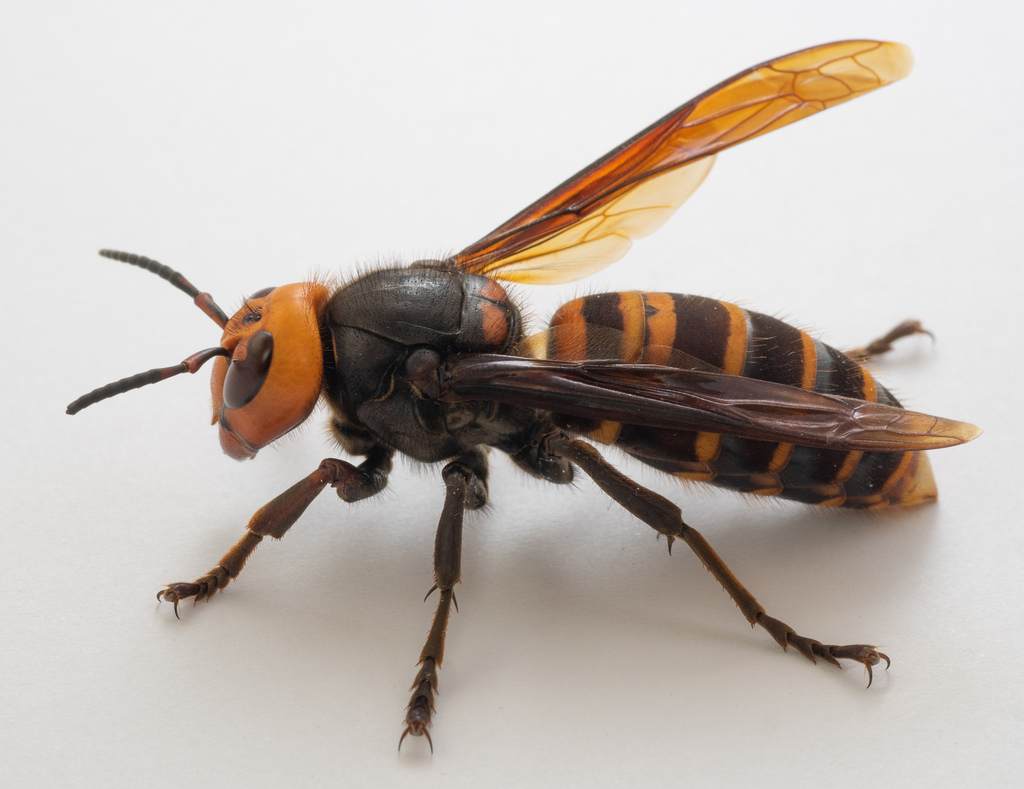
The world's largest hornet, with queens up to about 5 cm long and a 6 mm sting. A few dozen workers can wipe out a European honeybee colony in hours, but Japanese honeybees fight back by cooking scouts alive in a ball of vibrating bodies.
The Asian giant hornet, also known as the northern giant hornet, is the world's largest hornet. It is native to temperate and tropical East Asia, South Asia, mainland Southeast Asia, and parts of the Russian Far East. It was also briefly found in the Pacific Northwest of North America from late 2019 but was eradicated by December 2024. Wikipedia
What it can do
- iLargest hornet in the world
- iiWorkers mark a beehive with pheromone and attack in groups, decapitating thousands of bees
- iiiVenom contains a neurotoxin (mandaratoxin) and compounds that damage tissue; multiple stings can be fatal
- ivCan fly long distances, foraging several kilometres from the nest
In the field
Field marks
- aVery large size
- bBroad, bright orange-yellow head with large jaws
- cDark brown thorax
- dAbdomen banded dark brown and yellow-orange
- Not to be confused with
- European hornet (Vespa crabro) is smaller, with a reddish-brown head and a mostly yellow abdomen. Yellow-legged hornet (V. velutina) is dark with yellow legs. Southern giant hornet (V. soror) of southern China and Southeast Asia is very similar but darker. In North America, cicada killer wasps (Sphecius) and European hornets are commonly mistaken for it.
- Where to see it
- Forested hills and countryside in Japan and Korea; best viewed in museums or from a safe distance.
- When
- Queens fly in spring; workers abundant Jul–Oct
Listen
Looking for field recordings…
Life & habits
- Diet
- Adults drink tree sap and feed larvae with chewed insects, especially bees and other wasps; larvae give adults a nutritious liquid in return
- Habitat
- Low mountains and forest edges; nests underground in old rodent burrows or rotting root cavities
- Size
- Queens up to about 5 cm; workers about 3.5–4 cm; wingspan around 7 cm
- Lifespan
- Workers a few weeks to months; colonies last one season, with only mated queens overwintering
In late summer and autumn, workers enter a 'slaughter phase', killing a hive's adult bees and carrying off the brood to feed their own larvae.
Where it lives
Recorded sightings
—
geo-referenced records in GBIF, from museums, herbaria and field observers.
Native range
East Asia: Japan, Korea, eastern and central China, Taiwan and the Russian Far East; briefly established in British Columbia and Washington State (2019–2021), declared eradicated from the US in 2024
Drag the globe to turn it. Dots are where records exist, not a range map; darker means more records.
In the old herbals & bestiaries
No plate in the Source Library names this exact species, so these show its closest relatives as the old naturalists drew them: same genus, or the same kind of animal. Click a plate to read the page it came from, with translation.

In the stacks
Searching the stacks…
Every page naming Vespa mandarinia in the Biodiversity Heritage Library →
Marginalia
In Japan, hornet larvae are eaten in some mountain regions, and a sports drink (VAAM) launched in the 1990s was based on amino acids identified in the liquid larvae feed to adult hornets.
Curiosity
Japanese honeybees engulf a hornet scout in a ball of hundreds of bees and shiver their flight muscles, raising the temperature to about 46 °C, which kills the hornet but not the bees.
Kinship




Photographs: iNaturalist contributors under the licences shown. Records: GBIF.org. Historical plates: Source Library (CC BY-SA 4.0; originals public domain). Summary text: Nature Library editors and Wikipedia (CC BY-SA). Medicinal and edibility notes are historical and educational, not advice. iNaturalist taxon 322284.