 NL·0784
Herbarium of the Nature Library
- Name
- Crotalus adamanteus
- Family
- Viperidae
- Native to
- Southeastern United States coastal plain, from North Carolina to Florida and west to Louisiana
- Habitat
- Longleaf pine savanna, Scrub, Coastal islands, Palmetto flatwoods
Eastern diamondback rattlesnake
Crotalus adamanteus
Also calledDiamondback · Cascabel diamante (Spanish)
The largest rattlesnake and the heaviest venomous snake in the Americas, marked with a chain of cream-edged dark diamonds. It is a snake of the longleaf pine savannas of the southeastern US, where it often shelters in gopher tortoise burrows.
The eastern diamondback rattlesnake is a species of pit viper in the family Viperidae. The species is endemic to the Southeastern United States. It is the largest rattlesnake species and one of the heaviest venomous snakes in the Americas. No subspecies are recognized. Wikipedia
What it can do
- iHeat-sensing pits between eye and nostril let it 'see' warm-blooded prey in the dark
- iiIts rattle, built from interlocking keratin segments added with each shed, gives a loud buzzing warning
- iiiVenom destroys tissue and stops blood from clotting
- ivCan go months between meals
In the field
Field marks
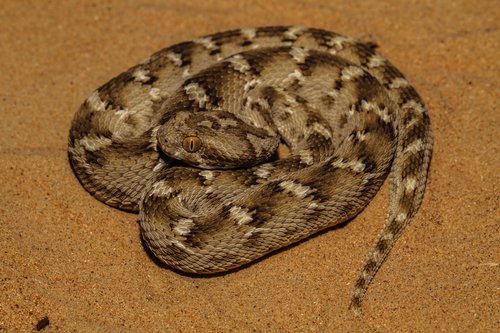
- aDark brown diamonds outlined with cream along the back, on an olive or brown body
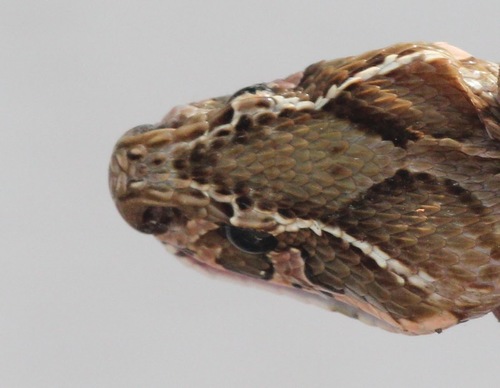
- bTwo pale diagonal lines on each side of the face, one running from in front of the eye and one behind it
- cRattle at the tip of a tail banded brown and grey
- dHeavy body, broad triangular head, heat pit and vertical pupils
- Not to be confused with
- The timber (canebrake) rattlesnake has dark chevron crossbands and an all-black tail. Harmless rat snakes, racers and hognose snakes may vibrate their tails in dry leaves to make a rattling sound, but they have no rattle and their pupils are round. The rattle, diamonds and pale facial lines identify the diamondback.
- Where to see it
- Longleaf pine forests of Florida and Georgia, such as Ocala National Forest, and coastal islands such as Little St Simons and Sapelo
- When
- Resident; most active in spring and autumn; mating takes place in late summer
Life & habits
- Diet
- Rabbits, rats, squirrels, birds
- Habitat
- Pine flatwoods, longleaf pine and wiregrass, sandhills, coastal dunes and barrier islands
- Size
- Typically 1–1.7 m; exceptionally ~2.4 m
- Lifespan
- ~10–20 years
An ambush hunter that waits beside rabbit trails for days, then strikes and follows the scent trail of the dying prey. A bite is a hospital emergency. Keep the person calm and the limb still at about heart level, remove rings and watches, and get them to a hospital for CroFab or Anavip antivenom. Do not use tourniquets, ice, cutting, suction or electric shock.
Where it lives
Recorded sightings
—
geo-referenced records in GBIF, from museums, herbaria and field observers.
Native range
Southeastern United States coastal plain, from North Carolina to Florida and west to Louisiana
Drag the globe to turn it. Dots are where records exist, not a range map; darker means more records.
In the old herbals & bestiaries
No plate in the Source Library names this exact species, so these show its closest relatives as the old naturalists drew them: same genus, or the same kind of animal. Click a plate to read the page it came from, with translation.

The natural history of Carolina, Florida, and the Bahama Islands : containing two hundred a...
Relative · Catesby, Mark, bioloog, kunstenaar · 1743 · p.132

Museum of the Royal Society
Relative · Nehemiah Grew · 1681 · p.468

Florentine Codex, Vol. 3 (Books 10-12)
Relative · Bernardino de Sahagún · 1577 · p.488

Jan Jonston — Naeukeurige beschryving van de natuur der viervoetige dieren (1660)
Relative · Jan Jonston · 1660 · p.565

Mark Catesby — Piscium, serpentum, insectorum (pt. 1) (1750)
Relative · Mark Catesby · 1750 · p.130

Historia naturalis Brasiliae
Relative · Willem Piso / Georg Marcgraf · 1648 · p.385

Thesaurus of Medical Things of New Spain, or History of Mexican Plants, Animals, and Minerals
Relative · Francisco Hernández; Nardo Antonio Recchi (ed.) · 1651 · p.357

De Indiae utriusque re naturali et medica
Relative · Willem Piso · 1658 · p.304

The Natural History of Carolina Florida and Bahama Islands Vol. 2
Relative · Mark Catesby · 1743 · p.130

Georg Wolfgang Knorr — Deliciae naturae selectae (1771)
Relative · Georg Wolfgang Knorr · 1771 · p.384
In the stacks
Searching the stacks…
Every page naming Crotalus adamanteus in the Biodiversity Heritage Library →
Marginalia
In 1775 Benjamin Franklin, writing as 'An American Guesser', proposed the rattlesnake as a symbol of the colonies because it gives warning before it strikes. The coiled rattler on the Gadsden flag ('Don't Tread on Me') dates from the same period.
Curiosity
Rattlesnake roundups, where snakes are gassed out of gopher tortoise burrows and killed, have long threatened this species; Georgia's Claxton roundup was converted to a wildlife festival in 2012.
Kinship



Photographs: iNaturalist contributors under the licences shown. Records: GBIF.org. Historical plates: Source Library (CC BY-SA 4.0; originals public domain). Summary text: Nature Library editors and Wikipedia (CC BY-SA). Medicinal and edibility notes are historical and educational, not advice. iNaturalist taxon 53491.